Pulse24 Original
Deere's Construction Equipment Sales Jumped 18% on 'Data Center Starts.' Its Farm Machinery Business Fell 6% in the Same Quarter.
August 21, 2026
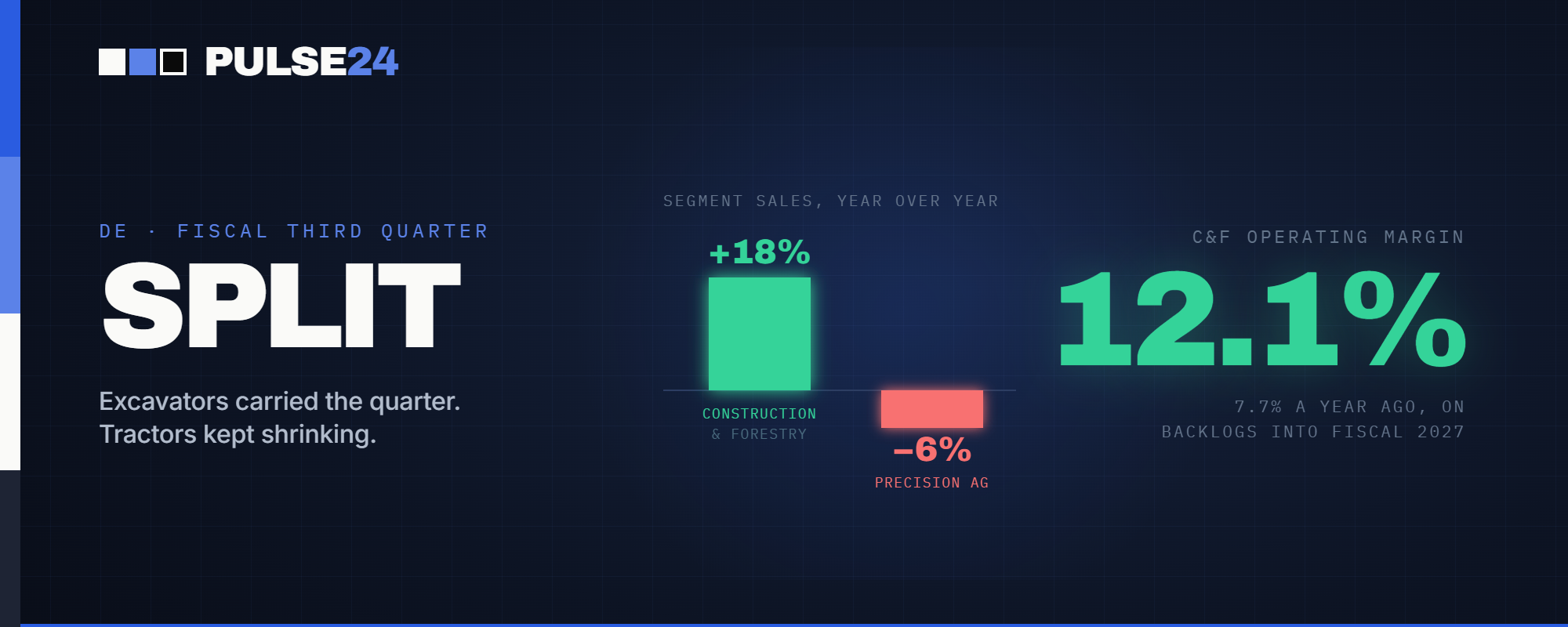
Deere's construction and forestry segment grew sales 18% last quarter, and executives pointed straight at data center construction as the driver. Meanwhile the company's core farm equipment business kept shrinking, a split that says as much about the AI buildout as it does about the American farm belt.
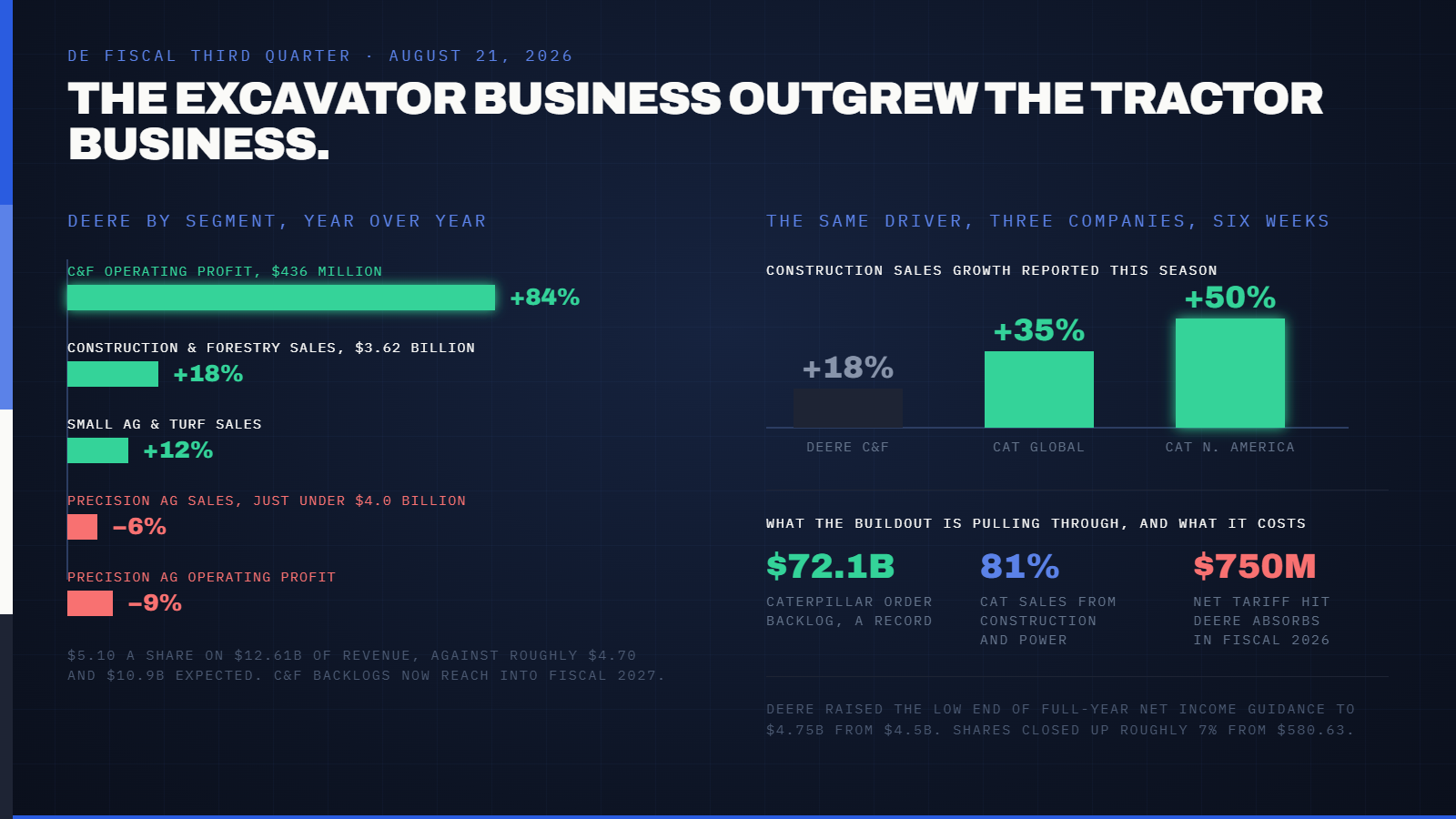
Deere pulled in $5.10 a share last quarter, more than a dollar ahead of what Wall Street had penciled in, and the number that mattered most wasn't the beat itself. It was where the growth came from. Construction and Forestry, the segment that sells excavators, dozers and graders rather than tractors, grew sales 18% to $3.62 billion. Housing starts and highway budgets don't explain that jump. Deere's own commentary pointed to large infrastructure projects, data center starts and energy-related work, the same language equipment makers up and down the industry have started using to explain why their order books look nothing like their farm-equipment neighbors'.
What Actually Changed
The fiscal third quarter, reported Thursday, split Deere's business in two. Production and Precision Ag, the unit that sells the big row-crop tractors and combines that most people picture when they hear the company's name, fell 6% to just under $4.0 billion in net sales, with operating profit down 9%. Small Ag and Turf grew a healthier 12%. But Construction and Forestry carried the entire report. Operating profit in that segment jumped 84% to $436 million, and margin nearly doubled to 12.1% from 7.7% a year earlier. Deere said backlogs in the segment now stretch into fiscal 2027, evidence that the order flow isn't a one-quarter blip tied to a handful of projects breaking ground at once.
Why It Matters
Deere isn't the first heavy-equipment maker to report this pattern this earnings season. Caterpillar posted its own numbers three weeks earlier, on August 4, and the story was nearly identical at a larger scale. Revenue jumped 24% to $20.54 billion, adjusted profit of $8.17 a share blew past the roughly $6.20 analysts expected, and construction sales alone grew 35%, with North America up 50%. Combined with its power and energy segment, those two businesses now make up 81% of everything Caterpillar sells. Cummins reported a similar dynamic in its own engine business around the same time. Three separate heavy-machinery and engine makers, reporting in the same six-week window, all point to the same underlying driver: the physical construction phase of the AI buildout, the concrete, steel, generators and earthmoving needed before a single chip goes into a rack, is now large enough to move a $100 billion industrial company's income statement.
That distinction matters for anyone trying to size up how real the AI infrastructure spending cycle actually is. A recent report found nine of the largest tech companies are carrying roughly $3 trillion in AI-related financial commitments that don't show up cleanly on their balance sheets, a structure that has made investors nervous about how the buildout gets paid for. Deere and Caterpillar sit on a different part of that chain. They aren't financing data centers. They're selling the machines that clear the ground and pour the foundations, on backlogs measured in firm orders rather than pledges, and getting paid for it now rather than waiting on a financing structure to hold together.
The Farm Belt Side of the Ledger
The other half of Deere's report is a reminder that not every part of the industrial economy is riding the same wave. Production and Precision Ag has now been soft for three straight fiscal years, and tariffs are adding a direct cost on top of weak commodity prices. Deere is absorbing roughly $1.1 billion in direct tariff expense this fiscal year, a net hit of about $750 million after refunds, and projects that cost will grow to roughly $1.0 billion in fiscal 2027. That is a different tariff story than the one Target told last week, when a one-time tariff refund added $1.65 of the $2.40-a-share increase to its own profit forecast. Deere is paying tariffs as an ongoing cost of doing business, not collecting a one-time credit, and its farm customers are the ones ultimately absorbing higher input costs alongside soft grain and soybean prices.
What to Watch Next
Watch whether the construction strength broadens beyond a handful of large equipment makers into the smaller suppliers and dealers that feed them, which would suggest the data-center buildout's physical footprint is still expanding rather than concentrating in a few markets. Watch Deere's backlog commentary next quarter for whether fiscal 2027 orders keep growing or plateau, since that backlog is the clearest signal available on how durable this demand actually is. And watch whether Production and Precision Ag finds a floor. Row-crop farmers have absorbed three years of soft prices and rising tariff-driven input costs, and at some point that pressure either eases with a farm-focused policy response or starts showing up in credit stress across the farm belt the way it already has in parts of commercial real estate.
The Pulse24 Take
The easy read on Deere's quarter is that a tractor company had a good three months. The more useful read is that Deere just became the latest data point in a pattern that spans three different heavy-industrial companies reporting in the same six-week window, all describing the same driver in almost the same language. That kind of alignment across separate companies is hard to write off as coincidence. It says the AI buildout has moved past the financing-headline stage and into the phase where cement trucks and excavators show up on-site, and that phase is now big enough to swing a century-old farm equipment maker's earnings more than its actual farm business does. It also means the AI trade's health can no longer be judged only by chip demand or power-utility stock prices. Watch what the machine makers are shipping. Right now they're saying the buildout is still accelerating, even as the segment of the economy Deere was built to serve keeps shrinking.
How we read the data
Curious how we get from raw data to a take like this? Our Trader's Toolkit walks through the tools we lean on.
Explore the Toolkit