Pulse24 Original
A Former Bank of Japan Official Now Puts October Hike Odds at 20% to 30%. The Yen Already Noticed.
October 1, 2026
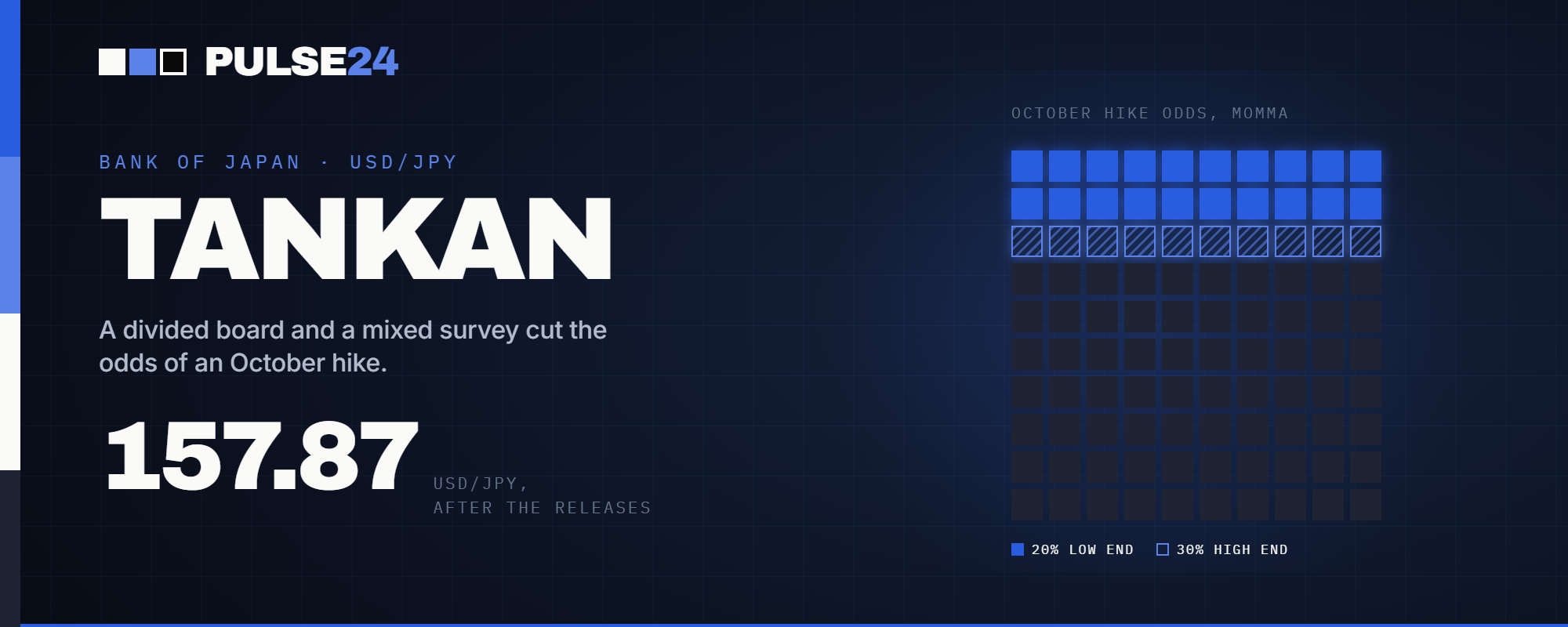
The Bank of Japan's own policy committee is more divided than markets assumed. A fresh batch of internal opinions and a mixed Tankan survey released Thursday cut the odds of an October rate hike, and the yen moved first.
Hideo Momma, a former Bank of Japan executive director, now puts the odds of an October rate hike at 20% to 30%, a marked step down from the live possibility several economists had been pencilling in just days earlier. The shift followed two releases on Thursday: the central bank's quarterly Tankan survey and its Summary of Opinions from the September meeting, the one that took the policy rate to 1.25%, its highest level since 1995.
Together, the releases showed a board more divided on timing than markets had assumed, and that division is what moved the yen Thursday, not the prospect of another hike.
What Changed
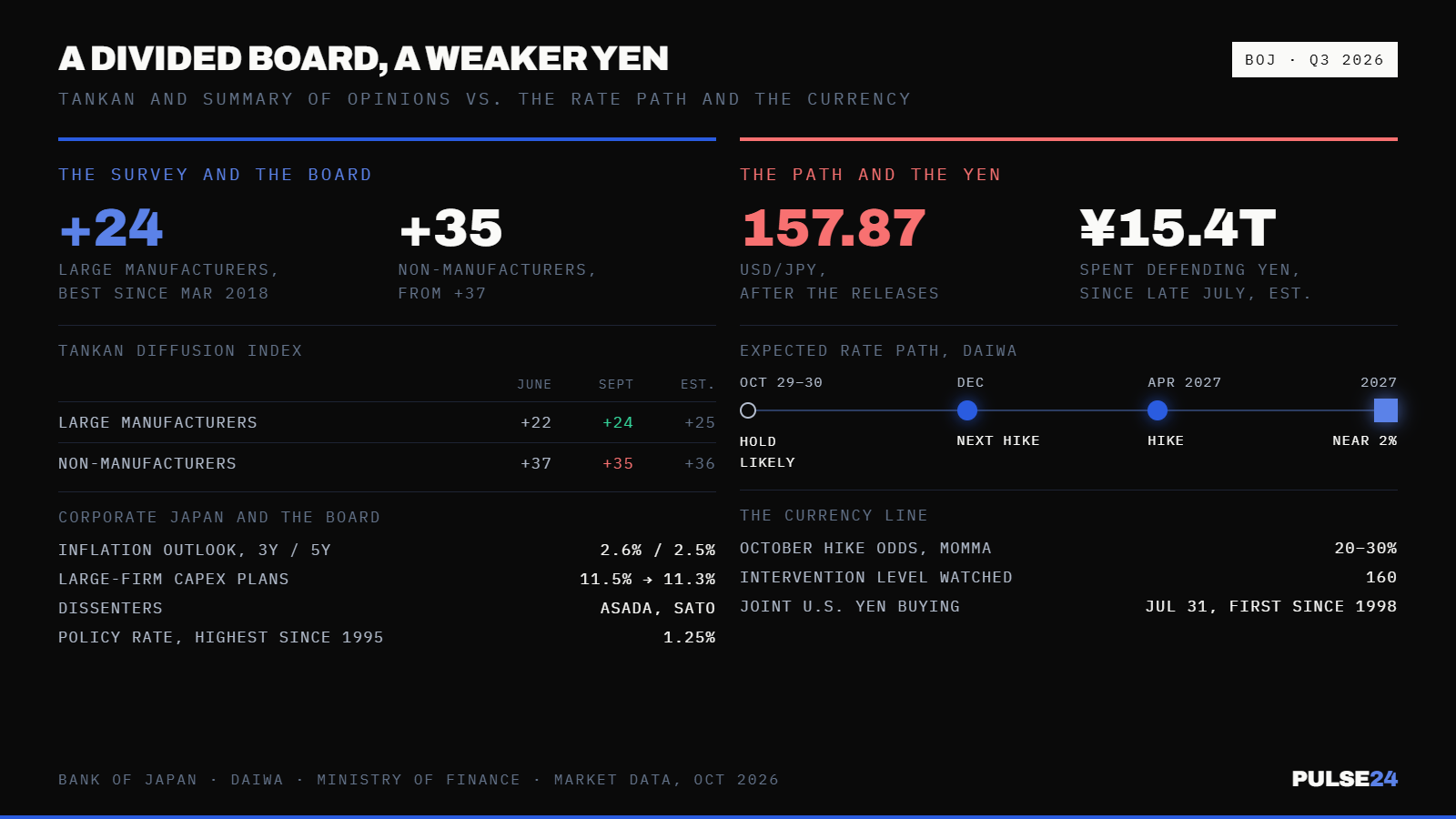
The Summary of Opinions showed some board members pushing to “accelerate rate rises or move the policy rate closer to the goal soon.” Two dissenters, Toichiro Asada and Ayano Sato, raised the same objections they voted against in September: weak consumption and services inflation that hasn't picked up as much as headline prices have. One member flagged rising crude oil prices, tied partly to ongoing tension in the Middle East, as a fresh inflation risk to watch rather than a reason to move immediately.
The Tankan added its own mixed signal. Large manufacturer sentiment rose to +24 from +22 in June, the strongest reading since March 2018, though it missed the +25 economists expected. Non-manufacturer sentiment told a different story, easing to +35 from +37 and missing the +36 economists forecast, with large service-sector firms turning slightly more cautious about current conditions. Corporate Japan still expects inflation well above the Bank of Japan's 2% target for years, 2.6% over a three-year horizon and 2.5% over five, and large companies trimmed their capital spending plans slightly to 11.3% for the fiscal year, down from 11.5% in June, even as profits hold up.
Governor Kazuo Ueda has described the bank's position as a “new phase,” where the job is no longer pushing inflation up to 2% but keeping it from running past target. Economists at Daiwa now expect the next hike in December, followed by another in April 2027, with the policy rate eventually settling near 2%. USD/JPY rose to 157.87 on the news, not far from where the yen was testing resistance near 160 in late September.
Why It Matters
A central bank trimming its own near-term hike odds usually weakens the case for its currency, and that's roughly what happened Thursday. The more interesting dynamic is what sits underneath it. Japan's Ministry of Finance has spent an estimated 15.4 trillion yen defending the yen since late July, and the US Treasury joined that effort on July 31, the first coordinated yen-buying operation between the two governments since 1998. That kind of intervention usually buys a currency time rather than a permanent floor, and Thursday's move shows how quickly the ground can shift once a data release introduces fresh doubt about the pace of tightening.
The bigger story for markets outside Japan is the yen carry trade, the practice of borrowing cheaply in yen to fund investments elsewhere. Two decades of near-zero rates made that trade close to free, and a lot of global risk-taking, including the debt financing behind the AI infrastructure boom, has leaned on it. SoftBank's own borrowing costs have already climbed to records as it funds its OpenAI commitments, and a Bank of Japan that keeps raising rates, however unevenly, changes the math on every yen-funded position still open.
What to Watch Next
The next scheduled decision is October 29-30, and Thursday's releases make a hold the more likely outcome. December is now the market's preferred date for the next move, though Ueda hasn't ruled out consecutive hikes or a larger 50 basis-point step if inflation data surprises higher. Watch crude oil prices heading into the Bank of Japan's October Outlook Report, since economists have flagged oil as the variable most likely to pull the timeline forward again if it stays elevated. And watch USD/JPY's distance from 160. Every approach to that level this year has revived intervention speculation, and a Ministry of Finance that has already committed 15.4 trillion yen isn't likely to let the line get tested quietly a second time.
The Pulse24 Take
The headline number from Thursday, trimmed odds of an October hike, is the least interesting part of this story. What's more useful is what it reveals about how fragile the market's read on Bank of Japan timing really is. Just days ago, several economists still treated an October move as a live possibility. One mixed Tankan reading and a single survey of internal opinions cut that to one in three or one in five. Nothing about the Bank of Japan's actual intentions changed this week. The market simply never had as firm a read on its timing as the odds implied. For investors watching the yen carry trade and its reach into AI infrastructure financing, the lesson is worth repeating: Japan's path to policy normalization isn't a straight line, and every data point between now and December is going to move markets more than its size alone would suggest.
How we read the data
Curious how we get from raw data to a take like this? Our Trader's Toolkit walks through the tools we lean on.
Explore the Toolkit