Pulse24 Original
Copper Just Hit a New All-Time High of $6.71 a Pound. US Warehouses Are Already Sitting on a Record Stockpile.
August 16, 2026
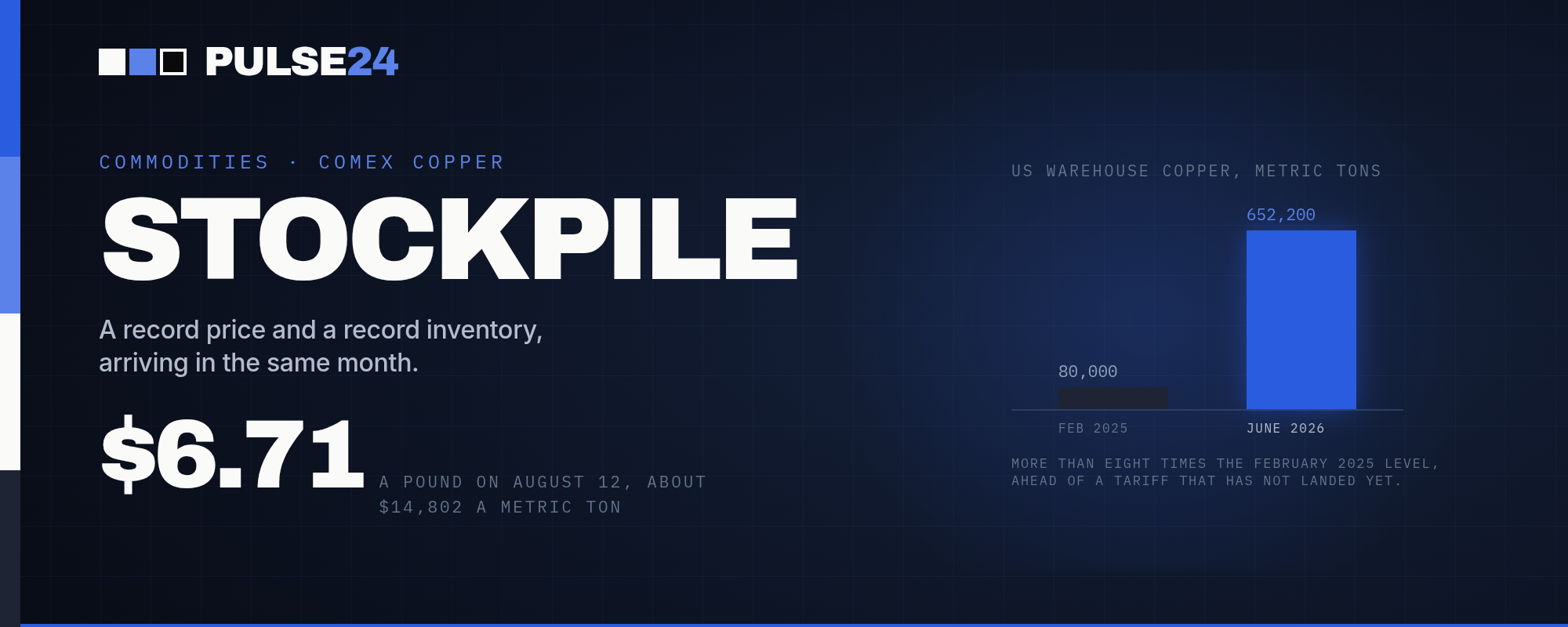
Copper hit a fresh all-time high of $6.7140 a pound on COMEX in mid-August, weeks after US warehouses filled with a record 652,200 metric tons of the metal back in June. The rally has more to do with traders positioning for a tariff that hasn't taken effect yet than with any near-term supply crunch.
Copper hit a fresh all-time high of $6.7140 a pound on the COMEX exchange on August 12, worth roughly $14,802 a metric ton and its second record in just over a week. A price record like that usually signals a shortage. What's actually been filling American warehouses in the run-up to it is the opposite: more copper than they've held in over a decade.
US copper stockpiles hit a record 652,200 metric tons in late June, up from roughly 80,000 tons back in February 2025. Traders shipped in more than 200,000 tons in July alone, the largest single month of imports since recordkeeping began in 2014. Almost none of that copper has been used. Most of it is sitting in bonded warehouses, waiting.
What Changed
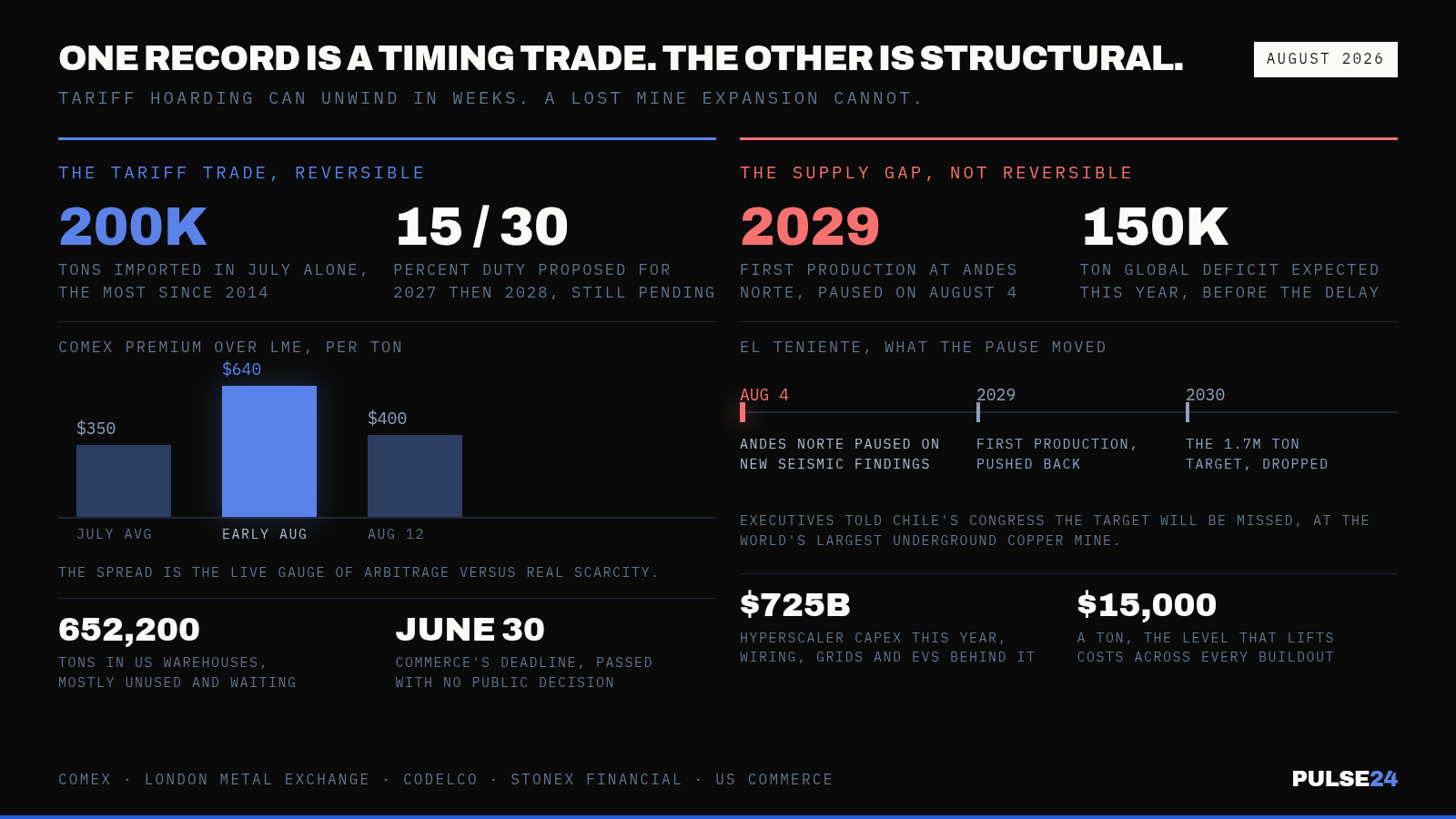
The driver isn't a mine going offline or a factory ramping up production. It's a tariff Washington still hasn't finalized. The Commerce Department opened a Section 232 investigation into refined copper imports last year and was supposed to deliver its recommendation to the White House by June 30. That deadline passed more than six weeks ago with no public decision. The proposal on the table would impose a 15% duty on refined copper starting in January 2027, rising to 30% the following year.
Traders aren't waiting to find out how it lands. Every ton of copper physically inside a US warehouse before the tariff takes effect is a ton that dodges the duty entirely, so importers have been racing to get metal onshore now rather than later. That arbitrage shows up directly in the price gap between exchanges. The COMEX premium over the London Metal Exchange peaked near $640 a ton in early August, nearly double July's average of roughly $350, before easing to around $400 a ton by August 12. StoneX Financial's Michael Cuoco summed it up in early August: tariff arbitrage was ruling over demand growth at the time.
A second, unrelated story is pushing prices the same direction. Codelco, the Chilean state miner that produces more copper than any company on earth, paused the Andes Norte expansion project at its El Teniente mine on August 4. New seismic risk assessments found the ground beneath the world's largest underground copper mine was less stable than earlier surveys showed. First production is now pushed to 2029. Codelco has effectively abandoned its goal of reaching 1.7 million tons of annual output by the end of the decade, and company executives told Chile's congress the broader production target will be missed.
Why It Matters
Tariff hoarding and a genuine mine setback don't usually arrive in the same month, but when they do, they reinforce each other instead of canceling out. The hoarding is a timing story. Eventually those 652,200 tons get released into the US market, and domestic supply should loosen when they do. The Codelco delay is a structural story that doesn't reverse on any timeline this short. A mine that was supposed to add production capacity now won't for at least three more years, and analysts already expect a roughly 150,000 metric ton global deficit in refined copper this year, before fully accounting for El Teniente's setback.
Copper isn't gold or oil. Its price rarely makes headlines on its own, but it shows up everywhere else in the economy that does. Data centers need it for wiring at the same time hyperscalers are ramping $725 billion in combined capex this year, utilities need it to expand grid capacity, and EV production consumes it by the ton. A sustained move toward $15,000 a ton raises costs across each of those buildouts, right as companies are already fielding questions about whether AI infrastructure spending is outrunning the returns it's supposed to generate.
The macro backdrop is helping for now. Cooling inflation data has been chipping away at the odds the Fed hikes rates in September, and industrial metals tend to benefit when tightening pressure fades, since lower borrowing costs make it cheaper to finance the infrastructure that consumes them. Copper doesn't strictly need that tailwind this month, given how much of the current move is being driven by tariff positioning rather than financing conditions, but it removes one obstacle that could otherwise have slowed the buildout copper demand depends on.
What to Watch Next
The Commerce Department's overdue tariff recommendation is the single biggest catalyst here. A formal announcement, whenever it lands, will either confirm the 15%/30% structure traders are positioning for or change the terms entirely, and either outcome should move the COMEX-LME spread sharply. That spread is a real-time gauge of how much of the current price is arbitrage versus genuine scarcity. It peaked near $640 a ton in early August against a July average closer to $350, then eased to around $400 a ton by August 12. Further narrowing would suggest the hoarding trade is unwinding on its own, while a move back toward the early-August peak would signal traders are bracing for the tariff to land sooner rather than later.
Codelco's next update on El Teniente matters more than any single price print. The company already walked back its 1.7 million ton target once. Another downward revision, or news that the seismic issues extend beyond the Andes Norte project, would tighten the supply picture further and make the current record look less like a peak than a floor.
The Pulse24 Take
A record copper price looks like proof the world is short on the metal, and eventually that might be true. Right now, though, the price and the inventory data are telling two different stories, and the gap between them is the more interesting one. Traders are stockpiling copper not because they need it this quarter but because a tariff that doesn't exist yet is expensive enough to plan around. That's a rational trade, and it's also one that can reverse fast once the Commerce Department actually rules.
Underneath the hoarding sits a slower-moving problem that won't reverse on any announcement. A major mine expansion just lost three years, structural demand from AI infrastructure and grid buildouts keeps climbing, and the deficit analysts are projecting for this year was calculated before Codelco's setback became public. The tariff trade might unwind on schedule. The supply gap under it probably won't.
How we read the data
Curious how we get from raw data to a take like this? Our Trader's Toolkit walks through the tools we lean on.
Explore the Toolkit