Pulse24 Original
The Treasury Just Proposed Rules for a $287 Billion Stablecoin Market. One Bank Thinks It Could Grow to $2 Trillion and Buy Up to $1 Trillion in T-Bills.
August 18, 2026
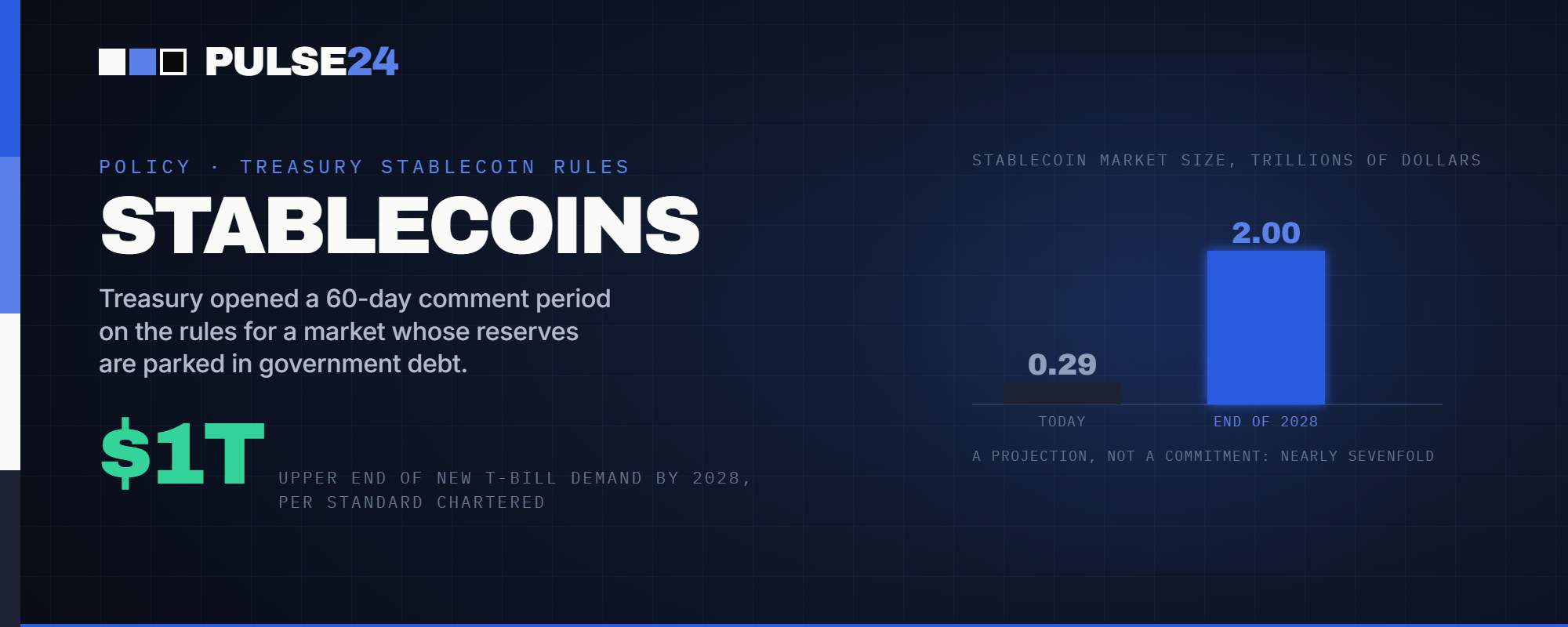
The Treasury opened a 60-day comment period on stablecoin rules this week, and Standard Chartered says the market behind them could grow nearly sevenfold by 2028, sending as much as $1 trillion of fresh demand into short-term government debt. It's a reminder that crypto regulation and Treasury market plumbing are no longer separate stories.
The Treasury Department published its first real rulebook for stablecoin issuers on Monday, opening a 60-day public comment period that runs through mid-October. It is the government's initial attempt to spell out how the GENIUS Act, the stablecoin law Congress passed in July 2025, actually works once regulators have to write the details rather than just pass the bill.
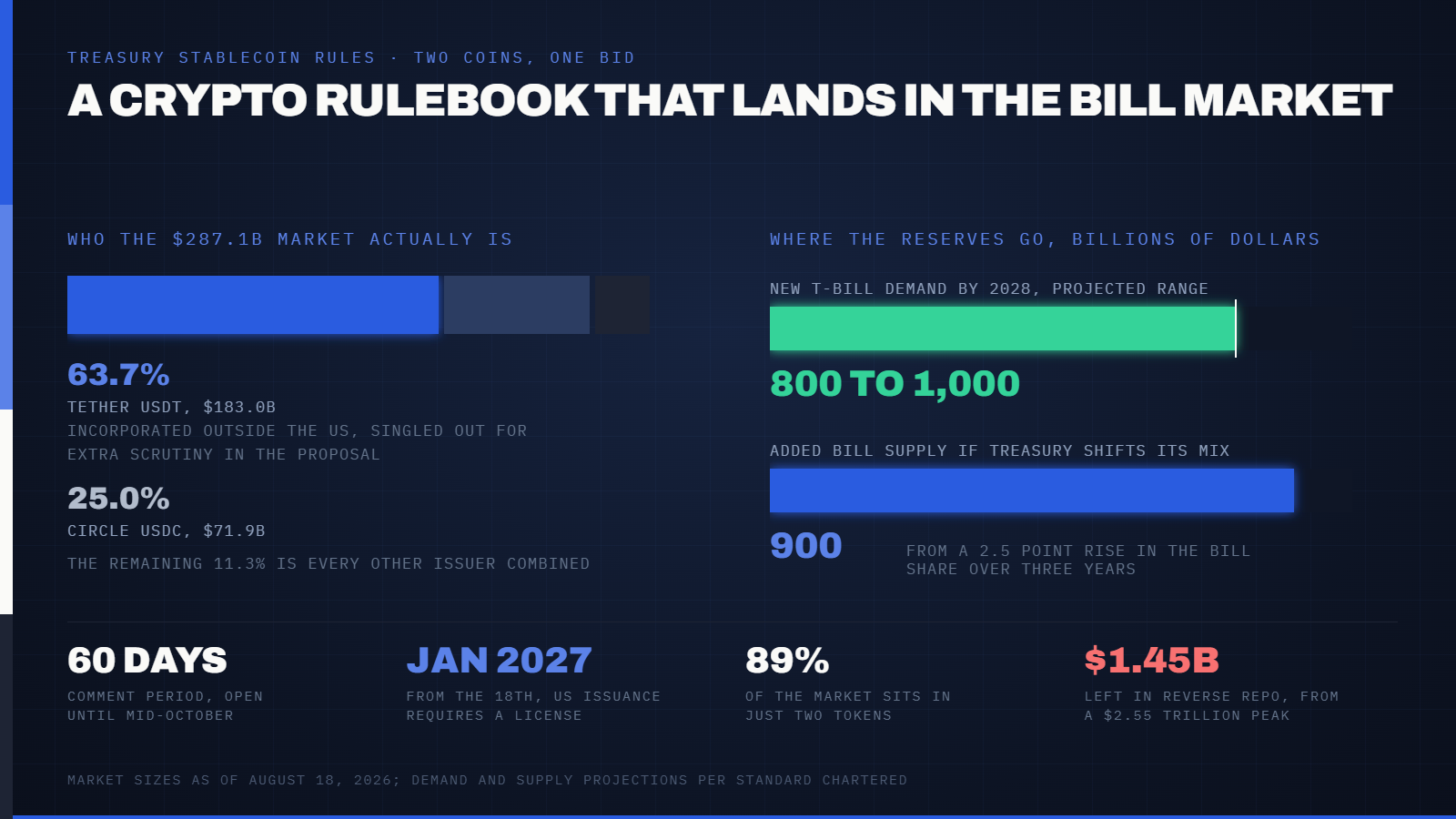
The market the rule is meant to govern is already substantial. Total stablecoin supply sits at $287.1 billion, with Tether's USDT alone worth $183.0 billion and Circle's USDC adding another $71.9 billion. Those two tokens control almost 89% of the entire category, which is one reason Treasury's proposal reserves some of its sharpest language for foreign issuers. Tether, a company incorporated outside the US, gets singled out for extra scrutiny in a document that otherwise reads like a rulebook being written from scratch rather than borrowed from securities law.
What Changed
Treasury's proposal treats stablecoins as their own category. Officials wrote that "the Act evinces a clear intent for payment stablecoins to serve as an effective means of payment and settlement," and that applying traditional investment rules would work against that goal. The department says it studied securities regulation as a reference point, then built something separate instead. Dozens of open questions remain in the text, everything from custody requirements to how foreign issuers prove compliance, and the answers won't be locked in until the comment window closes.
Timing complicates the rollout. The GENIUS Act's own one-year implementation deadline already passed last month. Companies generally won't be allowed to issue payment stablecoins in the US without a federal or state license after January 18, 2027, and getting a workable rulebook finalized well before then looks unlikely given how long transition periods typically run after a comment period this size. A separate bill covering how crypto trades rather than how it's backed tells a different story about regulatory momentum right now. The CLARITY Act missed its own window to pass before the Senate's recess, even as Bitcoin ETFs pulled in hundreds of millions the same week. Stablecoin rules are moving. Trading-market rules are stuck.
Why It Matters
The reason this belongs in a markets newsletter and not just a crypto one comes down to what backs a stablecoin. Issuers like Tether and Circle hold Treasury bills as reserves, since bills earn yield while staying liquid enough to redeem tokens on demand. Every dollar that flows into a stablecoin tends to become a dollar parked in short-term government debt within days.
Standard Chartered has modeled where that goes from here. The bank's analysts project the stablecoin market could reach $2 trillion by the end of 2028, up from $287 billion now, generating $800 billion to $1 trillion of fresh T-bill demand along the way. To meet that demand, the bank estimates Treasury could raise the share of its financing that comes from bills by 2.5 percentage points over three years, adding close to $900 billion in supply. One consequence, according to the analysis, is that Treasury could afford to slow down its long-dated auctions.
That would be a welcome shift. The US paid the highest price for 30-year debt since 2001 at its most recent auction, even as the 10-year sale a day earlier found buyers without much trouble. A steady new source of demand at the short end doesn't fix appetite for 30-year paper, but it gives Treasury more room to lean away from the maturities where investors have been demanding the most compensation.
There's a second connection worth drawing. The Fed's reverse repo facility, which used to be the market's shock absorber for excess cash, has fallen from a $2.55 trillion peak to just $1.45 billion. That buffer isn't there to soak up swings in short-term funding anymore. A new, structural buyer of T-bills matters more in a system with less spare cushion than it would have two years ago.
What to Watch Next
The 60-day comment period runs through mid-October, and the details that emerge from it, especially how foreign issuers like Tether are treated, will shape whether stablecoin growth actually tracks Standard Chartered's forecast or falls short of it. Regulatory clarity has historically preceded growth in this market, not followed it. Watch Treasury's quarterly refunding announcement in late October or early November too. If officials start shifting the bill share of issuance the way StanChart expects, it will show up there before it shows up anywhere else.
The Pulse24 Take
Stablecoins used to be a crypto story. Increasingly, they're a Treasury market story wearing a crypto label. Every stablecoin issued is effectively a small, permanent bid for short-term government debt, and that bid gets larger as adoption grows, comment periods notwithstanding. Washington is still arguing over the fine print, foreign issuer scrutiny, custody rules, what counts as a security, but the direction of travel already tells you something about how the US plans to fund itself for the rest of the decade. A government running large deficits has found a new class of buyer that doesn't ask for much term premium and doesn't seem to be going away. That's worth watching regardless of where crypto prices head next.
How we read the data
Curious how we get from raw data to a take like this? Our Trader's Toolkit walks through the tools we lean on.
Explore the Toolkit