Pulse24 Original
USD/JPY Is Back Near 159, Erasing Nearly Half the Ground Gained From the August 3 Yen Intervention. Washington and Tokyo Don't Agree on What the Bank of Japan Should Do Next.
August 13, 2026
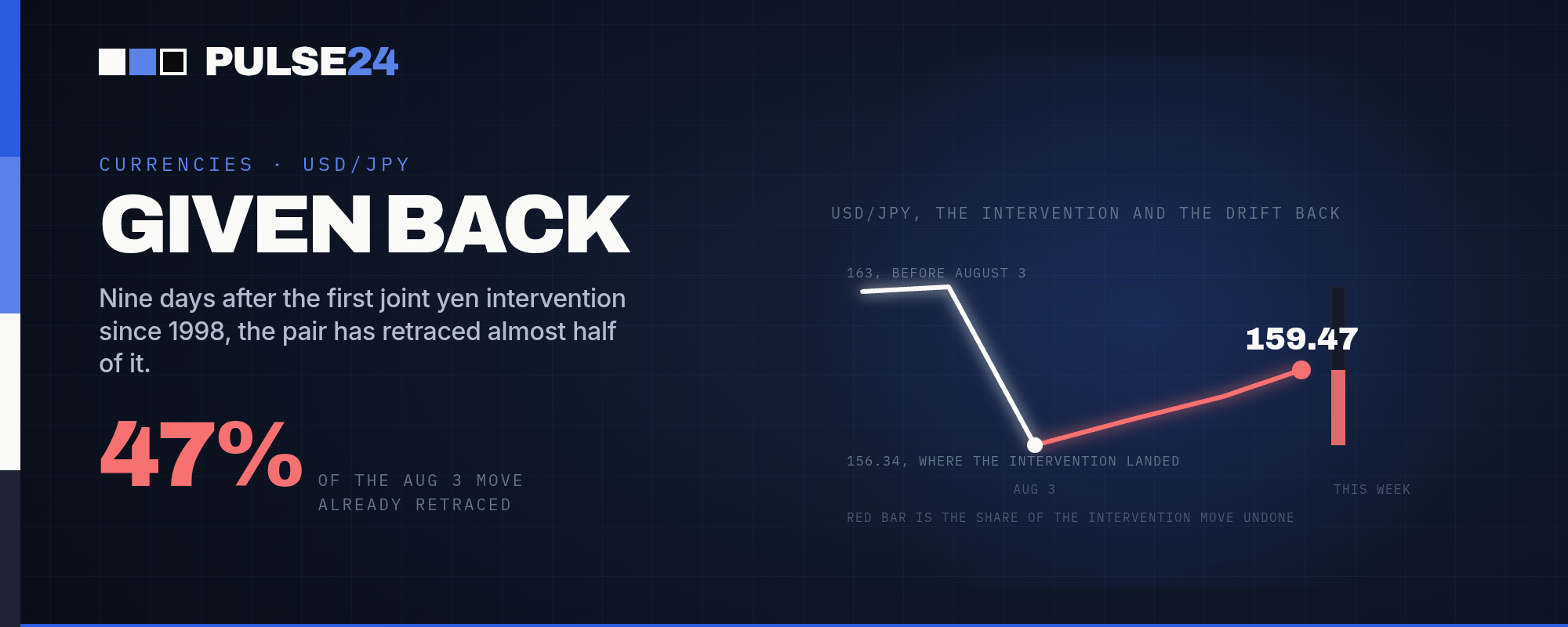
USD/JPY has climbed back near 159, giving back close to half of what the August 3 US-Japan currency intervention gained. Treasury Secretary Scott Bessent wants a faster Bank of Japan, Prime Minister Sanae Takaichi wants the opposite, and the split is starting to show up in the exchange rate.
USD/JPY touched 159.47 this week, its highest level in about a week and a half. Nine days earlier, on August 3, the US Treasury and Japan's Ministry of Finance jointly bought yen for the first time since 1998, driving the same pair down from above 163 to roughly 156.34 within hours. Close to half of that intervention's work has already come undone.
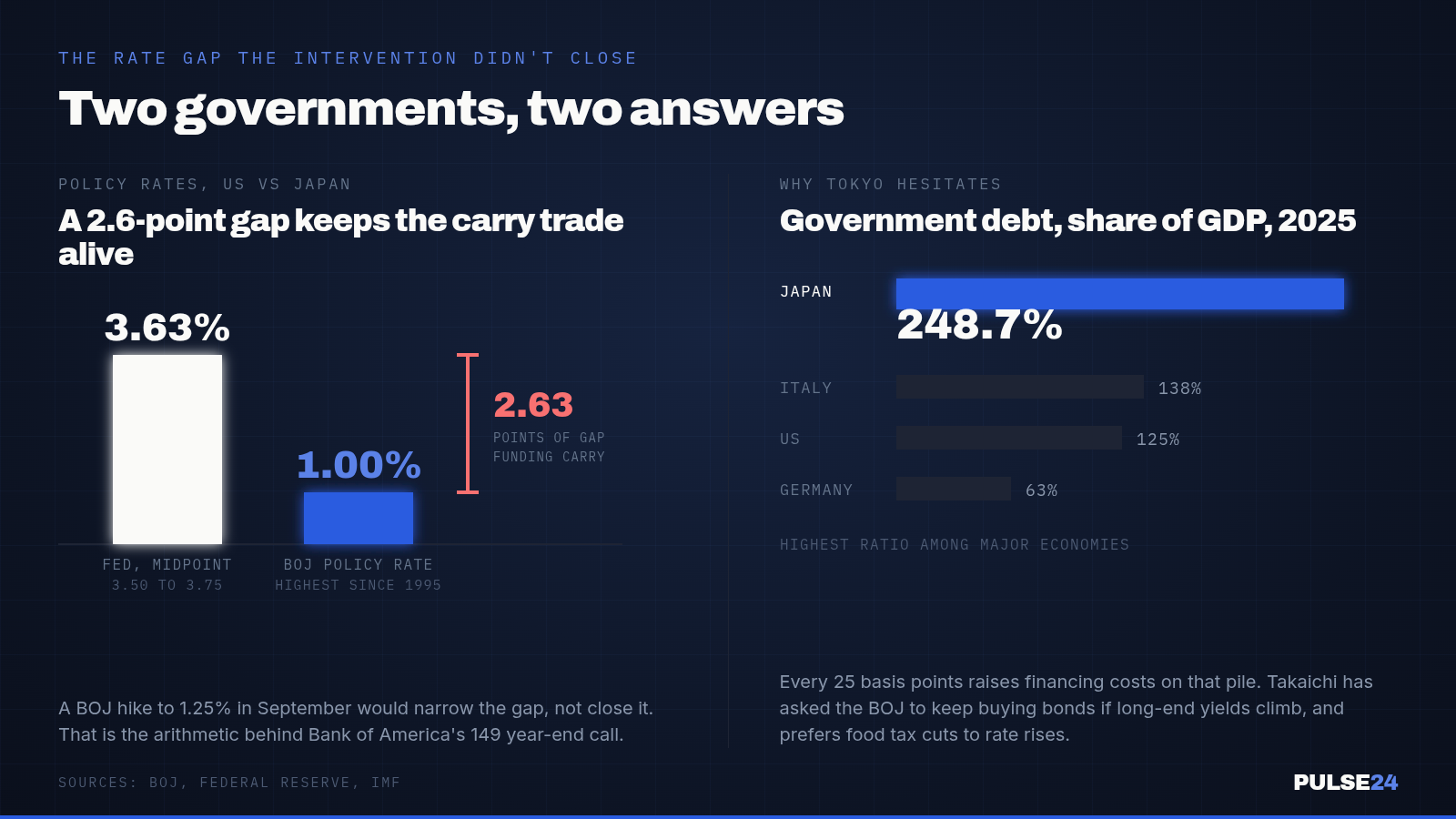
The retracement matters less as a number than as a signal. The US and Japan jointly bought yen for the first time since 1998 to buy Tokyo time to fix a more basic problem: a policy rate stuck at 1% while the Fed sits at 3.50% to 3.75%, a gap wide enough to keep funding the yen carry trade no matter how many dollars get sold in a single session. Nine days later, Washington and Tokyo don't agree on how to close that gap, and the currency market is starting to notice.
What Changed
Treasury Secretary Scott Bessent has spent the past year pushing the Bank of Japan to move faster on rates, arguing Tokyo has stayed behind the curve on inflation and needs to give its central bank room to act. Japanese Prime Minister Sanae Takaichi wants the opposite. She has asked BOJ Governor Kazuo Ueda to keep buying government bonds if long-term borrowing costs climb, and she has floated food tax cuts rather than higher rates as her preferred tool for cooling inflation. The disagreement became public again this week, landing at an awkward moment for a currency defense that depends on both governments pulling in the same direction.
None of this is abstract for Takaichi. Tokyo's core inflation data already beat every forecast on the Street in July, running at 1.9% and pushing at least three BOJ board members toward wanting to hike faster than the bank's usual twice-a-year pace. A faster BOJ would likely help the yen. It would also raise financing costs on a debt pile that stood at 248.7% of GDP in 2025, the highest ratio among major economies, just as Takaichi's government tries to fund higher defense and crisis-preparedness spending.
Why It Matters
The BOJ held its policy rate at 1.00% on July 31, an 8-1 vote that included one dissent in favor of an immediate move to 1.25%. Bank of America read that decision as a signal the bank would hike in September rather than October, and moved its year-end USD/JPY forecast down to roughly 149 on the bet. The September 17-18 meeting is the one traders are watching now, with the October 29-30 meeting as the fallback if policymakers wait again.
A hike would close some of the rate gap that makes the yen carry trade profitable. It would not close all of it. Bessent has already asked for a bigger Fed credit line so Japan, which holds $1.14 trillion in US Treasuries, never has to sell them to defend its own currency, a request that only makes sense if officials expect more defense to be necessary. The bigger risk to markets isn't the yen exchange rate by itself. A wide, unresolved rate gap has fueled carry trade unwinds before, and unwinding that trade too quickly is what turned a currency story into a global equity selloff in August 2024.
What to Watch Next
The number worth tracking isn't a single headline level so much as whether USD/JPY can hold below 160 without another visible intervention. A drift back above that line, on top of this week's move to a week-and-a-half high, would suggest the August 3 purchase bought time rather than changed direction, the same pattern that played out after Japan's earlier solo intervention this year. The September BOJ meeting is the more immediate test. If Ueda's board holds again, expect the Bessent-Takaichi disagreement to get louder, not quieter, and expect BofA's 149 forecast to be the first casualty.
The Pulse24 Take
Currency intervention buys time, not outcomes. Washington and Tokyo proved that on August 3, when a joint operation did in a few hours what months of jawboning couldn't: pull USD/JPY off a 40-year high. What it hasn't done is settle the actual disagreement between the two governments over how Japan should get its own house in order, and nine days later that disagreement is the story again. If the BOJ hikes in September, this cycle starts to look like coordinated pressure that worked. If it doesn't, and Takaichi keeps favoring an accommodative stance while the Fed stays put, the same August 3 headline could reappear before year end, only this time markets will already know how it ends.
How we read the data
Curious how we get from raw data to a take like this? Our Trader's Toolkit walks through the tools we lean on.
Explore the Toolkit