Pulse24 Original
$7 Trillion in Options Expired Friday. Three Out of Four Septembers Since 2000, Stocks Fell From Here.
September 21, 2026
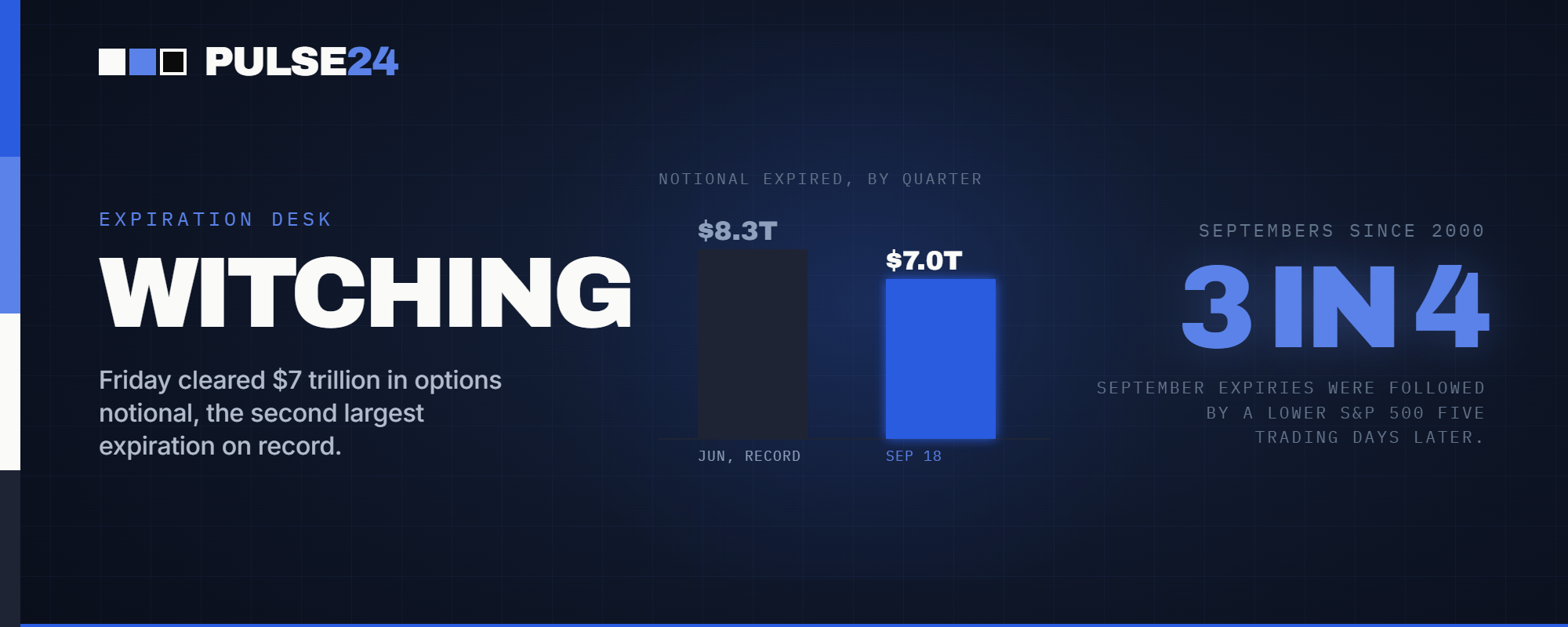
Friday's triple witching cleared $7 trillion in options notional, the second-largest expiration on record behind June's $8.3 trillion. History says the S&P 500 often struggles in the two weeks that follow, though not always.
Seven trillion dollars in options notional came off the board on Friday, September 18. Stock options, index options, and futures on all of them expired within the same session, a quarterly event traders shorthand as triple witching. Citadel Securities, whose Global Market Intelligence desk tracks positioning across the US options market, marked it the second-largest expiration of its kind on record. Only June's $8.3 trillion event was bigger.
Scale alone doesn't usually move markets on its own. What often does is what happens after the size resets, when dealers who spent weeks hedging that exposure have to rebuild their books from scratch.
What Changed
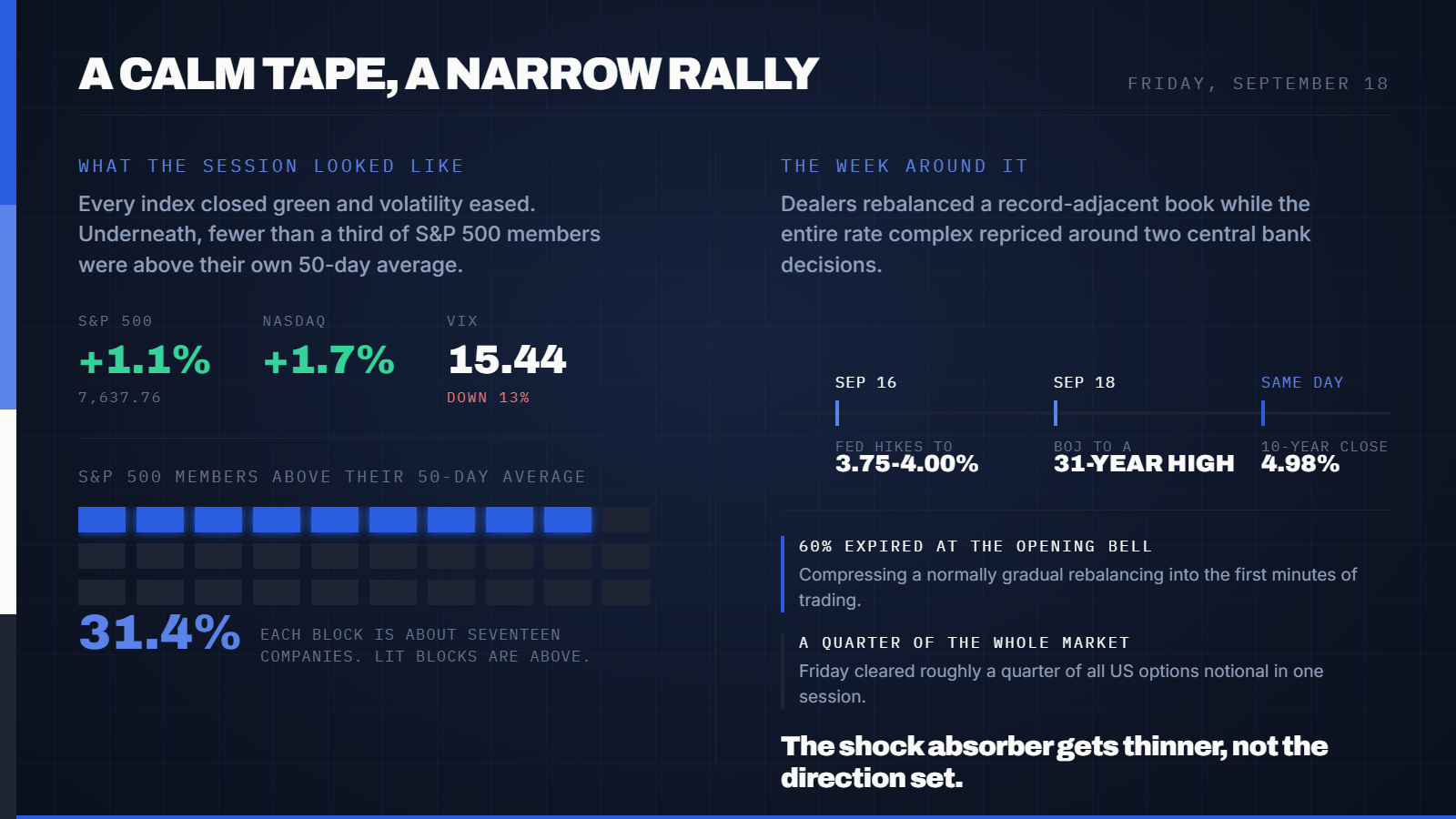
Triple witching happens four times a year, on the third Friday of March, June, September, and December, when stock options, index options, and index futures all expire together. September's version cleared roughly a quarter of the entire US options market's notional value in a single session, with about 60% of that expiring right at the opening bell, according to Citadel's Scott Rubner. That concentration matters because it compresses a normally gradual rebalancing process into a narrow window.
Friday's session itself looked calm on the surface. The S&P 500 closed at 7,637.76, up 1.1% on the day, while the Dow Jones Industrial Average added 0.6% and the Nasdaq Composite rose 1.7%. Volatility actually eased that day: the Cboe Volatility Index fell to 15.44, down close to 13%, hardly a sign of stress. But under that headline strength, only 31.4% of S&P 500 stocks were trading above their own 50-day moving average, a divergence that shows a narrower rally than the index return suggests.
The timing compounded the setup. The Bank of Japan lifted its own policy rate to a 31-year high on the very same Friday, two days after the Federal Reserve raised US rates to 3.75%-4.00%, its first increase in over three years. Japan's move rippled through Treasuries: the 10-year, which had first touched 5% earlier this month for the first time since 2023, pushed back up near that level Friday before closing at 4.98%, then eased toward 4.97% by Monday morning. Dealers were rebalancing a record-adjacent options book at the exact moment the entire rate complex was repricing around two central bank decisions landing in the same week, one of them on expiration day itself.
Why It Matters
Options market makers stay roughly delta-neutral by buying or selling the underlying stock as prices move, and the size of that hedging flow depends on how much gamma they're holding. When dealers are net long gamma, as they generally have been through most of this year's rally, their hedging tends to dampen volatility, buying dips and selling rallies in small increments that smooth out the moves. Roll off a large chunk of that positioning in a single session, though, and the dampening effect can fade with it.
Rubner's team put it directly in Friday's note: "as these positions expire or roll forward, the positioning that has helped dampen realized moves can change materially, potentially leaving the market more sensitive to underlying flows afterward." That doesn't guarantee a selloff. It means the shock absorber gets thinner, so whatever direction the next real catalyst points, the move can travel further than it would have with dealers still holding a large offsetting book.
The historical record adds some caution, though not certainty. Looking back to 2000, roughly three out of every four September triple witching periods have finished with the S&P 500 lower five trading days later. That's a meaningful tilt, but a five-day return is a short and noisy thing to lean on, and one calendar quirk correlating with a short-term dip is not the same as it causing one. Treat it as a mild seasonal headwind worth watching, not a forecast.
What to Watch Next
The clearest signal will be whether the S&P 500 can hold its recent gains without dealer hedging flows turning from a stabilizing force into an amplifying one. Options desks including Citadel's have flagged support levels in their gamma models for the days just after expiration. If the index holds above them, the dampening effect Rubner described should persist. A meaningful break lower would be the first real test of how thin the shock absorber has actually gotten.
Monday's open gave an early read. Futures pointed higher as oil retreated, with Brent crude falling for a fourth straight day to around $102 a barrel after peaking near $108 earlier in the month. Gold eased modestly to around $4,395 an ounce, while Bitcoin jumped more than 5% to touch $85,000 for the first time since January, a move that triggered roughly $650 million in short liquidations. None of that tells you whether the post-expiry flows are calm or simply delayed.
There's also a medium-term angle worth tracking alongside the near-term technical noise. Capital Economics recently put the S&P 500 at 8,250 by December, followed by its own call for a 30% reversal by 2027. Getting from here to 8,250 will require the index to absorb whatever volatility the options unwind produces without it turning into something structural.
The Pulse24 Take
Options expirations are market plumbing. A record-adjacent event like Friday's doesn't usually tell you which direction stocks go next. What it tells you is that a structural source of calm just got smaller, at least for a while, and that's worth remembering the next time a headline seems to move the market more than it should.
Three out of four is a tendency, not a rule, and 2026 has already broken a few historical patterns that looked reliable going in. The more useful habit is watching how the index behaves around those gamma levels over the next two weeks rather than betting on the seasonal stat alone. If support holds, this was plumbing, nothing more. A break lower would mean the reason behind it matters more than the coincidence of timing with a heavy expiry.
How we read the data
Curious how we get from raw data to a take like this? Our Trader's Toolkit walks through the tools we lean on.
Explore the Toolkit