Pulse24 Original
Marvell Beat Every Earnings Estimate and Fell 10% Anyway. The $120 Billion Google Payoff Won't Show Up Until Fiscal 2029.
August 29, 2026
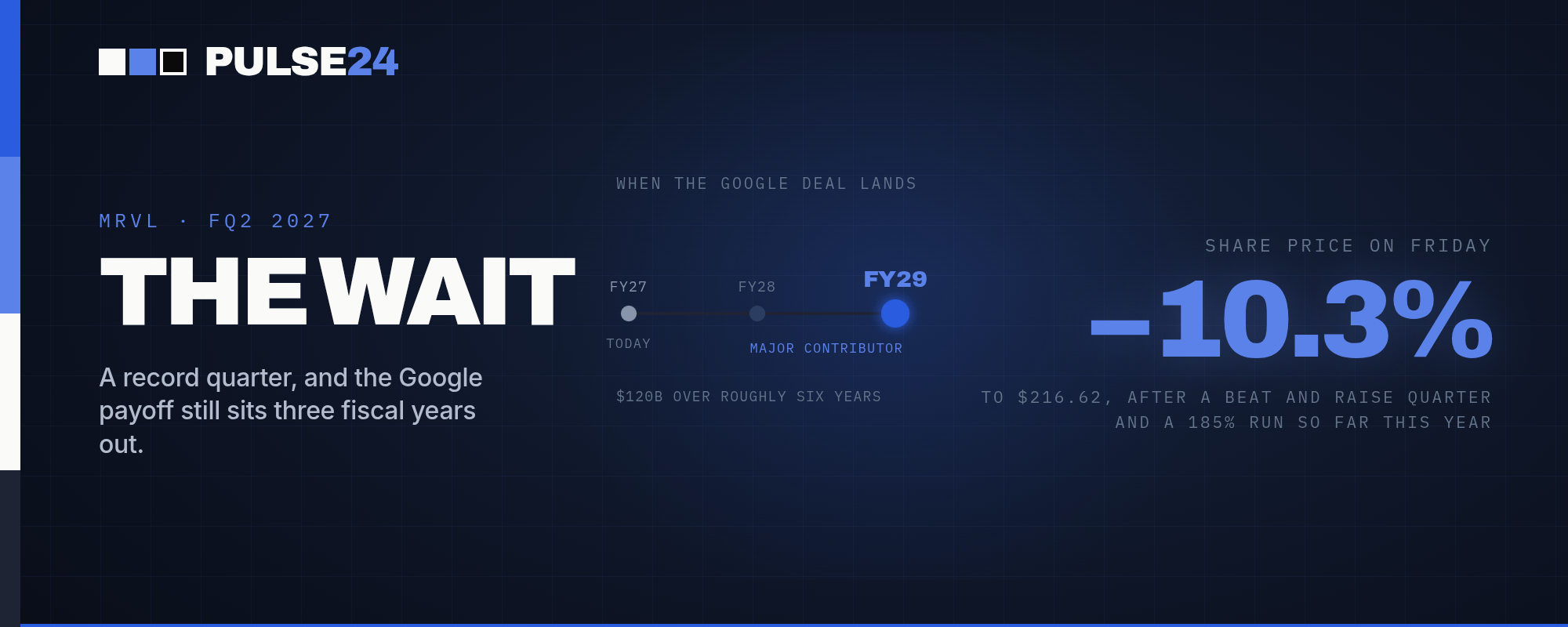
Marvell posted record data center revenue and raised guidance twice over, but investors sold the stock down more than 10% after learning the Google AI chip payoff pushes into fiscal 2029. The gap between Wall Street's excitement and the deal's real timeline got a lot more concrete on Friday.
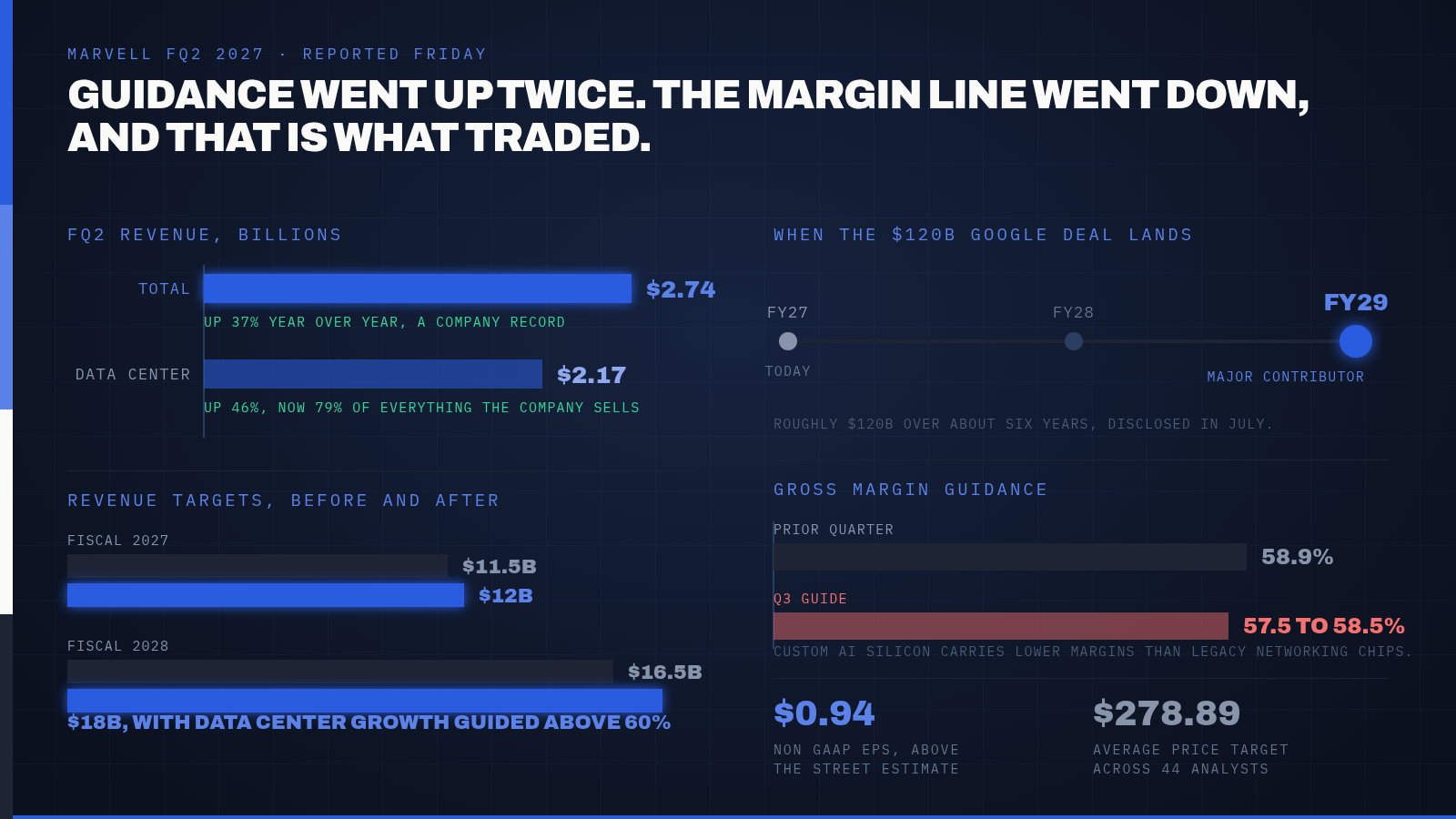
Marvell Technology's data center revenue hit a record $2.17 billion last quarter, up 46% from a year earlier and now 79% of everything the company sells. Non-GAAP earnings of $0.94 a share cleared Wall Street's estimate, and management raised guidance for both this fiscal year and next. The stock closed down more than 10% anyway.
The selloff traces back to one detail buried in an otherwise strong report: fiscal 2029. That's when Marvell's custom AI chip agreement with Google, worth an estimated $120 billion in cumulative revenue over roughly six years, is expected to become what the company called a major contributor to results. Investors had been pricing the deal as a nearer-term catalyst since Marvell first disclosed the warrant tied to it in July. Friday's earnings call made clear the payoff sits three fiscal years out, not one.
What Changed
Marvell's quarter itself was hard to fault. Revenue of $2.739 billion beat estimates and marked the company's best quarter on record, driven almost entirely by custom silicon and networking chips sold into hyperscale data centers. Management raised its fiscal 2027 revenue outlook to roughly $12 billion from $11.5 billion, and its fiscal 2028 target to about $18 billion from $16.5 billion, with data center growth guided above 60% for both years. Third-quarter revenue guidance of $3.15 billion at the midpoint implies another 15% sequential jump.
What spooked traders was the margin line, not the top line. Third-quarter gross margin guidance came in at 57.5% to 58.5%, down roughly 90 basis points from the prior quarter's 58.9%. Custom AI silicon, the same business generating Marvell's fastest growth, carries structurally lower margins than the company's legacy networking and storage chips. As Google and other hyperscalers become a larger share of revenue, that mix shift shows up directly in profitability, and Friday's guidance was the clearest evidence yet of the tradeoff.
Why It Matters
Marvell's stock reaction fits a pattern that's shown up across AI infrastructure earnings all year. Nvidia beat every Wall Street estimate the day before with revenue that doubled to $96.2 billion, and its stock dropped before recovering. The common thread is a market that has priced AI buildout stocks for near flawless execution, where a beat-and-raise quarter isn't enough on its own if the timeline for a marquee deal shifts even slightly later than assumed.
The Google agreement also illustrates how custom silicon deals actually get paid for. Google holds a warrant for up to 7% of Marvell's shares, vesting as revenue milestones are hit, the same structure disclosed when the partnership was first detailed. That means Marvell is trading dilution today for a revenue stream that mostly shows up after fiscal 2028. For a stock that had already climbed 185% this year into Thursday's close, a three-year wait for the marquee catalyst to pay off gave holders a reason to take profits, even with the underlying business firing on every other cylinder.
What to Watch Next
Watch Marvell's gross margin trajectory over the next several quarters. If the sequential decline in Friday's guidance continues as custom silicon keeps growing faster than the legacy business, it will test whether investors treat margin compression as an acceptable cost of AI-era growth or a reason to discount the stock further. Management has said it expects operating margin to reach a 38%-40% long-term range by the fourth quarter of fiscal 2027, a target worth checking against actual results as they come in.
Analyst behavior is worth tracking too. The Street's average price target held at $278.89 across 44 analysts even after Friday's drop, implying nearly 29% upside and a Strong Buy consensus. That gap between analyst conviction and investor reaction echoes what happened after Nvidia's own post-earnings dip a day earlier, and it says something about how skittish this market has gotten around any AI infrastructure company whose biggest payday sits multiple years out.
The Pulse24 Take
There's a difference between a bad quarter and a quarter that simply didn't move fast enough for the market's expectations, and Marvell's was clearly the second kind. Record data center revenue, a raised guide two years out, and a mega-cap customer with a $120 billion commitment attached to it would have been treated as unambiguously bullish news a year ago. On Friday it was enough to send the stock down more than 10%.
That says more about how AI infrastructure stocks are priced right now than it does about Marvell's underlying business. When a company needs a multi-year payoff to justify its valuation, the market starts treating every earnings call as a referendum on whether that payoff is still on schedule, not whether the business is healthy today. Marvell's business looks healthy today. Whether that's enough to hold the stock here depends on whether investors are willing to wait three fiscal years for the number that got them excited in the first place.
How we read the data
Curious how we get from raw data to a take like this? Our Trader's Toolkit walks through the tools we lean on.
Explore the Toolkit