Pulse24 Original
Bank Reserves Fell $84 Billion in a Week. The Repo Market Didn't Blink.
September 29, 2026
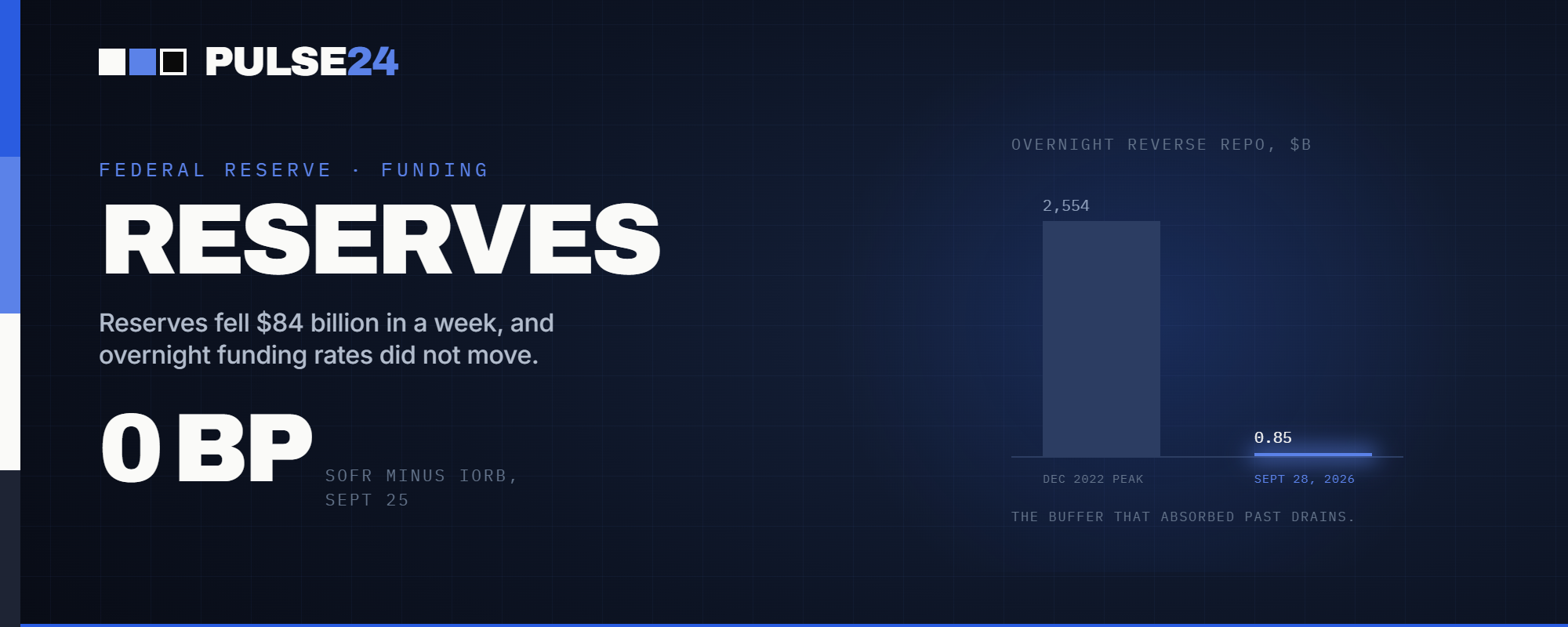
Bank reserves dropped to $2.93 trillion heading into quarter end, the kind of move that used to send repo rates spiking. This time the funding market barely budged, and the reason says something about where liquidity risk is actually hiding now.
Wednesday marks the end of the third quarter, and for most of the last five years that date has meant trouble for short-term funding markets. Banks pull cash to dress up balance sheets for regulators. Money funds shift cash out of repo and into Treasury bills. The overnight rate banks charge each other to borrow cash for a single night tends to jump. Heading into this particular quarter end, the plumbing looks almost boring.
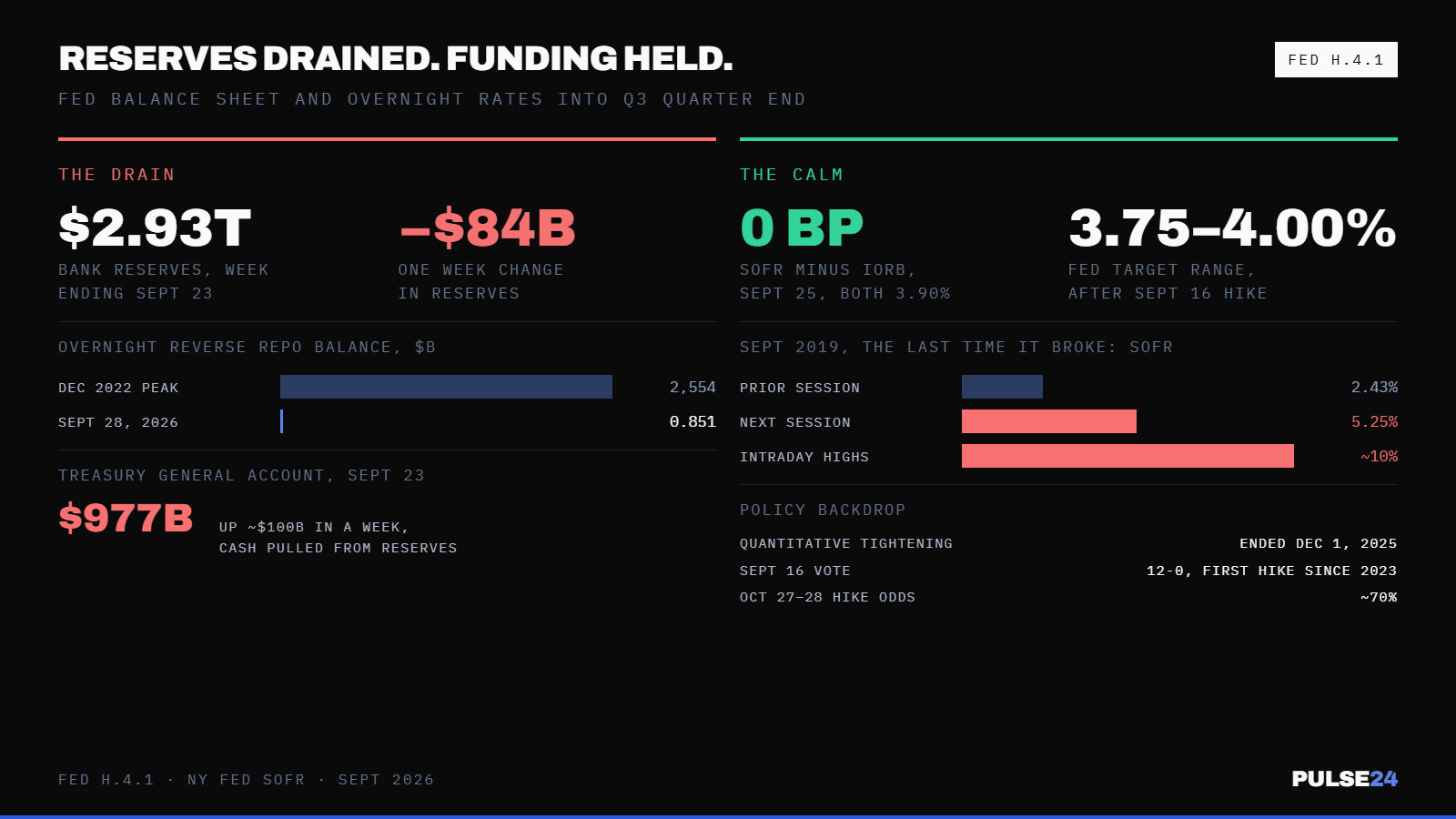
Reserve balances at the Fed dropped to $2.93 trillion in the week ending September 23, according to the central bank's own H.4.1 release, down about $84 billion from the week before. A move that size used to be enough on its own to put money-market desks on alert. Instead, the Secured Overnight Financing Rate closed at 3.90% on September 25, precisely level with the rate the Fed pays banks to hold reserves. When those two numbers sit on top of each other, traders read it as a market with plenty of cash and nowhere near a shortage.
What Changed
Two things happened at once this year, and they normally pull funding conditions in opposite directions. The Federal Reserve raised interest rates on September 16 for the first time since July 2023, a unanimous 12-0 vote that lifted the target range to 3.75%-4.00%. Officials pointed to inflation that remains elevated as the reason, and futures markets are already pricing roughly 70% odds of another quarter-point hike at the October 27-28 meeting, a shift that hit gold and silver hard this week.
At the same time, the Fed has kept quantitative tightening off the table since December 1, 2025, when it stopped letting Treasuries and mortgage bonds run off its balance sheet unreplaced. That decision followed three straight rate cuts in September, October and December of 2025 that took the target range down to 3.50%-3.75%, then five consecutive meeting holds before September's hike reversed course entirely. Rates went up. The balance sheet did not shrink further. That combination is unusual, and it is a big part of why this quarter end isn't behaving the way it used to.
Why It Matters
The overnight reverse repo facility used to be the market's shock absorber. Money funds parked idle cash there when they had nowhere better to put it, and when reserves got tight elsewhere in the system, that cash could flow back out to cushion the drain. At its peak in December 2022, the facility held $2.554 trillion. As of September 28, it held $851 million, functionally empty.
That matters because the cushion is gone. Every dollar the Treasury pulls out of the banking system to rebuild its own cash balance, and every dollar that leaves through ordinary quarter-end window dressing, now has to come directly from bank reserves instead of from idle money-fund cash parked at the Fed. The Treasury General Account stood at $977 billion as of September 23, up roughly $100 billion in a week, exactly the kind of draw that pulls reserves out of the banking system. It's happening at the same time the Treasury is leaning on bill issuance that demand hasn't fully kept pace with.
Compare that to September 2019, the last time reserve scarcity actually broke the plumbing. A drain of similar scale, driven by a corporate tax deadline landing on the same day as a large Treasury settlement, sent SOFR from 2.43% to 5.25% in a single session, with the most stressed overnight trades printing as high as 10% intraday. The Fed had let reserves fall too far without fully realizing it, and it took an emergency return to repo operations to calm the market down. Reserves today, even after the latest drop, remain well above where they sat in 2019.
What to Watch Next
None of this means the plumbing is risk-free from here. Reserves are still falling, the RRP buffer that used to absorb the first leg of any drain is essentially used up, and this week's quarter end is the first real test of the post-QT, hiking-cycle combination the Fed now finds itself managing. The number worth watching isn't SOFR in isolation, it's the spread between SOFR and IORB. A print that turns meaningfully positive, rather than the roughly flat reading seen this week, would be the first sign that reserves have crossed from ample into scarce.
The October 27-28 FOMC meeting is the next real catalyst, both for whether the Fed hikes again and for what officials say about the balance sheet. The Fed's December decision carries its own uncertainty, with growth estimates for the quarter swinging widely enough that policymakers' own read on the economy is still unsettled. Treasury's borrowing calendar for November, when it typically front-loads bill issuance to rebuild the TGA after quarter end, is the other variable worth tracking closely. If reserves keep declining at anywhere near this week's pace without incident, that strengthens the case that the ample-reserves framework is working as designed. If a funding squeeze shows up instead, this week is the moment analysts will point back to as the first crack.
The Pulse24 Take
Markets have spent years associating quarter end with stress, so it's tempting to read this one's calm as the new normal. That's probably premature. What actually changed is that two offsetting forces landed in the same quarter: a Fed that's hiking again for the first time in three years, and a balance sheet policy that stopped shrinking ten months ago specifically because officials didn't want to repeat 2019. Reserve scarcity hasn't stopped being a risk. What's different is that the Fed moved before the market forced its hand this time. Whether that discipline holds through another possible hike in October and a Treasury Department still rebuilding its cash account is the more interesting question than anything that happened this week.
How we read the data
Curious how we get from raw data to a take like this? Our Trader's Toolkit walks through the tools we lean on.
Explore the Toolkit