Pulse24 Original
China's Exports Rose 23.9% in July. Shipments to the US Are Up Just 2.6% for the Year So Far.
August 9, 2026
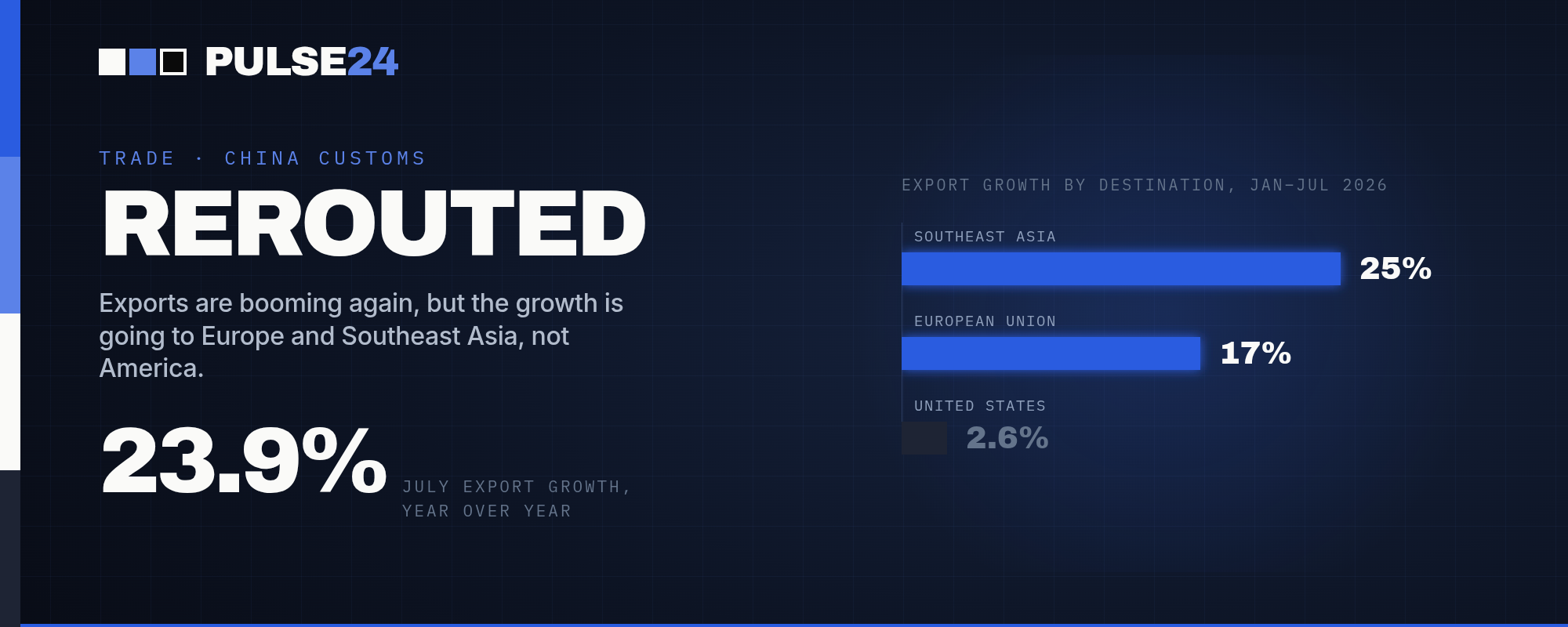
China's exports rose 23.9% in July, but the growth engine has shifted away from the United States over the course of the year: shipments to the US are up just 2.6% for the seven months through July, while exports to the EU and Southeast Asia are growing far faster. The shift says as much about global AI and green-tech demand as it does about tariffs.
China's exports rose 23.9% year over year in July, according to customs data released this week, beating the 22.2% growth economists had forecast. The number that matters more sits one layer down. Shipments to the United States grew just 2.6% over the first seven months of the year, while exports to the European Union rose 17% and exports to Southeast Asia rose 25% over the same stretch.
Washington imposed another round of tariffs on dozens of trading partners, China included, in late July. Chinese exporters barely flinched: shipments to the US actually jumped 17% that month alone, even though the cumulative total for the first seven months of the year is still just 2.6% higher than a year earlier, a gap that says more about a weak start to 2026 than about tariffs working.
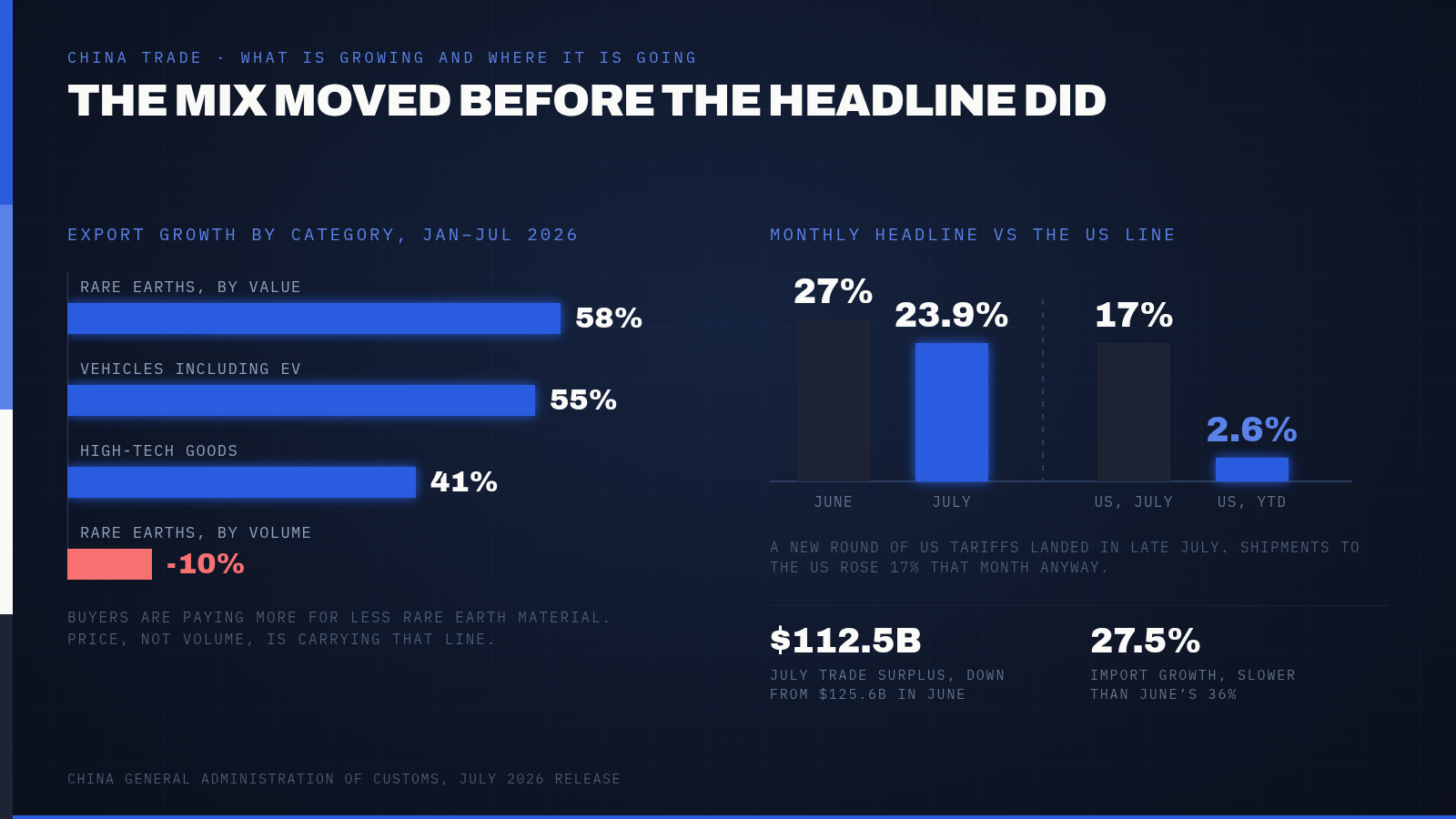
The trade surplus for July came in at $112.5 billion, above the roughly $107 billion economists expected, though narrower than June's $125.6 billion. Imports grew 27.5% year over year, a deceleration from June's 36% pace but still fast enough to suggest domestic demand hasn't collapsed the way some China bears keep predicting.
What Changed
The headline growth rate slowed. June's export growth was 27%; July's was 23.9%. On its own, that deceleration reads like a warning sign. Paired with the destination data, it reads more like a rotation already underway.
High-tech exports rose 41% over the first seven months of the year, according to Chinese customs figures, while electric vehicles and other vehicles combined jumped 55%. Rare earths climbed 58% in value even as the volume shipped fell 10%, meaning buyers are paying up for material they can't easily source elsewhere. None of that growth needed an American customer.
Julian Evans-Pritchard, head of China economics at Capital Economics, described the pattern simply: export and import values remain elevated, helped by soaring global demand for electronics and green tech products. That demand is coming from Europe, from Southeast Asia, and increasingly from the worldwide buildout of AI infrastructure, not from a US consumer facing a fresh round of tariffs.
Why It Matters
For years, the working assumption in markets was that US tariffs functioned as leverage. Raise the rate, squeeze Chinese export volumes, force concessions at the negotiating table. July's data complicates that model. Tariffs went up again in late July, and exports to the US rose 17% that same month, the strongest reading in a year that's otherwise been soft for that relationship. Leverage like that only works if China needs the American market more than it needs its other markets, and the export mix over the full seven months, tilted hard toward the EU and Southeast Asia, suggests otherwise.
There's a second layer here for anyone tracking the AI trade specifically. The US Is Reviewing How China Rents the Nvidia Chips It Can't Buy covered how Washington is trying to close off China's access to advanced compute. July's export data shows the other side of that contest. Even without full access to the newest American chips, Chinese manufacturers are winning a growing share of global electronics and green tech demand, and getting paid more for it, not less. Rare earths are the clearest example: prices are rising even as shipped volumes fall, and Beijing controls enough of that supply chain that global buyers have limited alternatives in the near term.
For the dollar and for Fed watchers, resilient Chinese trade data cuts against the idea that global demand is buckling. A world where Chinese exports keep growing at double-digit rates, just increasingly to Frankfurt and Jakarta instead of Los Angeles, is a world where the case for aggressive rate cuts on global-slowdown grounds gets harder to make.
What to Watch Next
Xi Jinping is expected to visit the United States next month, and trade terms along with restrictions on China's access to advanced technology are likely to be on the agenda. A deal that meaningfully lowers tariffs would be the clearest test of whether Chinese exporters actually need the US market back, or whether the diversification already underway is now the default path regardless of what Washington offers.
Watch the August trade release due in early September for confirmation that the export mix keeps shifting away from the US. Also worth tracking: whether rare earth prices keep climbing on falling volumes, a combination that tends to show up in downstream costs for anything with a battery or a magnet in it, from EVs to wind turbines to the servers powering AI data centers.
The Pulse24 Take
The easy read on China's July trade data is a story about tariffs: rates went up, exports barely slowed, so tariffs must not be working. That's true as far as it goes. It skips the more interesting part.
China's export engine increasingly runs on demand that doesn't route through Washington at all. European carmakers are buying the EV components, Southeast Asian factories are buying the electronics, and Beijing still controls enough of the rare earth supply chain to set its own price when the AI buildout needs batteries and magnets.
Tariffs can tax what's left of the US relationship, but they can't manufacture new American demand for the products driving the growth, and they can't undo a shift toward markets that no longer need Washington's approval to keep buying.
This looks like a structural shift rather than a one-month blip. Investors watching for signs that trade tension is finally denting China's economy should look past the tariff headlines and toward the destination data instead. Right now, the destination data is telling a very different story.
How we read the data
Curious how we get from raw data to a take like this? Our Trader's Toolkit walks through the tools we lean on.
Explore the Toolkit