Pulse24 Original
The US Is Reviewing How China Rents the Nvidia Chips It Can't Buy. Alibaba and DeepSeek Just Gave Washington a Reason to Move Faster.
August 7, 2026
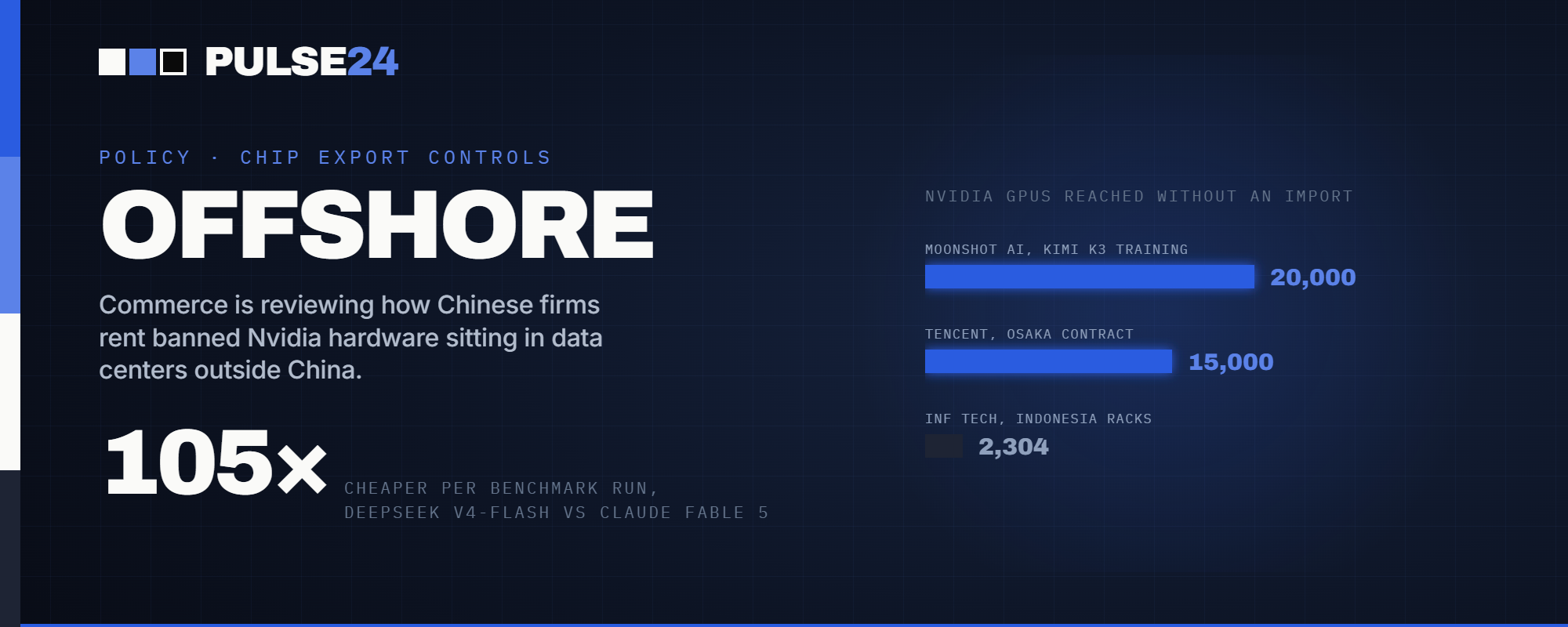
The Commerce Department is examining how Chinese AI firms get around chip export bans by renting Nvidia hardware sitting in data centers outside China. The review comes days after Alibaba and DeepSeek both released models cheap and capable enough to make that workaround worth the trouble.
Qi Yuan didn't need Washington's permission to get his hands on Nvidia's most restricted chips. The Chinese-born American citizen, who also heads Fudan University's AI institute, founded Shanghai-based INF Tech and spent roughly $100 million renting 2,304 Blackwell GPUs racked inside an Indonesian data center, paying a local telecom provider, Indosat Ooredoo Hutchison, instead of buying anything from Nvidia directly. Thirty-two GB200 server racks landed there in October 2025. Nothing about the deal broke US export law, because the chips never left Indonesia and Yuan never touched them physically. He just rented the compute they produced.
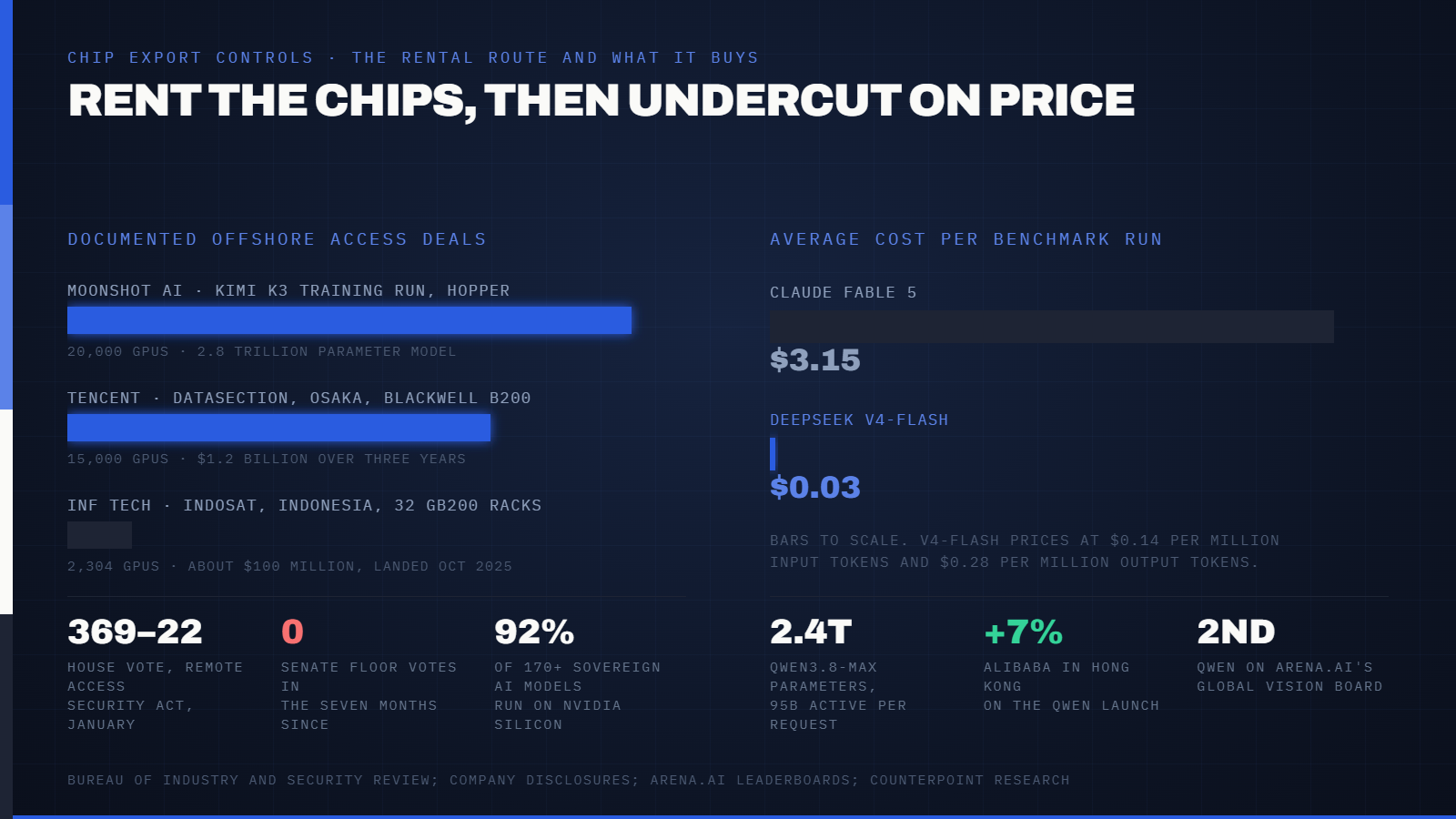
What Changed That workaround is now the specific target of a Commerce Department review. The Bureau of Industry and Security is examining how Chinese AI developers lease Nvidia processing power sitting in third countries, a practice that sidesteps rules written for physical chip sales but says nothing about renting time on chips that never cross into China. Tencent has used the same playbook at larger scale, signing a three-year, $1.2 billion-plus contract with Japan's Datasection for access to 15,000 Blackwell B200 processors in an Osaka-area facility. Smaller versions of the same trick show up at the university level too: Shenzhen University reportedly spent around $28,000 on AWS to reach restricted A100 and H100 chips for research use.
Bloomberg reported the review was prompted specifically by Chinese firms training frontier models on restricted hardware, most notably Moonshot AI's Kimi K3, a 2.8 trillion parameter model trained on roughly 20,000 Hopper-generation Nvidia chips. Days later, Alibaba added its own data point, unveiling Qwen3.8-Max on August 3, a 2.4 trillion parameter model built on a mixture-of-experts architecture that activates only about 95 billion parameters per request, keeping inference costs down while still ranking near the top of Arena.AI's leaderboard, trailing only Anthropic's Claude family among text models and placing second globally on Arena's vision leaderboard. Alibaba shares jumped 7% in Hong Kong on the news. The same week, DeepSeek pushed its V4-Flash model out at prices that make the earlier chip-restriction debate look almost quaint: $0.14 per million input tokens and $0.28 per million output tokens, translating to an average benchmark cost near $0.03, versus roughly $3.15 for a comparable run on Claude Fable 5. That's about 105 times cheaper.
Why It Matters Export controls were built around a simple assumption: if China can't buy the chip, China can't run the model. Renting compute abroad breaks that assumption without breaking the letter of the rule, and Alibaba and DeepSeek just demonstrated why closing that gap now carries higher stakes than it did a year ago. A model that's merely competitive is easy to write off. A model that's competitive and roughly two orders of magnitude cheaper to run changes the calculus for every enterprise deciding which AI provider to build on, and it raises the value of whatever compute route gets a Chinese developer to scale fastest. Congress noticed the same pattern back in January, when the House passed the Remote Access Security Act 369-22 after it cleared the Foreign Affairs Committee 51-0. Representative Michael Lawler put the concern plainly at the time: "Our export controls are only as strong as the weakest link, and right now, the CCP has a real tool to sidestep these prohibitions." The bill has been waiting on the Senate ever since, and this week's review suggests the executive branch isn't willing to wait for it any longer.
For Nvidia, the review sits alongside a business that keeps finding new ways to grow regardless of where the political fight lands. Shares closed at $223.95 on Friday, up 2.26% on the day and keeping the company within reach of the $5.5 trillion market-cap milestone it first touched in May, helped along separately by a Counterpoint Research report showing Nvidia processors inside 92% of the more than 170 sovereign AI models built across roughly 55 countries. Nvidia's hardware has already shown up at the center of other supply deals this year, a reminder that whatever Washington decides about offshore rentals, demand for the chips themselves isn't the part in question.
What to Watch Next The Commerce Department's next move matters most: whether it settles on guidance treating offshore rental contracts the same way it treats direct chip sales, effectively extending export controls to the cloud the way the still-stalled Remote Access Security Act was designed to do. The Senate calendar is worth tracking alongside it. A bill that cleared the House by a nearly 17-to-1 margin in January doesn't usually stall for lack of support, and a fresh Commerce review is exactly the kind of headline that can push a stuck bill back onto the floor schedule. Pricing deserves attention too. If DeepSeek and Alibaba can keep undercutting US labs by this much while still landing near the top of independent benchmarks, the more interesting long-run question may not be who has the better model, but whether the cost of running a merely-good-enough model gets low enough that the compute-access fight ends up mattering more than the capability race ever did.
The Pulse24 Take China wanting Nvidia's chips is old news, true since the first export rule went on the books. What changed this week is how much more attractive the rental workaround just became for both sides of this fight. For Chinese developers, a 105-times cost advantage on inference makes renting foreign compute worth the logistical hassle in a way it wasn't when the models running on it were merely decent. For Washington, watching Chinese firms train frontier-scale models on offshore Nvidia hardware, from Kimi K3's 20,000 Hopper chips to Qwen3.8-Max's benchmark results, is a strong enough signal to accelerate policy rather than let a Senate calendar decide the pace. Nvidia's near-term demand picture stays intact either way; chips sold into sovereign AI projects and hyperscaler buildouts aren't going anywhere. The part actually up for debate is whether a rental contract signed in Osaka or Jakarta should get treated the same way regulators already treat a container ship. That argument just got a lot easier for Washington to make.
How we read the data
Curious how we get from raw data to a take like this? Our Trader's Toolkit walks through the tools we lean on.
Explore the Toolkit