Pulse24 Original
Paramount Just Agreed to Delay Its Own $110 Billion Merger. The Price Tag Is $7 Million a Day.
July 25, 2026
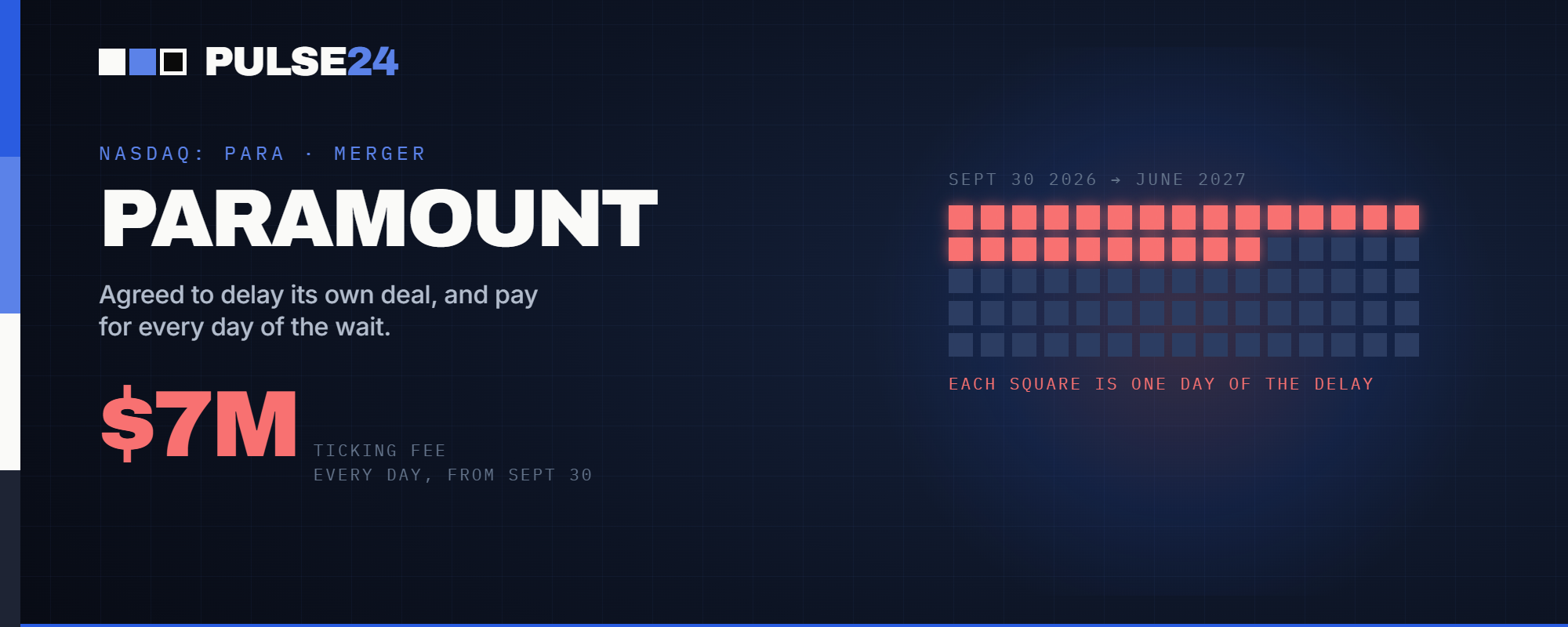
Twelve state attorneys general forced Paramount to push its $110 billion Warner Bros. Discovery merger to June 2027, a delay now costing the company roughly $650 million a quarter, and a preview of how aggressive state-level antitrust enforcement is reshaping the economics of every mega-deal in the pipeline.
What Changed
Paramount Skydance just did something companies almost never do voluntarily: it agreed to slow down its own $110 billion acquisition. In a Friday court filing, Paramount told a federal judge it would hold off closing its purchase of Warner Bros. Discovery until June 2027, or five days after a trial wraps, whichever comes first. The original plan had this deal closing by the third quarter of 2026.
The trigger was a temporary restraining order from Judge Araceli Martínez-Olguín, issued after twelve state attorneys general, led by California's Rob Bonta and joined by New Jersey and ten other states, sued to block the merger outright. Their argument leans on Section 7 of the Clayton Act: combine Paramount and Warner Bros. Discovery and you concentrate too much power over cable bills, movie ticket prices, and what gets made in the first place. Bonta put it bluntly: "When too few corporations have too much power in markets central to American life, it makes things more expensive, and it makes things worse."
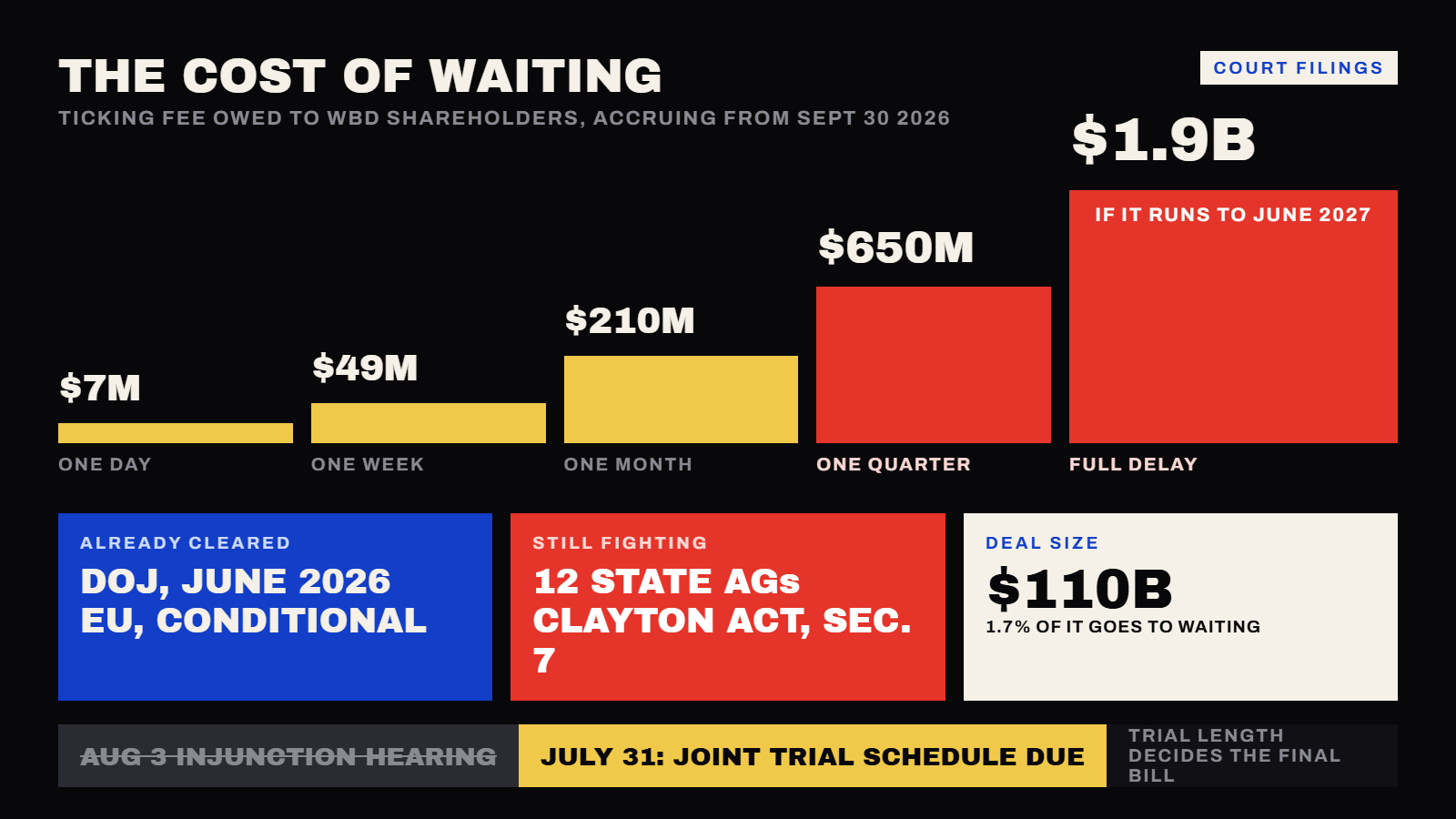
Here's what makes this different from a routine regulatory speed bump. The Department of Justice already cleared this deal back in June. The European Commission signed off too, with conditions attached. This isn't a case of federal antitrust enforcers standing in the way. It's state attorneys general asserting a veto the federal government already declined to use. That's the real story, and it's bigger than Paramount or Warner Bros.
For years, the working assumption in M&A has been that DOJ or FTC clearance is the finish line. State AGs suing afterward, and actually winning a court-ordered pause on a deal this size, changes that math. Deal lawyers now have to underwrite a second, less predictable layer of risk on every large transaction: not just whether Washington signs off, but whether a coalition of state prosecutors decides to fight anyway, and whether they can get a federal judge to agree before the ink dries.
Why It Matters
Delay isn't free. Paramount's agreement includes a ticking fee that starts accruing after September 30: roughly $7 million a day, close to $650 million a quarter, owed to Warner Bros. Discovery shareholders simply for not closing on schedule. Run the clock out to June 2027 and that bill tops $1.9 billion. Paramount is effectively paying nine figures a quarter to prove, in court, that a deal it already negotiated, already has federal approval for, and already has European sign-off on, is legal.
The company framed the concession as confidence, not retreat. A Paramount spokesperson said: "This is the fastest and clearest way to prove that this transaction is good for competition, good for consumers, and good for creators." Analyst Mike Proulx read it differently, telling reporters the deal "just became more uncertain," with the timeline now "longer, messier, and likely more expensive." Both things can be true. Paramount can still win the case in the end. Winning slowly, at $7 million a day, is a meaningfully worse outcome than winning fast.
What to Watch Next
The preliminary injunction hearing that was set for August 3 is cancelled, and both sides withdrew their injunction motions, though either can refile. The next real marker is July 31, when Paramount and the states owe the court a joint trial scheduling statement. That filing will show how long this actually drags on, and trial length is what decides whether the final bill lands closer to $650 million or closer to $1.9 billion. The Writers Guild of America is also still in the fight, on record that "it remains our view that this merger is unlawful." Watch how much appetite other studios and streamers show for their own consolidation moves while this plays out in open court. A coalition of state AGs successfully pausing a done deal is the kind of precedent that sends every general counsel in media back to reread their merger agreements.
The Pulse24 Take
Zoom out and this is less a Hollywood story than a market-structure story. Antitrust enforcement in the U.S. has spent the past decade shifting away from a purely federal, Washington-decides model toward one where a determined bloc of state attorneys general can functionally out-veto the DOJ. That's a structural change in how M&A risk gets priced, not a one-off footnote. Deal arbitrage desks price the probability and timeline of closing; both inputs just got messier for every large transaction sitting in a regulatory queue right now, media or otherwise.
Paramount will still likely land its Warner Bros. Discovery deal. The DOJ and EU sign-offs haven't gone anywhere. What changed this week is the price of getting there, and the assumption that a clean federal green light is the only approval that counts.
How we read the data
Curious how we get from raw data to a take like this? Our Trader's Toolkit walks through the tools we lean on.
Explore the Toolkit