Pulse24 Original
Shopify's Revenue, GMV, Gross Profit and Free Cash Flow All Grew More Than 30% at Once. The Stock Jumped 26%, and Management Says AI Is Why.
August 5, 2026
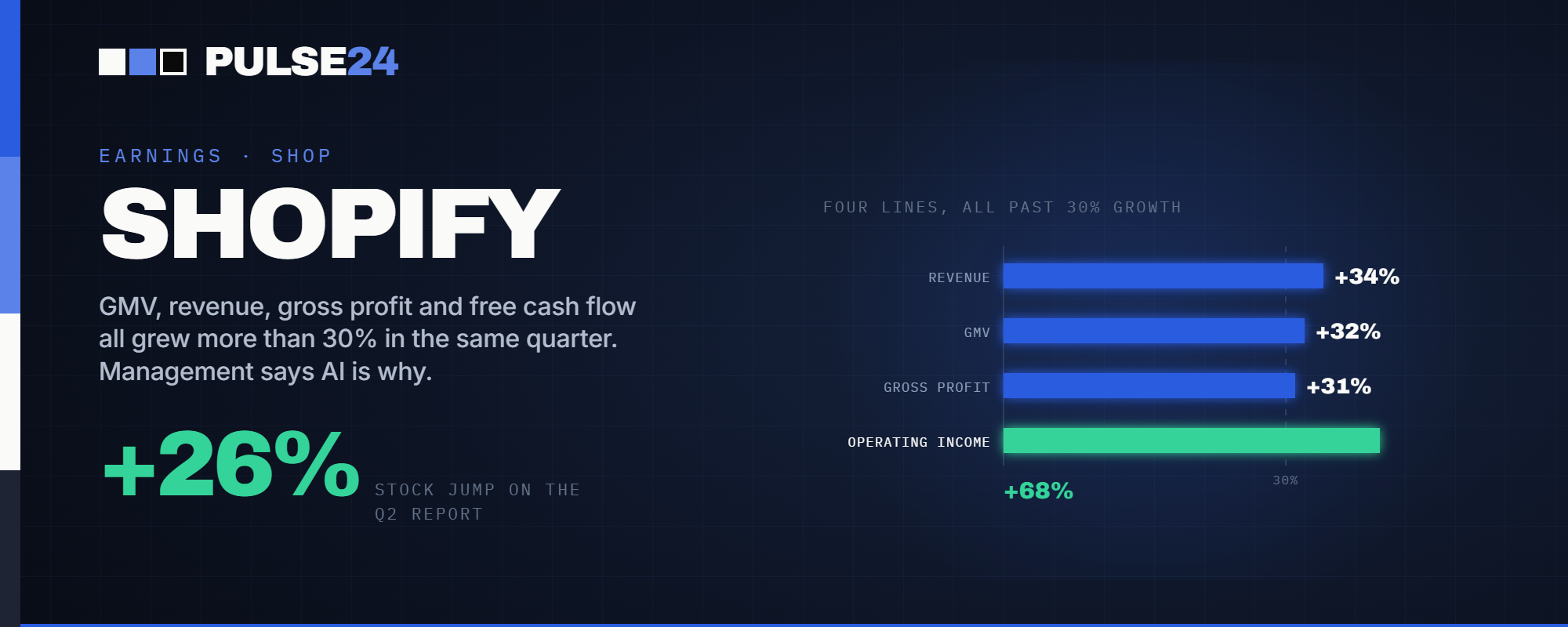
Shopify's GMV, revenue, gross profit and free cash flow all grew more than 30% in the same quarter, and the stock jumped 26% on the news. Management credited AI tools for lifting merchant sales across every size and channel, a rare real-revenue answer to a market that has spent weeks worried about AI spending outrunning AI payoff.
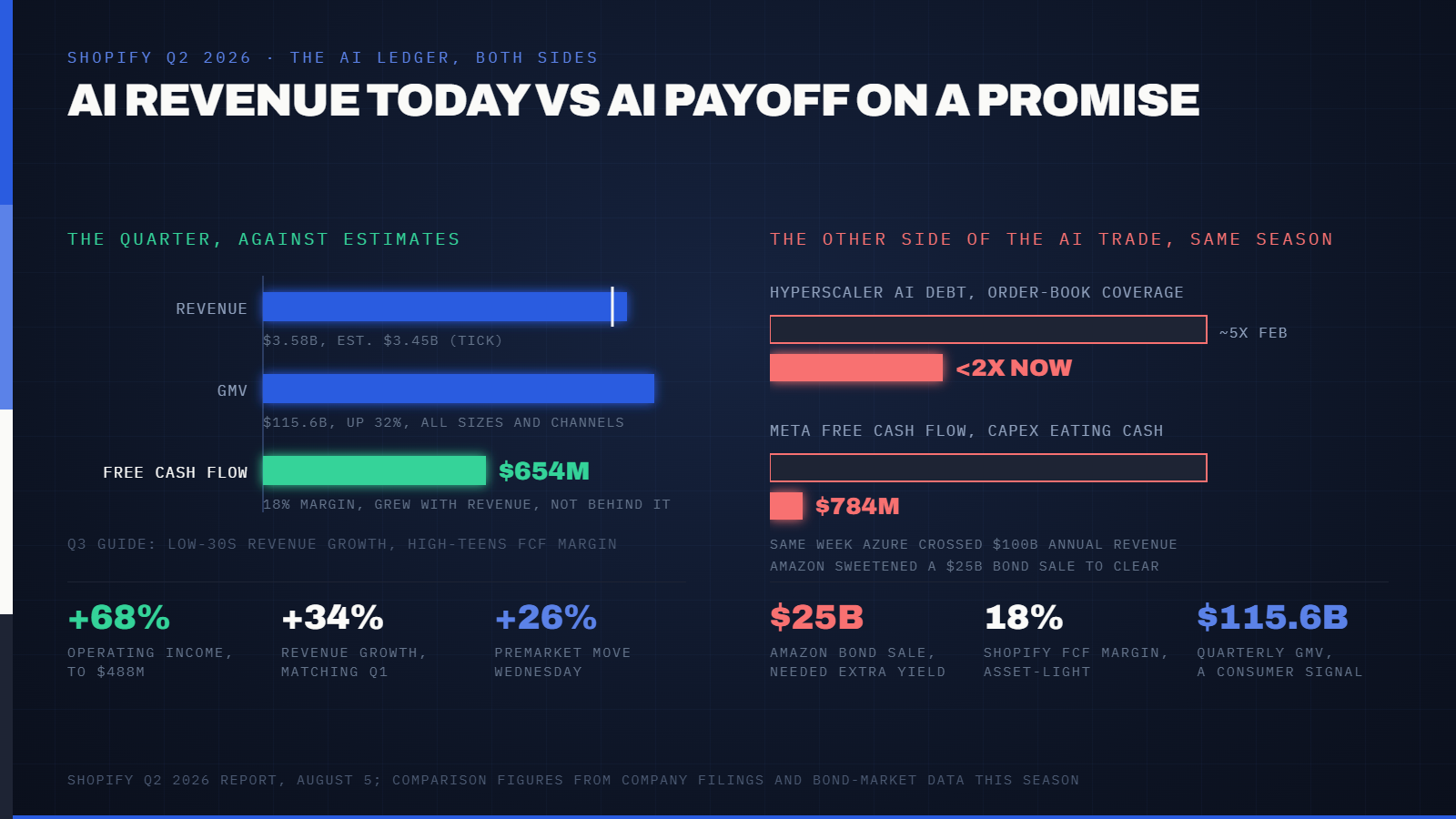
Shopify's stock jumped 26% in premarket trading Wednesday after the company reported second quarter revenue of $3.58 billion, up 34% from a year earlier and about $130 million ahead of the $3.45 billion Wall Street had penciled in. Gross Merchandise Volume, the total value of goods sold through Shopify's platform, climbed 32% to $115.6 billion, while gross profit rose 31% to $1.71 billion. Free cash flow came in at $654 million, an 18% margin. Four numbers, four growth rates above 30%, in the same three months. Shopify President Harley Finkelstein put it plainly: "This was a monster quarter: more than 30% growth in GMV AND revenue AND gross profit AND free cash flow."
What Changed
The headline number is revenue growth holding at 34%, roughly in line with the 34% Shopify posted in the first quarter of the year. What changed is the composition underneath it. Gross profit and free cash flow grew just as fast as revenue this quarter, not slower, which is the part that had been missing from a lot of software and e-commerce results this year. Operating income jumped 68% to $488 million, more than double the rate of revenue growth, evidence that Shopify converted more of each new dollar of GMV into profit rather than spending it on customer acquisition or infrastructure.
Management pointed to a specific driver behind the acceleration: AI tools embedded directly into the merchant experience, from product listings to customer support to checkout. "With AI, we're expanding what's possible for all of them. No one else comes close," the company said of its merchant base, which spans hobbyist sellers on Shopify's basic tier up through large retailers running on Shopify Plus. Shopify's finance chief, Jeff Hoffmeister, framed the growth as broad-based, saying GMV "accelerated on top of last year's already strong Q2 with solid results across all merchant sizes, channels, and geographies." That breadth matters. A single large merchant or a one-off promotional cycle can flatter a quarter's numbers; growth spread evenly across small, medium and large sellers on every channel is harder to wave away as noise.
Why It Matters
Shopify's quarter lands in the middle of a market that has spent the last several weeks nervous about the other side of the AI ledger. Amazon had to sweeten a $25 billion bond sale this month to attract buyers, and order books for hyperscaler AI debt that covered issuance nearly five times in February now cover it less than two times. The debate over whether AI spending is inflationary or deflationary has mostly played out through the lens of capital expenditure: hundreds of billions of dollars a year flowing into chips, data centers and power contracts, with the payoff still mostly a promise. Shopify's numbers are one of the few data points this earnings season showing AI translating into revenue and cash flow today, not a future return investors are being asked to trust.
That contrast looks sharper next to the hyperscalers themselves. Microsoft's Azure crossed $100 billion in annual revenue the same week Meta's free cash flow fell to $784 million, as capital spending on AI infrastructure ate into cash generation. Shopify's free cash flow margin held at 18% while growing more than 30% across every major line item, the advantage of an asset-light business that doesn't carry the depreciation burden of a company building its own data centers. Software companies applying AI to existing customer relationships and hyperscalers building the infrastructure underneath AI are, increasingly, telling two different financial stories in the same earnings season.
There's a second read here that has less to do with AI and more to do with the consumer. GMV growth accelerating across merchant sizes and geographies is, among other things, a signal about spending, and it arrives the same week government data showed factory employment turning positive for the first time in 33 months and a trade deficit that widened to $73.3 billion in June. The Federal Reserve has spent recent weeks weighing whether the economy is running hot enough to justify a hike rather than a cut. A retail platform processing more than $115 billion in a single quarter, growing faster than it did a year ago, is one more data point on the side of resilience, not one that argues for imminent rate relief.
What to Watch Next
Watch how Shopify's results shift the tone on other software and e-commerce earnings still to come this quarter. If AI-driven merchant tools are genuinely lifting Shopify's numbers, competitors selling similar tooling to small businesses should show some version of the same trend; if they don't, that undercuts the AI-attribution story and points instead to a broadly strong retail environment lifting e-commerce platforms together. Also watch Shopify's own Q3 print against its guidance of low-thirties percentage revenue growth. A deceleration back toward historical norms would suggest this quarter benefited from timing or one-off factors; holding steady near 30% for another quarter would make a stronger case that the AI tools are a durable growth driver rather than a one-quarter story.
It's also worth watching whether investors extend the benefit of the doubt Shopify just earned to other AI-native software companies reporting in the weeks ahead, or whether Wednesday's 26% jump turns out to be specific to Shopify's own execution. The gap between AI spending and AI payoff has been the market's central worry for months. One good quarter from one company doesn't close that gap, but it does give bulls a concrete example to point to instead of a projection.
The Pulse24 Take
Every AI story this year has had roughly the same shape: a company spends enormous sums building infrastructure, and investors are asked to trust that revenue eventually catches up. Shopify's quarter flips that script. The company isn't building data centers; it's layering AI into tools merchants already use, and the revenue showed up in the same quarter, not two years down the road on a promise. That's a meaningfully different risk profile than a hyperscaler financing a data center campus with debt against demand that hasn't arrived yet.
None of this means the broader AI capex debate is settled. Data centers and merchant software tools are different investments with different payback periods, and Shopify's own AI spending is a fraction of what Amazon or Microsoft commit in a single quarter. What Wednesday's numbers do show is that the AI story doesn't have to be binary between overhyped and underdelivering. Some parts of it are already paying for themselves, in real dollars, on a quarterly income statement investors can check today. The market's job now is figuring out which parts of the AI trade look like Shopify's Wednesday and which look like a bond sale that needed extra yield to clear.
How we read the data
Curious how we get from raw data to a take like this? Our Trader's Toolkit walks through the tools we lean on.
Explore the Toolkit