Pulse24 Original
Nasdaq Fell 2.9% Friday, Its Worst Session Since June. The 10-Year Yield Fell Too, Even With a December Hike Still Priced In.
October 31, 2026
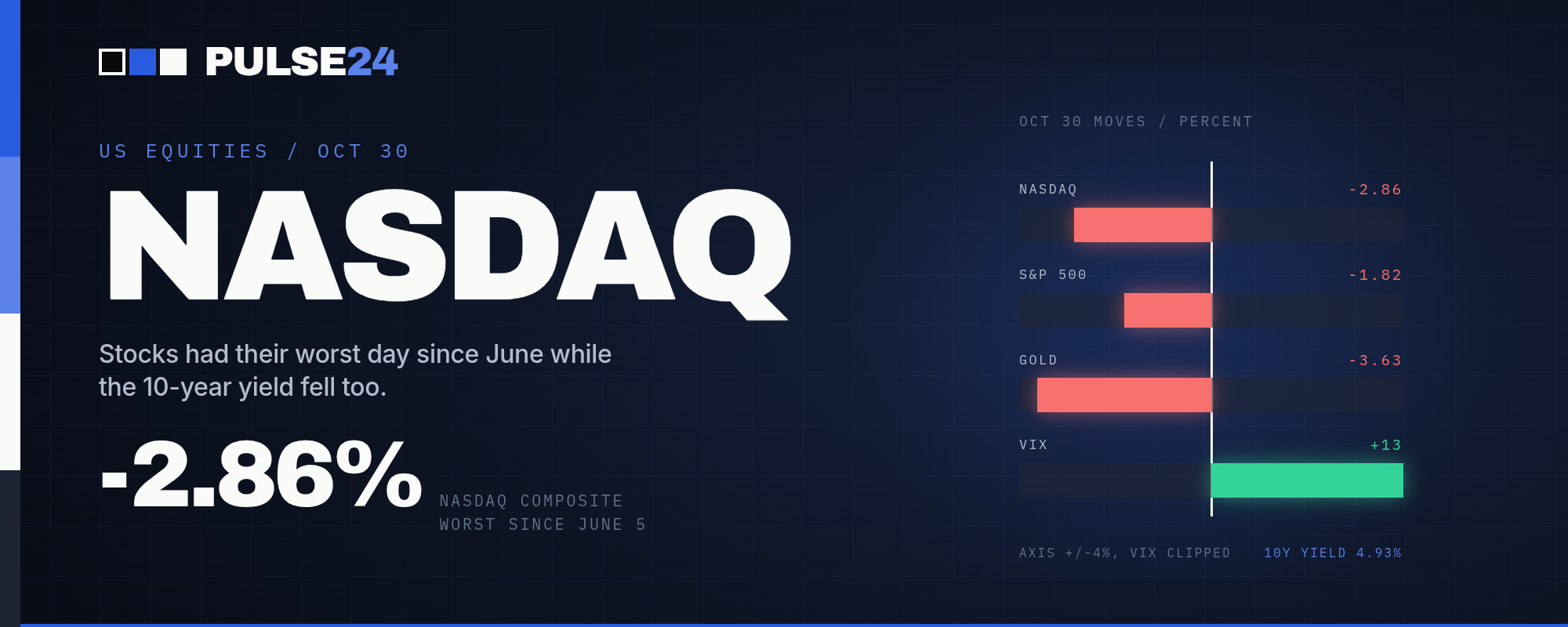
Stocks had their worst day since June on Friday, led by a fresh wave of AI spending jitters from Amazon and Intel. Bond yields fell right alongside them, a sign investors bought safety even with a Fed hike still mostly priced in for December.
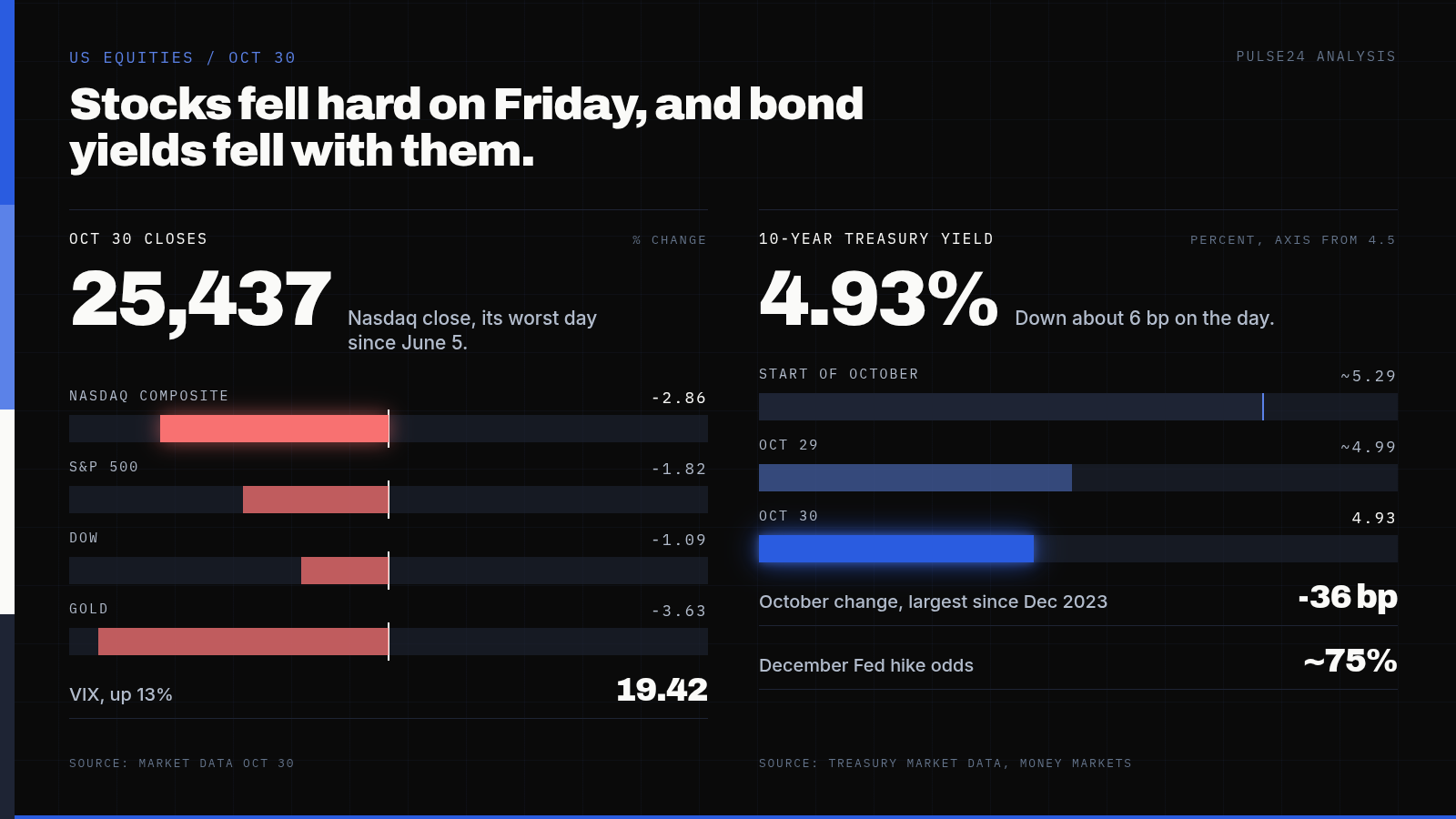
The Nasdaq Composite closed at 25,437.00 on Friday, down 2.86% on the day, its worst single session since June 5. S&P 500 fell 1.82% to 7,580.07, the Dow slipped 1.09% to 51,770.31, and the Cboe Volatility Index jumped 13% to 19.42. Amazon's quarterly report and a fresh demand warning from Intel reopened a question that has hung over this market for months: how much of the AI buildout's spending is actually turning into profit, and how much is still just a bet on it.
What Changed
Amazon's third quarter earnings came in at $1.89 a share, seven cents below what Wall Street expected, with sales landing slightly short too. The bigger number sat lower in the release: free cash flow over the trailing twelve months was a net outflow of $42.4 billion, a record for the company, after roughly $77 billion in quarterly spending on property and equipment. Amazon held its 2026 capital spending plan at $220 billion. Shares fell nearly 6% in response. Amazon's cloud division grew 39% last quarter, its fastest pace since 2021, and that growth is exactly what's funding the cash burn now spooking the stock.
Intel took the hardest single hit. The stock fell 29% on Friday alone, its steepest single day drop on record, after a weak fourth quarter revenue forecast of $15.0 billion to $16.0 billion, below both the third quarter's $16.5 billion and the $17.1 billion analysts expected. The gross margin outlook fell to 38% from 44.1%, and the PC business is being propped up almost entirely by a 78% jump in data center and AI revenue.
Alphabet extended its own slide from earlier in the week, when the stock fell after Microsoft's capital spending came in below forecast while Alphabet's jumped $27 billion in a year, on mounting scrutiny of AI infrastructure spending. Add in Thursday's stumbles from ServiceNow and Fortinet on otherwise solid earnings, and the pattern is hard to miss: good numbers aren't buying tech stocks the benefit of the doubt they used to get.
Why It Matters
What makes Friday's move more than an ordinary tech pullback is what happened in the bond market at the same time.
The 10-year Treasury yield slipped to roughly 4.93%, down about six basis points, even as fed funds futures kept pricing in close to a 75% probability of a rate hike in December. The Fed had held rates at 3.75% to 4.00% in a 10-2 vote two days earlier, with two governors pushing to hike immediately. St. Louis Fed President Alberto Musalem said this week that the central bank needs to act on inflation soon, and Richmond's Tom Barkin argued rates need to rise further still. None of that hawkish talk stopped bonds from rallying on Friday.
That's the tension worth sitting with. A hike priced at 75% should, all else equal, push yields higher, not lower. What overrode it was a flight-to-safety bid strong enough to outweigh the rate outlook, at least for one session, a signal that traders are less focused on where policy lands next month and more focused on what happens to risk assets between now and then.
Gold didn't act like the hedge it's supposed to be, either. The metal fell 3.63% to $3,884.90, extending a pullback that has already erased more than $130 from its October high. Bitcoin dropped 2.73% to $76,710.39, though a reported $6.3 billion hack at Binance muddies how much of that move was market stress versus a separate crypto-specific scare; crypto-linked stocks like Coinbase and Circle fell more than 6% in premarket trading regardless. When bonds rally but gold and crypto both sell off alongside equities, that combination usually points to one dynamic: funds raising cash across the board, not rotating into a single safe haven.
What to Watch Next
The next tell is whether this stays a one-day flush or turns into something longer. Truist's Keith Lerner, writing Friday, put the potential further downside for tech at 2% to 8%, but said the sector's longer-term uptrend remains intact, noting that tech now trades at a lower forward valuation than consumer staples or industrials, an unusual gap by historical standards. Capital.com's Daniela Hathorn framed the shift more bluntly: strong AI demand alone isn't enough anymore, and investors want to see that spending convert into revenue, margin, and free cash flow before they pay up for the story again.
Watch three things heading into next week. The first is whether the 10-year yield's slide holds or snaps back once the initial shock fades, since a snapback would suggest Friday was mostly a liquidity event rather than a genuine growth scare. Second, keep an eye on whether the roughly 75% odds on a December hike move at all, given that a selloff this size has, in the past, been enough to soften a Fed that otherwise sounds resolved to tighten. And gold is the wildcard: if it stabilizes alongside risk assets, that points to forced selling rather than a shift in the macro backdrop. Friday's six basis point move in yields is modest next to the 19 basis point plunge this market saw earlier this year, its steepest since the SVB collapse, a reminder of how fast bond moves can accelerate once a real flight to safety takes hold.
The Pulse24 Take
Friday's selloff wasn't really about any one company. Intel's PC business is shrinking, Amazon's cash flow went deeply negative, and Alphabet's spending keeps climbing, but those are three different stories about three different businesses. What ties them together is a market finally asking whether the payoff from AI spending is keeping pace with the bill for it, with bond traders answering that question by buying safety even while the Fed keeps talking about hiking. Stocks falling, yields falling, and a hike still mostly priced in all at once doesn't resolve itself in a single session. Whether Monday brings the dip buyers back or marks the start of the market demanding proof instead of promises from the AI trade is the thing worth watching most.
How we read the data
Curious how we get from raw data to a take like this? Our Trader's Toolkit walks through the tools we lean on.
Explore the Toolkit