Pulse24 Original
Amazon's Cloud Business Grew 39% Last Quarter, Its Fastest Pace Since 2021. Free Cash Flow Still Went $57 Billion Backward.
October 30, 2026
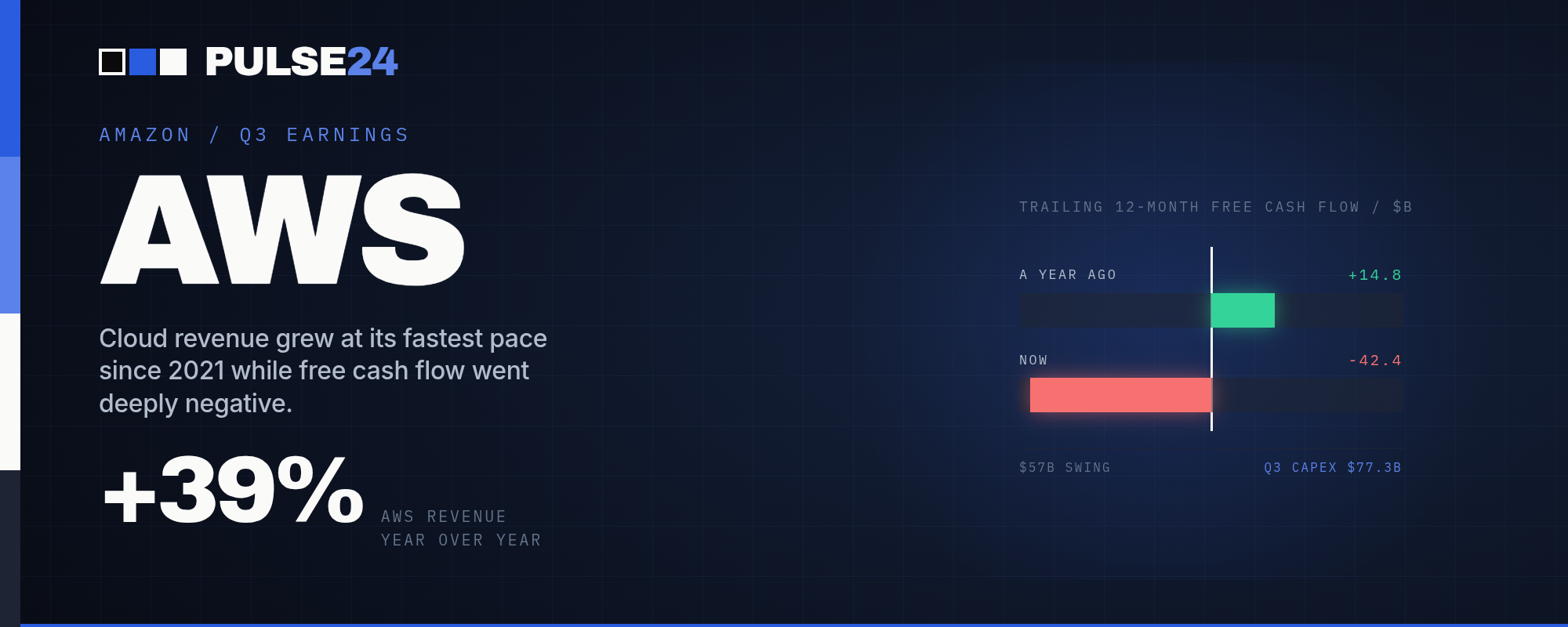
AWS grew at its fastest clip in nearly five years last quarter, crossing a $184 billion run rate. Amazon's free cash flow still swung tens of billions of dollars negative as AI infrastructure spending outran the cash coming in, and the stock fell anyway.
Amazon's cloud division grew revenue 39% last quarter, the fastest pace since 2021, back when the whole industry was living through the pandemic era shift to remote everything. Investors sold the stock anyway.
The headline numbers from Thursday's report told two different stories depending on which line investors read. Revenue came in at $201.9 billion, up 12.1% from a year earlier and close to the roughly $202.3 billion analysts expected. Earnings per share landed at $1.89, short of the $1.96 Wall Street had modeled. Shares fell as much as 11% within minutes of the numbers crossing the wire in after hours trading, then pared that back to a decline of roughly 6% to 7% as the call went on, down from Thursday's regular session close of $243.79.
What Changed
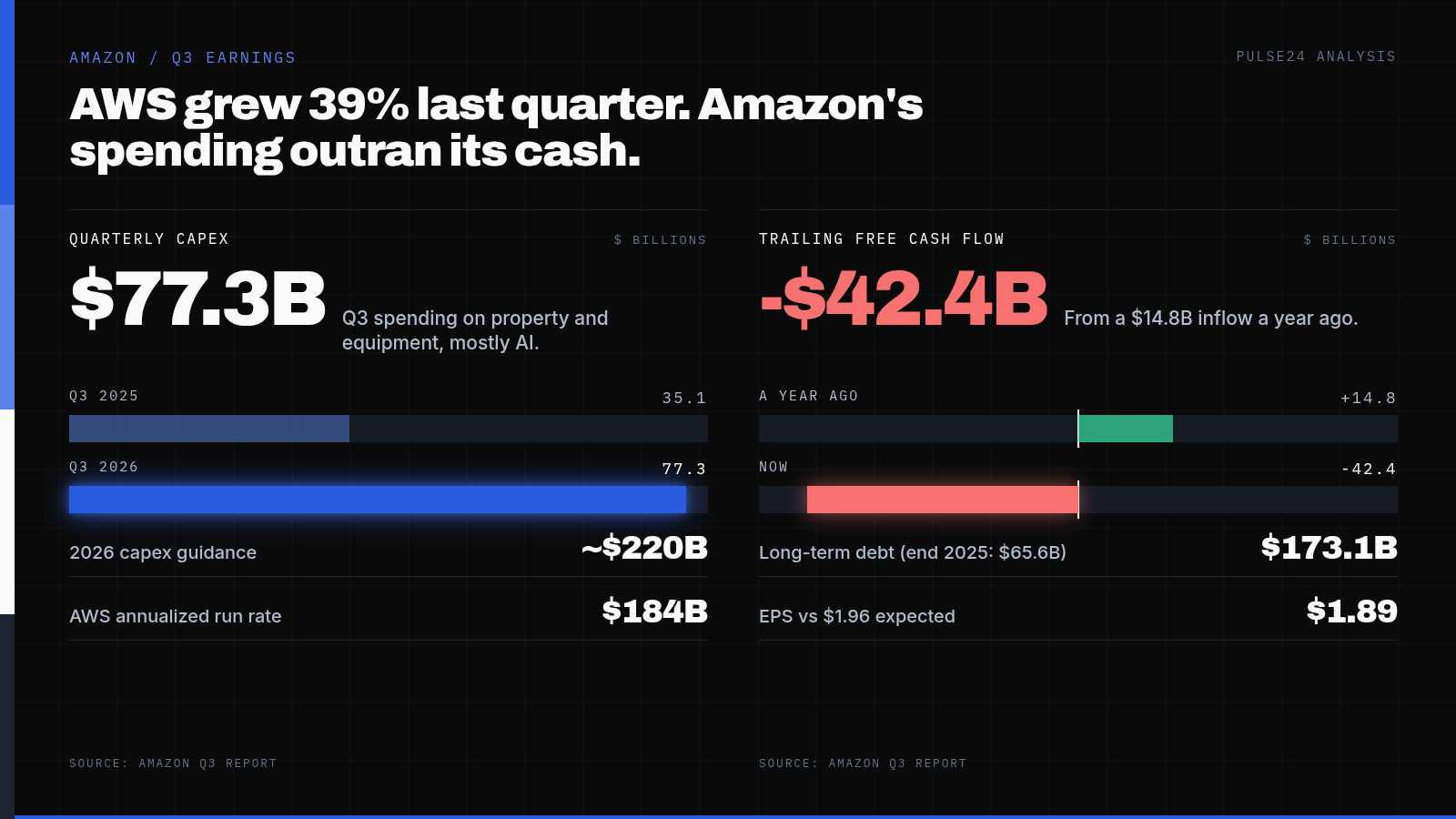
AWS, Amazon's cloud computing arm, is the business actually accelerating. Revenue there rose 39% year over year to roughly $46 billion, up from $33 billion a year ago, pushing the unit's annualized run rate to $184 billion. CEO Andy Jassy called it AWS's fastest growth in nearly five years and told analysts on the call he expects growth north of 40% in both 2027 and 2028. That is not a modest claim for a cloud business already generating well over $180 billion a year in revenue.
The catch sits a few lines further down the income statement. Amazon spent $77.3 billion on property and equipment in the third quarter alone, more than double the $35.1 billion it spent in the same quarter last year, with nearly all of the increase going toward data centers, chips, and the power infrastructure needed to run them. Trailing twelve month free cash flow swung from a $14.8 billion inflow a year ago to a $42.4 billion outflow now, a reversal of more than $57 billion in twelve months. Long term debt climbed to $173.1 billion from $65.6 billion at the end of 2025, as Amazon borrowed to help cover the gap.
Net income also fell slightly from a year ago, down roughly 2%, though that comparison flatters the current quarter more than it hurts it. The year ago period included a large pretax gain tied to Amazon's stake in Anthropic, a gain that did not repeat this quarter. Strip that one time item out and the underlying operating trend looks considerably better: operating margin rose to 13.9% from 9.7% a year earlier, even with all the new spending layered on top.
Why It Matters
Amazon just became the latest hyperscaler to post a quarter where the cloud numbers look great and the market marks the stock down anyway, following Microsoft and Alphabet's own capex driven stock swings earlier this week. Microsoft's AI spending actually came in below forecast and its stock held up fine. Alphabet's capex jumped and its stock fell 10%. Amazon's capex guidance just moved higher too, to about $220 billion for the year, and investors responded by selling first and asking about the growth later.
What's different this time is the financing. Meta covered its AI buildout by selling $95 billion in stock, diluting shareholders rather than adding debt. Amazon went the other direction, nearly tripling its long term debt in under a year. Both approaches get the data centers built. Only one of them shows up as leverage on the balance sheet if AI demand ever cools before the spending does.
The market's patience with this trade has a shelf life, and nobody knows exactly how long it is. Revenue growth of this size, 39% inside a cloud business already doing $184 billion a year, is rare enough that most investors are willing to look past a cash flow statement that would alarm them in almost any other context. That tolerance assumes the demand behind the spending is real and durable, not a temporary burst tied to a handful of large AI customers signing unusually large contracts at once.
What to Watch Next
The next checkpoint is Amazon's fourth quarter report, due in early 2027, which will show whether AWS can sustain growth near 40% through the holiday season while capex climbs further still. Amazon guided fourth quarter revenue to a range of $240.0 billion to $247.0 billion, implying growth of 12% to 16% from a year earlier, which would be among its strongest holiday quarter growth rates in years if it lands at the top of that range.
Also worth tracking is how much higher long term debt climbs from here, and whether rating agencies start treating the hyperscalers' AI borrowing the way they treat any other capital intensive buildout. A $173 billion debt load is still manageable for a company Amazon's size. The number that matters more is the rate of change, not the current level, and that rate has been steep all year.
The Pulse24 Take
Amazon's quarter restates something already true across this earnings season: demand and spending are being priced by the market as the same story now, not two separate ones. Growth that would have been celebrated outright two years ago gets measured today against how much cash it costs to produce, and lately that cost has been climbing faster than the growth itself.
None of this means the AI buildout is overextended. AWS growing 39% off a $184 billion run rate is a genuinely large, genuinely accelerating business, not a speculative one. But the gap between operating performance and free cash flow is wide enough, and growing fast enough, that it deserves more scrutiny than a single earnings call can give it. The next few quarters of capex guidance will say more about where this goes than this week's stock reaction did.
How we read the data
Curious how we get from raw data to a take like this? Our Trader's Toolkit walks through the tools we lean on.
Explore the Toolkit