Pulse24 Original
Meta Is Selling $95 Billion in Stock to Pay for AI. CoreWeave Had to Borrow at 15% Interest for the Same Thing.
October 27, 2026
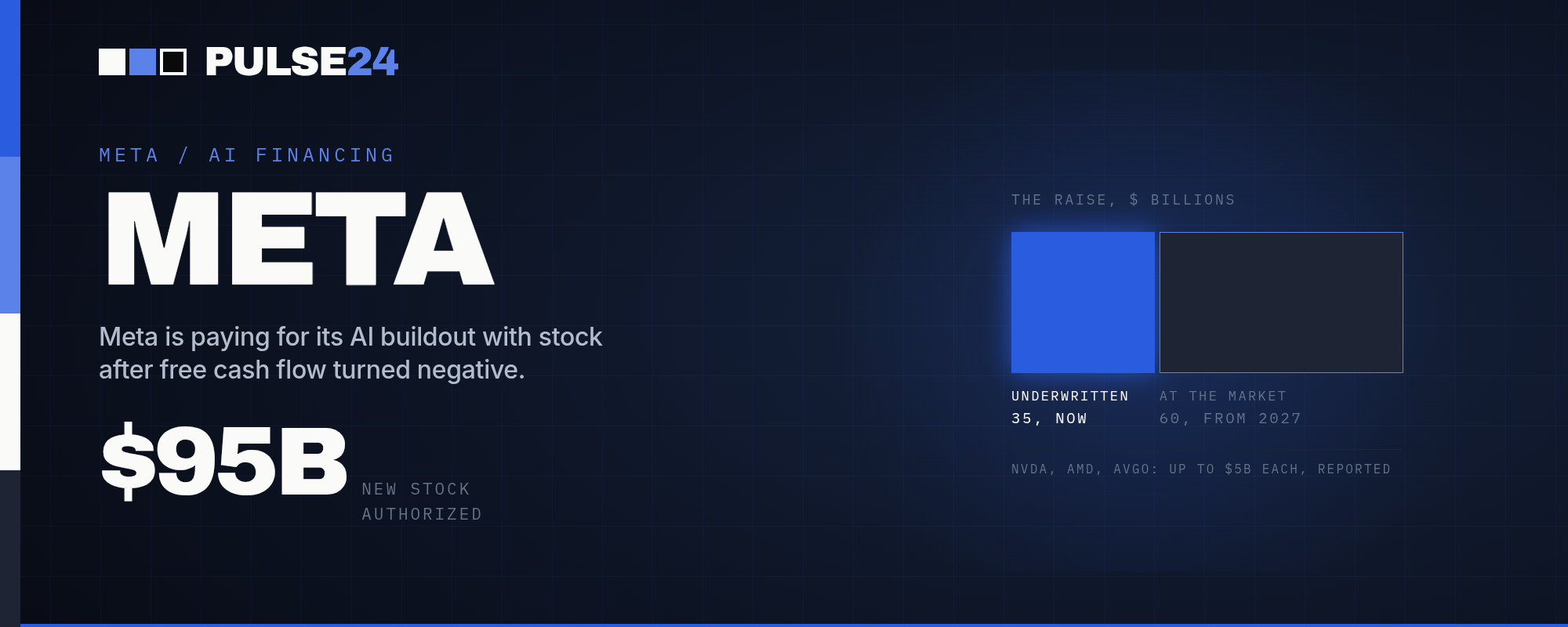
Meta's board approved a historic $95 billion stock sale this week, with chipmakers Nvidia, AMD, and Broadcom reportedly lining up to buy in themselves. Across the rest of the AI buildout, that kind of access to cheap capital is increasingly the line separating the winners from the ones stuck paying double digit yields on junk bonds.
Ninety five billion dollars. That is how much Meta's board authorized the company to raise in new stock this week, split between a $35 billion underwritten offering that priced immediately and a $60 billion at-the-market program meant to trickle shares into the market over the next several years. Nvidia, AMD, and Broadcom are reportedly circling the deal too, each weighing purchases of up to $5 billion of the new shares.
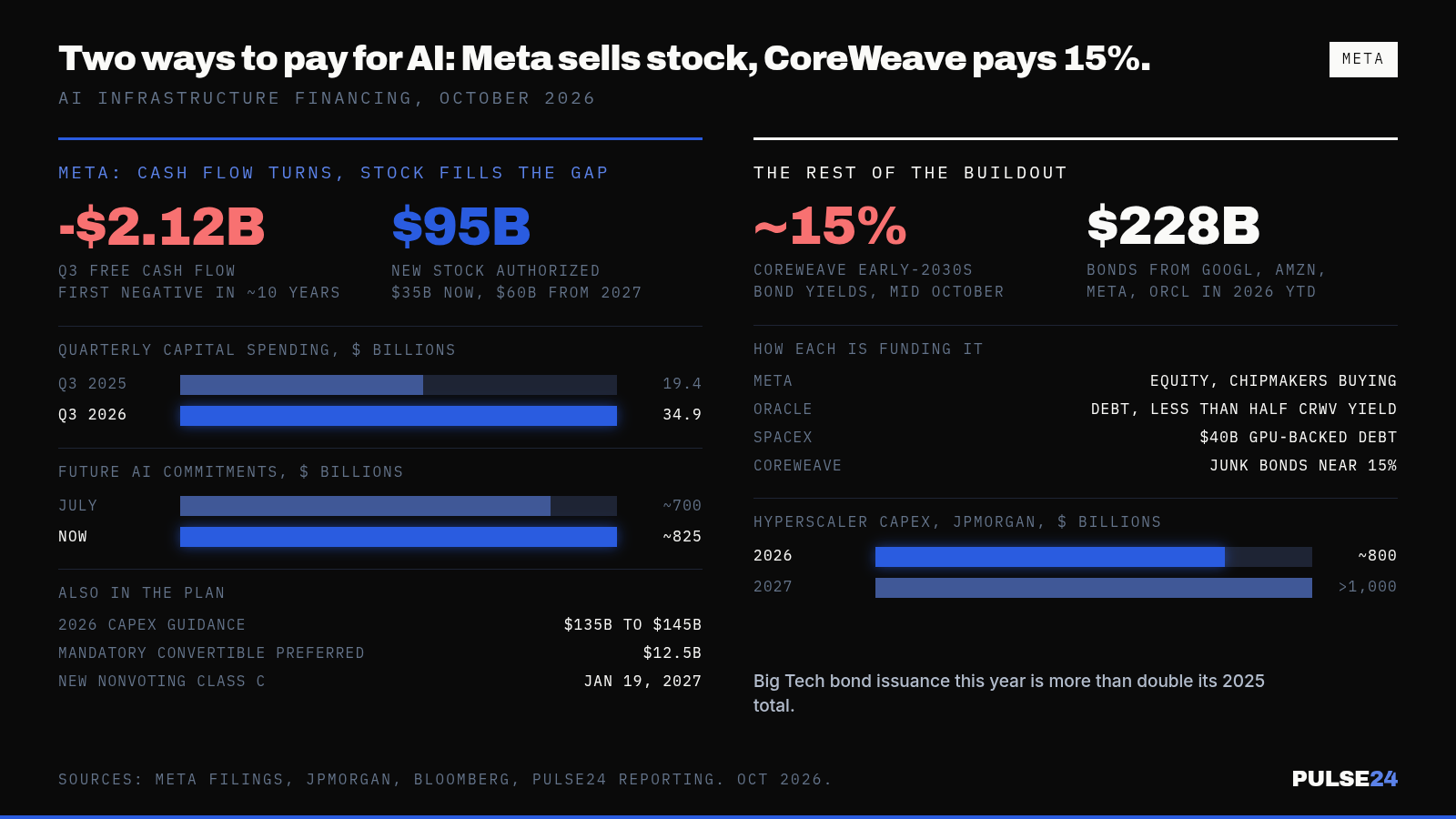
The size alone makes this one of the largest equity raises by any US company in 2026. The timing says more. Days earlier, Meta reported its first negative free cash flow quarter in roughly a decade: a $2.12 billion shortfall in the third quarter, against capital spending of $34.9 billion, nearly double the $19.4 billion it spent in the same period last year. Pulse24 covered that reversal when it first hit the stock; this is the sequel, and it tells you something the earnings call didn't quite spell out: even the companies with the deepest pockets in the AI race are starting to run short of cash.
What Changed
Meta's new capital comes in an unusual shape. The $35 billion piece splits into common stock and $12.5 billion of Series A depositary shares, each representing a 1/20th interest in a mandatory convertible preferred share with a $1,000 liquidation preference. Those preferred shares pay a cumulative dividend and are set to convert into common stock by August 2029, with underwriters holding an option to expand the deal further. The $60 billion at-the-market program is designed to be quieter: shares sold gradually, starting early next year, rather than placed all at once.
Meta is also creating a new class of stock altogether. A nonvoting Class C share, effective January 19, 2027, will go out to every Class A and Class B holder as a one time dividend, functioning much like a two for one split without changing anyone's voting power, Mark Zuckerberg's included. The company says the new shares can be used to raise capital, pay employees, or fund acquisitions. A special committee of independent directors recommended the move, and Zuckerberg separately signed what the company calls a Founder Alignment Agreement covering his own future stock sales.
None of this is happening in isolation. Meta's own regulatory filings now show roughly $825 billion in future spending commitments tied to AI data centers, energy, and compute, up from near $700 billion in July. That includes $356 billion in leases that haven't started yet and $455 billion in contracts the company can't cancel, with $121 billion of it due in 2027 alone. Meta's 2026 capital spending guidance has climbed to $135 billion to $145 billion, up from a floor of $130 billion just one quarter ago.
Why It Matters
Every company racing to build AI infrastructure needs to answer the same question: who pays for it, and how. Meta's answer, for now, is equity. Investors who buy into the offering are betting the buildout eventually pays for itself, and chipmakers themselves want a piece of it. That Nvidia, AMD, and Broadcom are reportedly willing to buy shares in their own biggest customer is notable on its own, since it is the kind of circular financing arrangement that has already drawn scrutiny elsewhere in the industry.
Compare that to how the rest of the AI buildout gets funded. CoreWeave fell 24% in a single week in October without missing an earnings estimate, purely on worries about how it pays for the data centers it's building. Its bonds due in the early 2030s were trading at yields near 15% in mid October, more than double what Oracle, the only other non-investment-grade name among the major AI issuers, pays on its own 2032 notes. SpaceX recently closed $40 billion in GPU-backed debt rather than tapping equity markets at all, a choice that reflects how differently lenders and investors price these companies. Credit appetite for the sector has cooled quickly too: AI related debt issuance collapsed roughly 80% over three months earlier this year, with at least one Oracle linked loan package trading at 90 cents on the dollar.
Put the two stories side by side and a pattern emerges. Businesses with cash generating operations to point to, even ones currently burning cash on AI, can still raise tens of billions in equity on reasonable terms. The ones without that cushion are stuck paying double digit yields, or borrowing against the hardware itself. Alphabet, Amazon, Meta, and Oracle have issued a combined $228 billion in bonds through mid October, more than double their 2025 total, and JPMorgan estimates hyperscaler capital spending is running near $800 billion this year and could top $1 trillion annually by 2027. The capital is still flowing. Where it comes from, and at what cost, is starting to separate winners from the rest.
What to Watch Next
Microsoft, Alphabet, and Amazon all report earnings this week, and every call will face the same question Meta just answered for itself: how much more capital spending is coming, and how will it get funded. Whether any of them follow Meta toward a large equity raise rather than leaning on debt is worth watching closely. So is how Meta's own at-the-market program trades once it starts selling shares in 2027, since a slow drip of new supply hits per share earnings differently than a one time sale would. CoreWeave reports again in November, and its CEO has argued that contract backlog alone covers its debt obligations. Whether the bond market agrees by then will say a lot about where this financing gap goes next.
The Pulse24 Take
Markets have spent most of 2026 treating AI capital spending as a single story: everyone is spending enormous sums, and the only question was whether revenue would catch up. That framing is breaking down. There are now, in effect, two different AI buildouts underway: one financed by companies that can issue equity to interested buyers, Nvidia and AMD among them, and one financed by debt markets charging rates that reflect real doubt about repayment. Meta sitting in the first group doesn't make its bet safe. A free cash flow swing from positive to negative in a single year is a real signal, not a rounding error, and diluting shareholders to cover it is a cost too, just a different kind than an interest payment. What it does mean is that the AI trade is no longer one trade. Investors sorting through it from here need to ask which group a given company sits in, not just how fast it is spending.
How we read the data
Curious how we get from raw data to a take like this? Our Trader's Toolkit walks through the tools we lean on.
Explore the Toolkit