Pulse24 Original
Meta Posted Negative Free Cash Flow for the First Time in a Decade. The Nasdaq Fell 2.7% on the News.
October 22, 2026
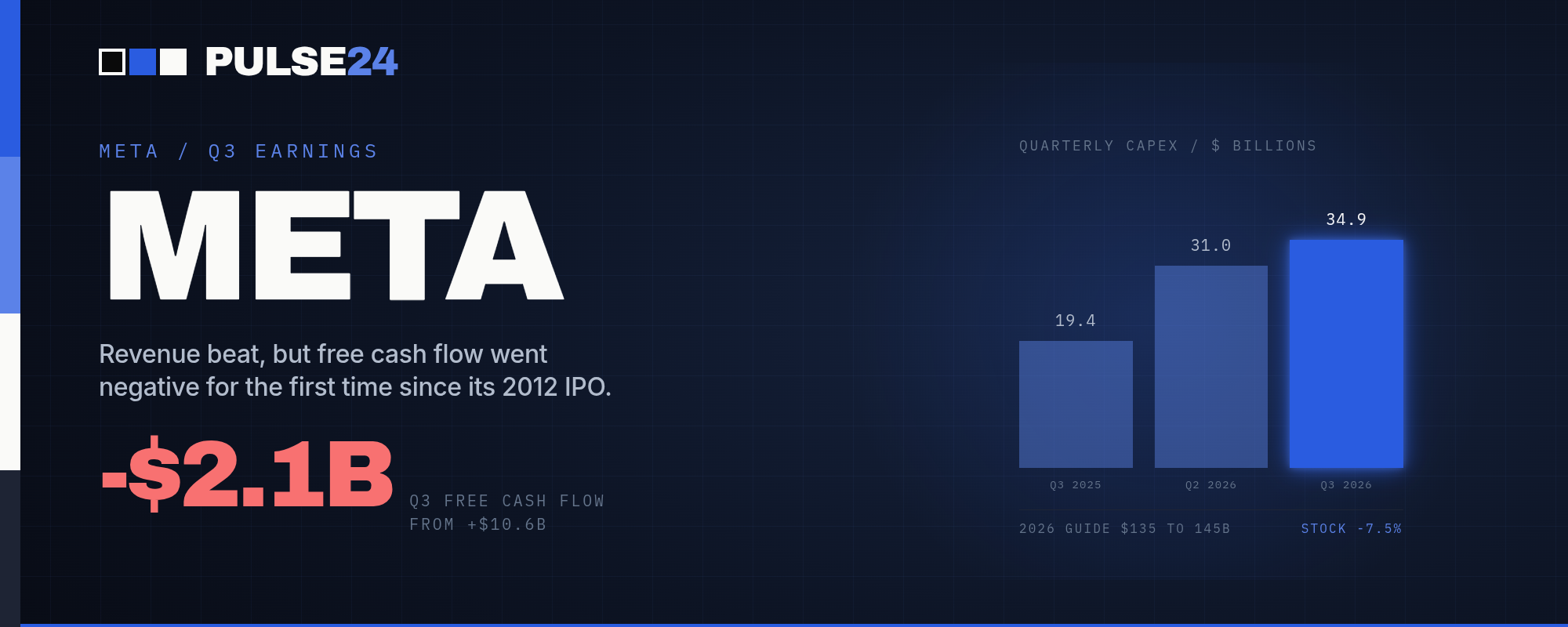
Meta beat Wall Street's revenue estimate by a wide margin and still watched its stock fall 7.5%, as its first negative free cash flow since going public in 2012 helped trigger a broader selloff across chip and AI infrastructure stocks. The Nasdaq dropped 2.68% and the semiconductor index fell more than 6% to its lowest level since July.
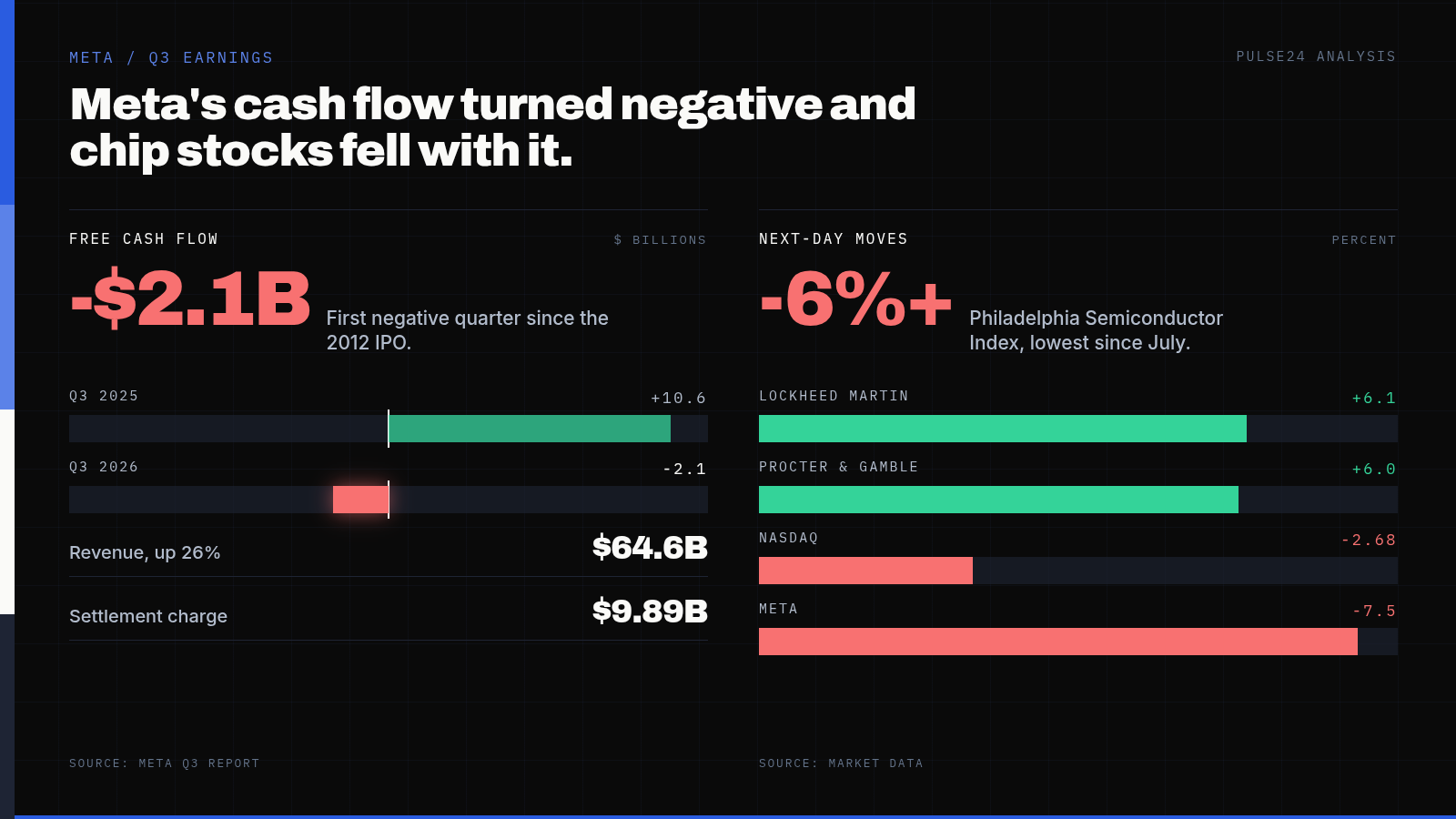
Meta Platforms reported $64.6 billion in third-quarter revenue on Wednesday, up 26% from a year earlier and ahead of the $63.3 billion analysts expected. Shares fell 7.5% the next day anyway, and semiconductor stocks fell even harder.
Quarterly capital expenditure reached $34.9 billion, up from $31 billion in the second quarter and $19.4 billion a year ago. Operating income dropped 37% to $13 billion, largely because of a $9.89 billion charge tied to a settlement of up to $18.59 billion with 52 state attorneys general over youth-safety practices. Strip that charge out and operating income would have been $22.88 billion, comfortably above what Wall Street modeled.
What Changed
The number that actually moved the market wasn't revenue or the settlement charge. It was free cash flow, which swung to negative $2.1 billion from positive $784 million in the second quarter and positive $10.6 billion a year ago. That's Meta's first quarterly cash outflow since it went public in 2012, and it landed the same week management raised the low end of its 2026 capital spending guidance to $135 billion, from $130 billion previously, while keeping the top end at $145 billion.
Visible Alpha's consensus had already priced in roughly $140 billion for Meta this year, nearly double what the company spent in 2025. Zoom out further and the pattern holds across the industry: analysts there expect combined tech infrastructure capex to reach $790 billion in 2026 and climb to $1.2 trillion in 2027, up from $404 billion in 2025. Meta isn't an outlier. It's the biggest single data point in a trend that's been building for two years.
Why It Matters
Wall Street has tolerated heavy AI spending for two years on the promise that it would eventually show up in returns. Thursday's reaction suggests that patience is thinner than it looks. The Nasdaq Composite fell 2.68%, or 712.85 points, to 25,988.10. The S&P 500 lost 1.41%, while the Dow, which carries less tech exposure, slipped just 0.20%. The gap between those three numbers tells the real story. Money didn't leave the market Thursday; it rotated out of anything tied to AI infrastructure spending and into stocks seen as safer.
The Philadelphia Semiconductor Index absorbed the worst of it, falling more than 6% to its lowest level since July 29. Western Digital, Intel, Sandisk and Marvell each lost more than 7%. It's the second sharp chip selloff this month: a separate, multi-session losing streak earlier in October had only just ended a couple of days earlier, a reminder that this sector has been volatile well before Thursday.
Not every AI-adjacent stock moved the same way. CoreWeave, which had already fallen 30% since late September on similar capex-return anxiety, continued to trade as a proxy for investor skepticism about whether cloud AI providers can turn spending into profit. Tesla, which had cut $5 billion from its 2026 spending plan just a day earlier and posted unexpectedly positive free cash flow, fell just 2.1%, a far gentler landing than Meta's. The gap suggests the market is drawing a real line between companies pulling back on AI spending and those still ramping it up.
Oliver Pursche, senior vice president at Wealthspire Advisors, summed up the mood: "There's a hypersensitivity around earnings for AI-related stocks." Melissa Otto, global head of Visible Alpha research at S&P Global, pointed to the underlying tension: investors still want clarity on how this spending will eventually produce shareholder returns, and so far that clarity hasn't arrived.
What To Watch Next
The next test comes from the rest of the AI infrastructure complex over the following weeks, as other hyperscalers report earnings and update their own capex plans. If more companies follow Meta's pattern of higher spending paired with a thinner near-term payoff, expect pressure on AI-linked names to continue. Thursday's gainers told a more mixed story than a simple flight to safety: Lockheed Martin rose 6.1%, Procter & Gamble gained 6.0%, and Union Pacific added 2.9%, but all three also posted their own earnings beats that morning, so company-specific results did real work alongside any rotation out of AI spending plays.
Markets are also still digesting a macro backdrop where year-end Fed policy remains an open question and oil prices sit at a five-month high, adding a layer of inflation concern on top of the AI spending debate. Neither is the main story here, but both make the market less forgiving of disappointing capex-to-returns math.
The Pulse24 Take
Meta didn't miss. It beat revenue estimates, grew 26% year over year, and still watched its stock fall 7.5% in a single session. That disconnect is the clearest signal yet that the market has moved past judging AI spending on growth alone and started judging it on cash. A company can post record revenue and still get punished if free cash flow goes negative while capex guidance keeps climbing. For investors watching this theme, the question is no longer whether these companies can grow. It's whether they can prove the spending converts into something investors can bank on, and until that proof shows up, the market may keep treating every AI capex update as a reason to sell first and ask questions later.
How we read the data
Curious how we get from raw data to a take like this? Our Trader's Toolkit walks through the tools we lean on.
Explore the Toolkit