Pulse24 Original
Tesla Cut $5 Billion From Its 2026 Spending Plan, Landing Right Back Where Wall Street Guessed in April
October 22, 2026
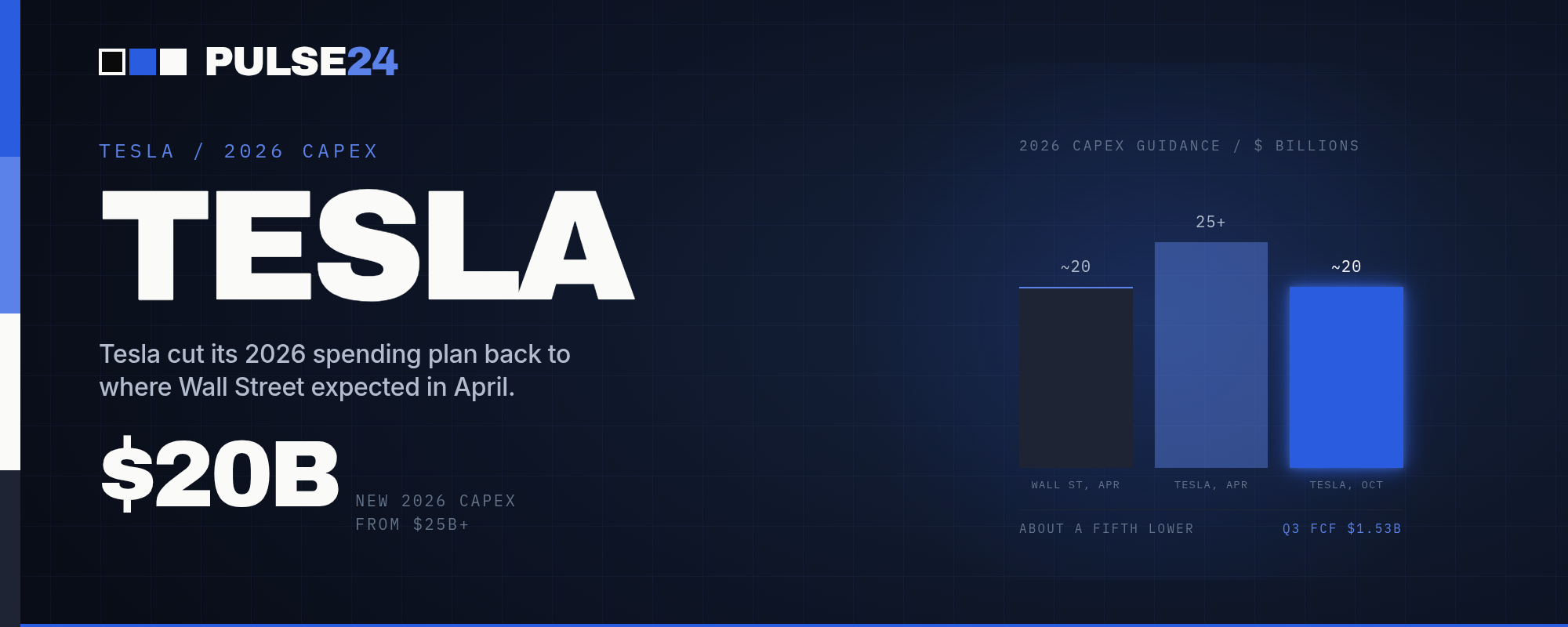
Tesla cut its 2026 capital spending target to about $20 billion, down from the more than $25 billion it promised in April, even as free cash flow swung positive and Elon Musk kept talking up Optimus and a possible SpaceX merger. The move lands the company right back at the number Wall Street expected before the spring's AI spending surprise.
Twenty billion dollars. That is Tesla's new ceiling for 2026 capital spending, disclosed Wednesday alongside third-quarter results. Back in April, the company told investors to expect more than $25 billion for the year, a figure that itself surprised Wall Street, which had been modeling closer to $20 billion. Six months and two quarters later, Tesla landed almost exactly where the market guessed before Musk's team revised the number upward.
What Changed
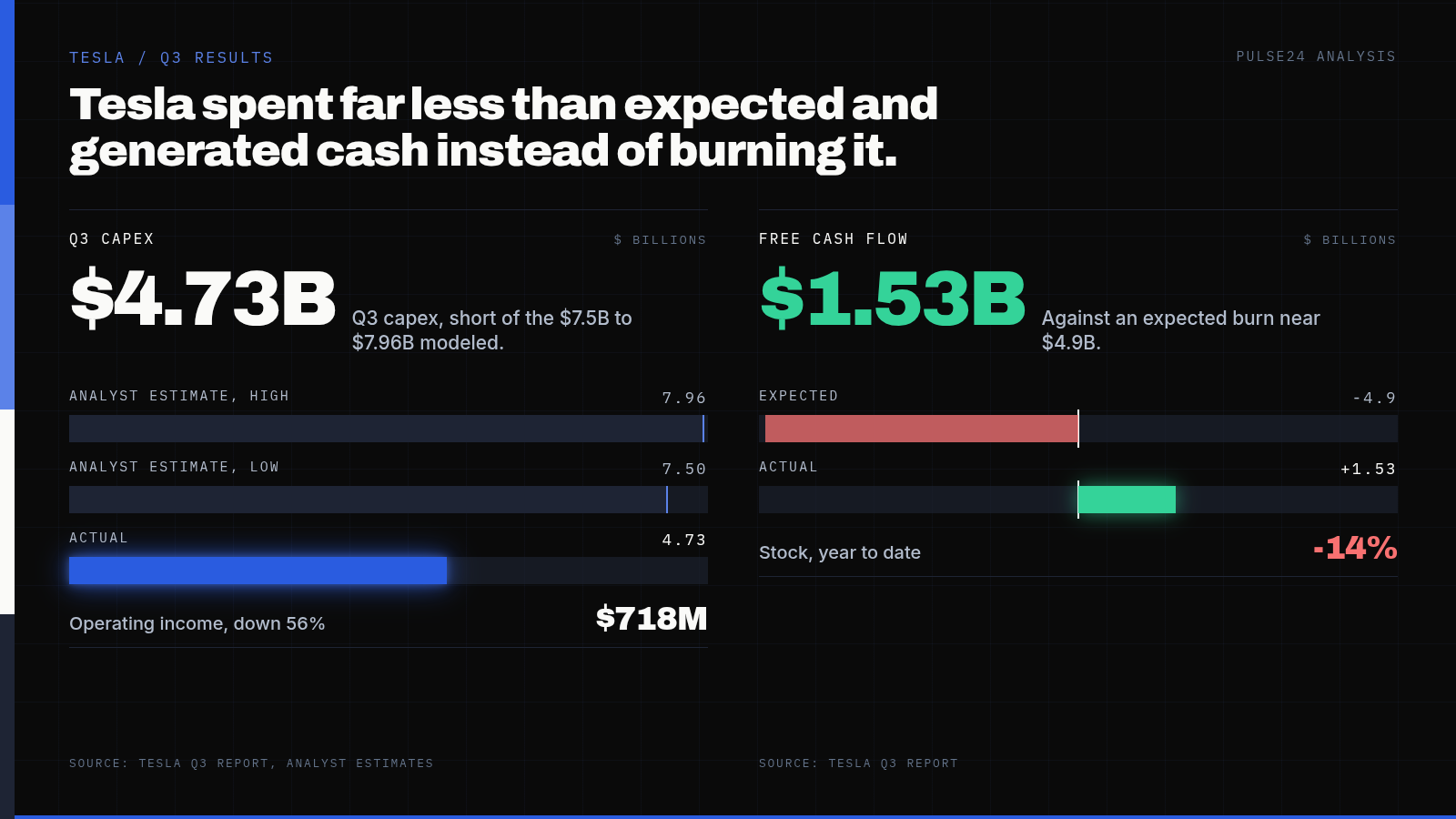
The third quarter did most of the work. Tesla spent $4.73 billion on capital projects between July and September, more than double the $2.25 billion it spent a year earlier but well under the $7.5 billion to $7.96 billion analysts expected, according to estimates compiled by LSEG. That underspending, paired with $1.53 billion in free cash flow against a forecast cash burn near $4.9 billion, let the company trim its full-year target to roughly $20 billion from the "more than $25 billion" it had guided to in April.
Everything else in the quarter told a more mixed story. Operating income fell 56% year over year to $718 million, and operating margin slid to 2.6% from 5.8% a year ago, even though both numbers improved from the second quarter's $398 million and 1.4%. Net income dropped 43% to $787 million. Automotive gross margin excluding regulatory credits came in at 18.1%, ahead of the 16.7% analysts had modeled, while deliveries fell 2.1% year over year to 486,532 vehicles. One bright spot: Tesla's supervised full self-driving software is now active on more than three-quarters of new North American deliveries, up nearly 20 percentage points from the second quarter.
Shares rose roughly 2% in after-hours trading immediately after the release, then reversed to trade about 2% lower. The stock is down close to 14% this year. Direxion's Ryan Lee called the capex reduction a sign of "less of an 'all-in' approach to the AI arms race than one would expect from Elon," adding that the free cash flow beat was welcome but raised its own question about what comes next. The timing matters here: Tesla and SpaceX are exploring a merger that Musk described as a "good idea" earlier in the week, with special committees already formed on both sides. SpaceX is reportedly preparing to invest up to $40 billion in a single upcoming quarter, and Investing.com's Thomas Monteiro noted that "the merger still faces a high bar, but tonight's numbers make the financial logic harder to ignore," pointing to Tesla's newly conserved cash as a possible funding source.
Why It Matters
Pulse24 has spent much of October tracking a single question across very different companies: is the AI buildout's spending actually keeping pace with the story investors are being told about it? CoreWeave's stock fell roughly 30% earlier this month as credit markets questioned whether its debt-funded data center expansion could outrun financing costs, and AI-related debt issuance collapsed 80% over three months as lenders grew choosier about which projects to fund. Tesla's capex cut adds a new wrinkle to that pattern, not because Tesla builds data centers, but because it is one of the loudest "all-in on AI" voices in the market, and it just spent a fifth less on physical investment than it told investors to expect six months ago.
None of this means the AI spending story is unwinding. Musk said demand for Tesla's vehicles is "exceeding our production by a significant margin," and he reiterated that the next generation of in-house AI chips, AI5, will carry "an order of magnitude more compute" than the current generation. A company can genuinely believe in a technology's future and still decide, quarter to quarter, that its cash is better spent carefully than quickly. The harder question for investors pricing the broader AI trade is whether that kind of capital discipline, applied across chipmakers, neoclouds, and now automakers-turned-robotics-companies, becomes the norm rather than the exception.
What to Watch Next
The math on the new guidance leaves little room. Tesla has spent about $13.01 billion on capex through nine months of 2026. Hitting the new $20 billion target means spending roughly $7 billion in the fourth quarter, versus the nearly $12 billion the old $25 billion target would have required. A fourth quarter that overshoots that $7 billion figure would suggest the cut was more about near-term optics than a genuine change in investment pace.
Watch the SpaceX talks closely. If a merger materializes, Tesla's conserved cash could end up funding SpaceX's own AI and launch ambitions rather than Tesla's robotaxi and Optimus programs, which would reframe this quarter's capex cut entirely. Also worth tracking: whether Optimus production, which Musk said is still "at least a year, maybe a little longer" from meaningful scale, and the robotaxi rollout, which still lags Musk's own timelines, show up in the capital spending Tesla does commit. A company can cut its budget and still be investing exactly where it matters. The guidance alone cannot tell investors which is happening.
The Pulse24 Take
A capex cut by itself is not a verdict on anything. Companies trim spending plans for reasons ranging from execution discipline to simple overestimation, and Tesla's free cash flow beat this quarter is a legitimately good outcome by almost any measure. What makes this one worth watching is the contrast sitting right next to it: a company run by the same person is reportedly readying to spend up to $40 billion in a single quarter, while Tesla itself just took $5 billion off its own annual plan.
That contrast does not prove capital is being funneled from one Musk company to another. It does mean investors evaluating the AI capex story need to look past the headline guidance number and ask where the dollars that aren't being spent are actually going. Tesla's stock already answered with a shrug, first up, then down, netting out close to flat. The more interesting answer will show up in the fourth quarter's actual spending, not in Wednesday's guidance slide.
How we read the data
Curious how we get from raw data to a take like this? Our Trader's Toolkit walks through the tools we lean on.
Explore the Toolkit