Pulse24 Original
AI-Related Debt Issuance Collapsed 80% in Three Months. One Oracle-Linked Loan Package Is Trading at 90 Cents on the Dollar.
October 17, 2026
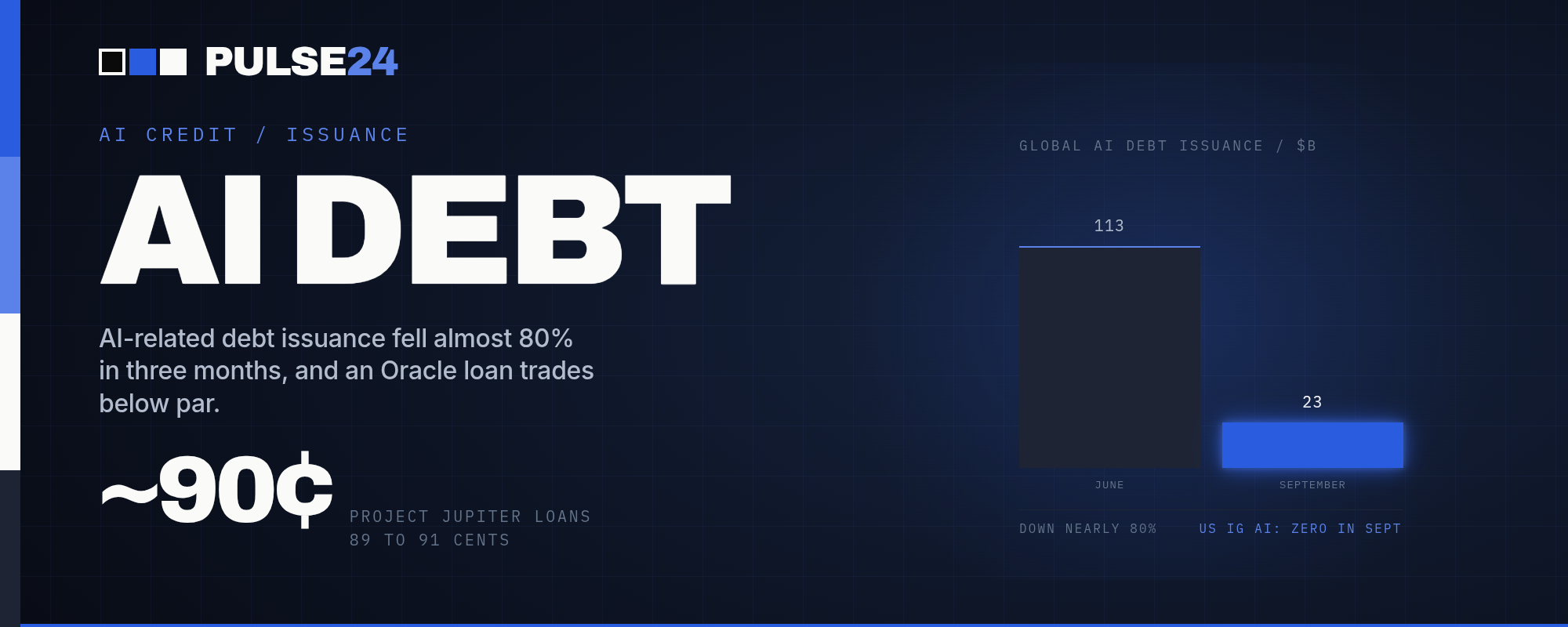
Global AI-related debt issuance fell from $113 billion in June to $23 billion in September, and loans tied to one Oracle data center project are now trading below face value. The credit pullback is the clearest sign yet that Wall Street is getting more selective about financing the AI buildout.
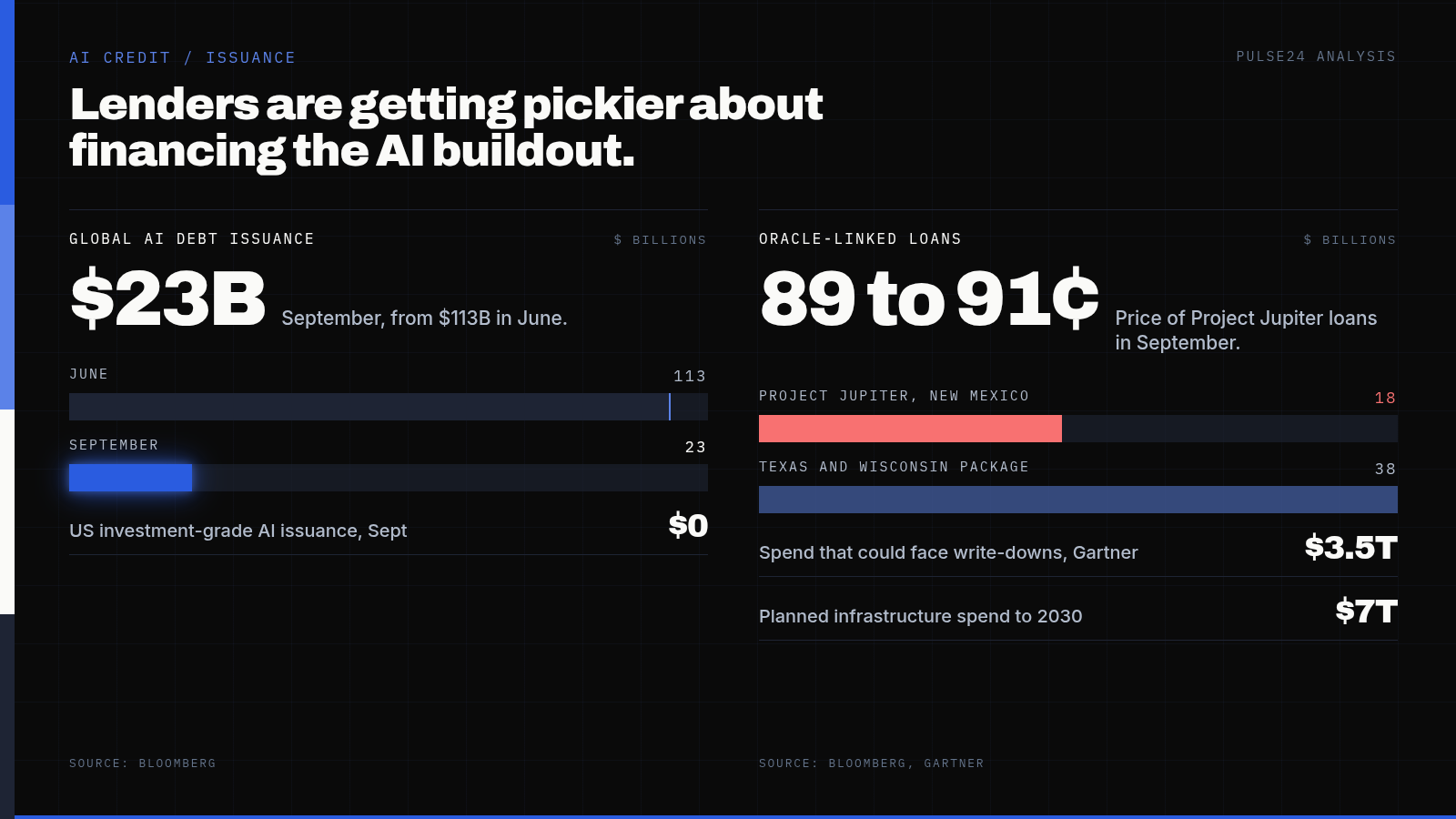
Eighteen billion dollars in loans backing Oracle's Project Jupiter data center campus in New Mexico changed hands in September at 89 to 91 cents on the dollar, according to trading desk data reported by Bloomberg. Banks including Santander and Jefferies struggled to find buyers willing to pay full price. A discount like that doesn't mean Oracle defaulted on anything, but traders pricing this debt are clearly asking harder questions than they were six months ago.
Those harder questions show up most clearly in a different number: how much new AI-related debt actually got sold. Global issuance tied to AI infrastructure fell to $23 billion in September, down nearly 80% from $113 billion in June, according to Morgan Stanley data cited by the Financial Times. September's volume came in at less than half of August's. U.S. investment-grade issuance specifically tied to AI projects stopped entirely for the month, following roughly $306 billion borrowed by major tech companies between January and August.
What Changed
The AI buildout has run largely on borrowed money for the past two years. Roughly a third of this year's capital spending by major AI providers is debt-funded, per Axios reporting on Goldman Sachs projections. That borrowing financed data centers, power infrastructure, and the chips inside them, mostly through special purpose vehicles that keep the debt off the parent companies' own balance sheets. Oracle, Meta, xAI, and CoreWeave have all used this structure, and roughly $120 billion in AI infrastructure spending now sits inside these vehicles.
Oracle's situation shows how the financing has grown more complicated. Beyond the $18 billion tied to Project Jupiter, a separate $38 billion loan package backing Oracle-linked data centers in Texas and Wisconsin, arranged by JPMorgan and MUFG, has taken more than a year to work its way through the market since Bloomberg first reported the deal in September 2025. Lenders have reportedly explored significant risk transfers, structures that let a bank keep a loan on its books while shifting the riskiest slice to outside investors, and some are willing to sell pieces to non-bank buyers at a discount just to get the exposure off their internal limits.
Why It Matters
Credit markets had been pricing this risk before the issuance numbers confirmed it. Oracle's five-year credit default swaps reached about 151 basis points in early October, the highest level since 2009, after S&P cut the company's rating to BBB- in July, one notch above junk. CoreWeave's bonds have moved even further: its 9.625% notes due 2032 were yielding close to 14.8% to maturity, well above what comparable corporate debt paid before the AI buildout accelerated.
Order books tell a similar story. Hyperscaler bonds from Alphabet, Amazon, Meta, Microsoft, and Oracle drew demand running at roughly five times the offering size back in February. By July, that ratio had fallen below two. Fewer buyers chasing the same debt tends to push yields higher and forces borrowers to sweeten terms, which is exactly what's playing out across the sector now.
The caution has real numbers behind it. Gartner estimates that AI providers are on pace to spend $7 trillion on infrastructure through 2030, against no more than $3.6 trillion in directly related revenue over the same stretch. The firm puts $3.5 trillion of that spending at risk of write-downs by the end of the decade and expects more than 80% of specialized AI cloud providers, the so-called neoclouds, to stop operating independently within four years. Nvidia-backed Firmus already shelved an IPO that had sought a valuation above $30 billion, and similar listings from AirTrunk and SB Energy were paused or pulled.
What to Watch Next
JPMorgan CEO Jamie Dimon has already confirmed his bank is tightening credit standards to avoid concentration risk, and that pullback will likely show up first in how quickly, or slowly, deals like the $38 billion Oracle package finally clear. Bond order books at the next round of hyperscaler issuance are worth watching for a read on whether investor appetite stabilizes or keeps shrinking. Meta Platforms and Tesla report earnings after the close on October 21, and both calls should bring fresh detail on capital spending plans heading into 2027.
Not every signal points the same direction. Anthropic turned free cash flow positive in its third quarter and grew revenue to roughly $16.8 billion, up about 45% from the prior quarter, even though that pace has slowed from closer to 140% sequential growth earlier in the year. OpenAI's own revenue came in $20 billion short of what investors had been told to expect, a gap that sits uncomfortably close to Oracle's exposure through Project Jupiter, which was built partly to serve OpenAI's infrastructure commitments. The distance between those two outcomes, one AI company funding its own growth and another leaning harder on borrowed infrastructure, is probably the clearest preview of which parts of this buildout get questioned next.
The Pulse24 Take
None of this means the AI buildout is over, and nobody serious is arguing that computing demand for AI has disappeared. What's changed is who's willing to finance the next leg of it, and on what terms. Hyperscaler bond order books ran five times oversubscribed as recently as February. Some of that same paper now trades below face value before the ink on the loan agreement has even dried. Barclays described this as a shift into a "more mature phase" for the AI trade, and that phrase probably undersells it. Maturity usually means better discipline about where money goes, and the market is now doing some of that discipline work for the industry, one skeptical bond order at a time. Companies with real cash flow, not just capital commitments, are best positioned to keep borrowing on reasonable terms. Everyone else is about to find out what their balance sheet actually says about them.
How we read the data
Curious how we get from raw data to a take like this? Our Trader's Toolkit walks through the tools we lean on.
Explore the Toolkit