Pulse24 Original
OpenAI's Revenue Came In $20 Billion Short of What Investors Were Told. The Chip Stocks Betting on Its Buildout Fell With It.
October 8, 2026
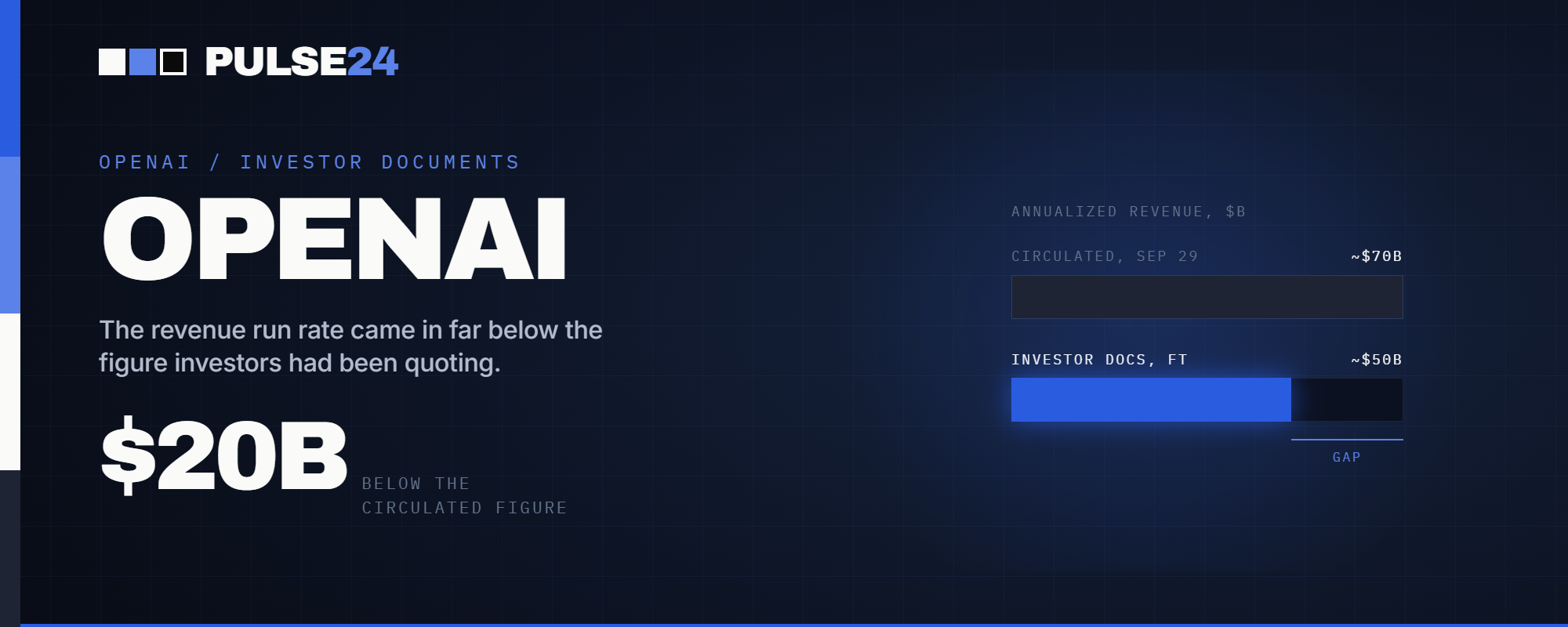
A Financial Times report on OpenAI's investor documents found its annualized revenue running about $20 billion below the figure that had been circulating since September, and the chip and cloud stocks funding its buildout fell within hours of the news. The gap turns out to be more about accounting method than a sudden drop in sales, but markets priced it as doubt about the AI trade anyway.
OpenAI's annualized revenue is running near $50 billion, not the roughly $70 billion figure that investors had been quoting since late September. The Financial Times reported the lower number Thursday, citing investor documents, and the $20 billion gap moved markets within hours. Chip stocks, cloud suppliers, and anything tied to the AI buildout fell together, even though the company's actual spending hasn't changed.
The $70 billion estimate traces back to an Axios report from September 29, built from numbers OpenAI's own investors were sharing as they tried to size the company up against Anthropic. Anthropic told the market in July that its own annualized run rate was near $65 billion, and a $70 billion OpenAI figure would have put the two companies roughly level. The problem is that the two numbers aren't built the same way. Anthropic counts revenue sold through cloud partners like Amazon and Google. OpenAI doesn't. Once that difference gets stripped out, a figure near $50 billion lines up with what OpenAI's own accounting was always going to show.
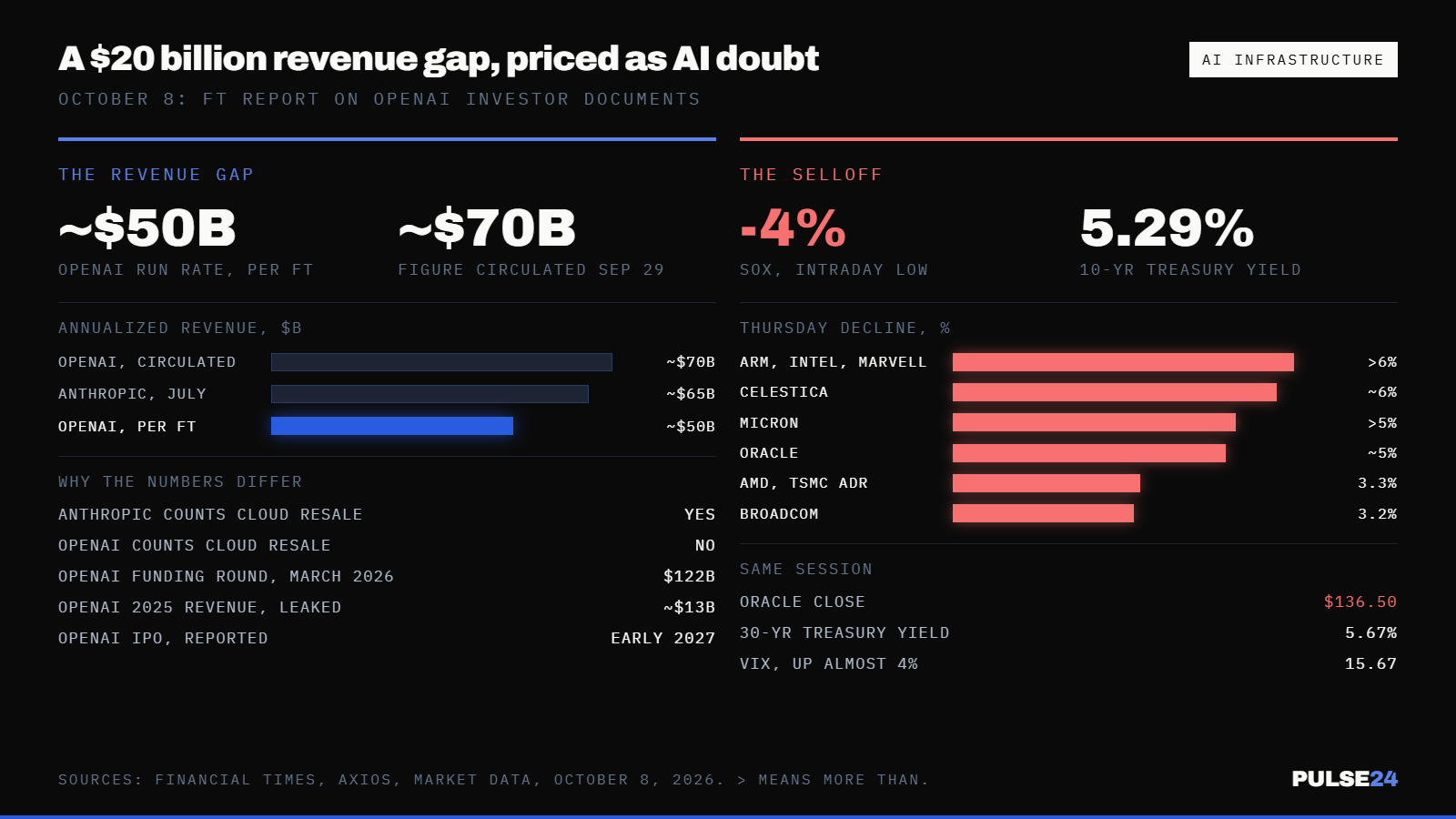
Markets didn't pause to sort out the accounting. The Philadelphia Semiconductor Index, which tracks the biggest US chipmakers, fell as much as 4% during Thursday's session before paring some of the decline. Arm, Intel, and Marvell each dropped more than 6%. Micron fell more than 5%. Nvidia slipped too, though by a smaller margin than its suppliers.
Oracle took the hardest hit among the AI-infrastructure names. The company has committed tens of billions of dollars in cloud capacity to OpenAI, and its stock fell almost 5% to $136.50 during the session before extending losses to nearly 6% after hours. AMD dropped 3.3% to $624.65. Broadcom fell 3.2% to $364.58. Taiwan Semiconductor's US-listed shares slid 3.3% to $456.79, adding to a decline that started earlier in the day after the company's own record quarterly earnings failed to lift its Taipei-listed stock. Celestica, a smaller contract manufacturer tied to the same AI supply chain, dropped almost 6%.
Why It Matters
Revenue is the number that's supposed to justify everything else. OpenAI raised $122 billion in a single funding round in March 2026, and leaked financials from 2025 showed roughly $13 billion in revenue against spending that ran far higher. Every dollar of that gap gets financed with someone's capital, whether that's equity from investors betting on future growth or debt sold against future cash flow. A $20 billion swing in the revenue figure investors thought they were underwriting doesn't change what OpenAI actually spent this year, but it changes how comfortable anyone should feel about the multiple being paid for next year's growth.
This is the same tension that's been building across the AI trade for months. Marvell raised its own 2028 AI revenue forecast to $20 billion last week, and only about a quarter of the S&P 500 was confirming the rally those forecasts are supposed to justify. SpaceX is reportedly trying to borrow $40 billion to buy Nvidia chips at almost the exact moment the 10-year Treasury yield reached a 24-year high, and JPMorgan is forecasting $540 billion in tech-sector bond issuance this year to fund builds like it. Every one of those numbers assumes the revenue is there to eventually pay the debt back. OpenAI's restated figure doesn't break that assumption, but it's a reminder that the revenue side of the ledger is softer and harder to pin down than the spending side.
The Anthropic comparison cuts both ways. Anthropic lost $42 billion last year and still received a loan from Broadcom for the exact same amount, which is its own version of the same story: revenue growing fast in percentage terms, losses growing just as fast in dollar terms, and lenders extending credit anyway because the alternative is missing the biggest infrastructure buildout in a generation. Investors are now expected to get a clearer look at both companies soon. Anthropic is reportedly aiming for an IPO around November. OpenAI's own listing, once expected sometime in 2026, has reportedly slipped to early 2027, pushing out the date investors get audited financials instead of investor decks.
What to Watch Next
Ray Dalio repeated his AI bubble warning Thursday, and Macquarie strategists flagged something worth sitting with: nearly all of the major financial blowouts of the past fifty years were preceded by a rapid move in bond yields. The 10-year sitting near 5.29% and the 30-year near 5.67% doesn't guarantee anything is about to break. It does mean the cost of capital underwriting every AI infrastructure bet keeps climbing at the same time the revenue numbers behind those bets are getting harder to pin down.
Watch hyperscaler earnings over the next several weeks. Microsoft, Amazon, and Alphabet will all report capital expenditure guidance, and any hint that they're trimming AI spending plans would matter more than today's stock moves. The Anthropic IPO roadshow is worth watching too, since audited numbers would replace a lot of the guesswork in comparisons like this one.
The Pulse24 Take
What happened Thursday wasn't really a revenue miss. OpenAI didn't lose $20 billion in sales overnight. Two different ways of counting the same business produced two different numbers, and the market had spent weeks anchored to the larger one.
Investor psychology explains the reaction better than OpenAI's fundamentals do. A trade priced for perfection can sell off without any bad news at all. A number that forces a recalculation, even a technical one, is enough. Treasury yields near multidecade highs make that recalculation sting more than it would have a year ago, because every future dollar of AI revenue now gets discounted at a higher rate before anyone even asks whether the revenue shows up.
None of this means the AI buildout is overbuilt or that the spending doesn't eventually pay for itself. Oracle's cloud contracts and Marvell's custom silicon reflect real demand, not vapor, and so does SpaceX's compute need. But Thursday was a useful reminder that the two biggest frontier labs remain privately held, report numbers through investor decks rather than audited filings, and leave room for a $20 billion gap to sit unnoticed for weeks. That gap narrows once Anthropic and OpenAI actually go public. Until then, every number in this trade deserves the same scrutiny investors just gave this one.
How we read the data
Curious how we get from raw data to a take like this? Our Trader's Toolkit walks through the tools we lean on.
Explore the Toolkit