Pulse24 Original
JPMorgan Raised Its 2026 Tech-Bond Forecast to $540 Billion. The US Treasury Needs the Same Buyers for a $2 Trillion Deficit.
October 7, 2026
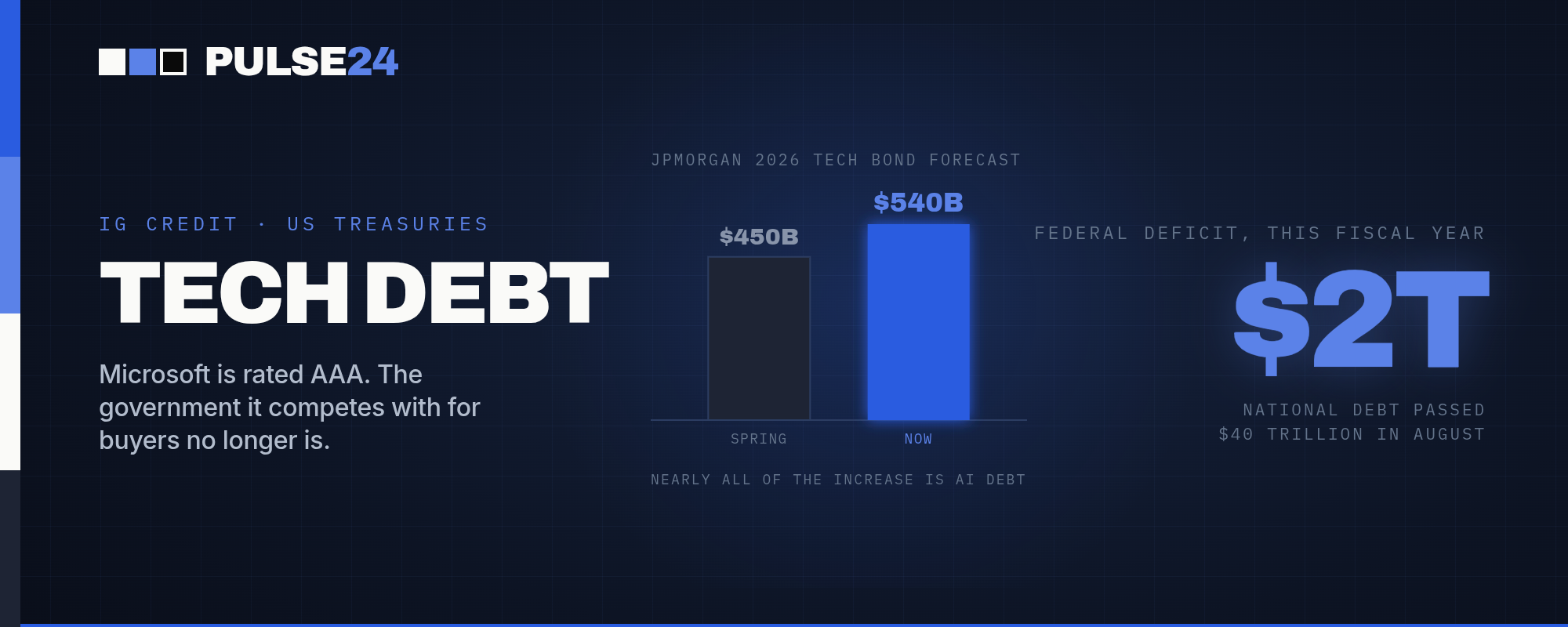
JPMorgan now expects $540 billion in tech-sector bond sales this year, almost all of it tied to AI infrastructure, at the same time Washington is financing a $2 trillion deficit on top of a debt load that crossed $40 trillion in August. Microsoft's credit rating is still better than the US government's, and that gap is starting to matter for how both sides borrow money.
JPMorgan raised its forecast for 2026 technology-sector bond sales to $540 billion this week, up from the $450 billion the bank projected back in the spring. Almost all of that extra $90 billion traces back to one thing: AI infrastructure. Hyperscalers alone are on pace to borrow $317 billion this year, with $85 billion of that tied directly to building data centers.
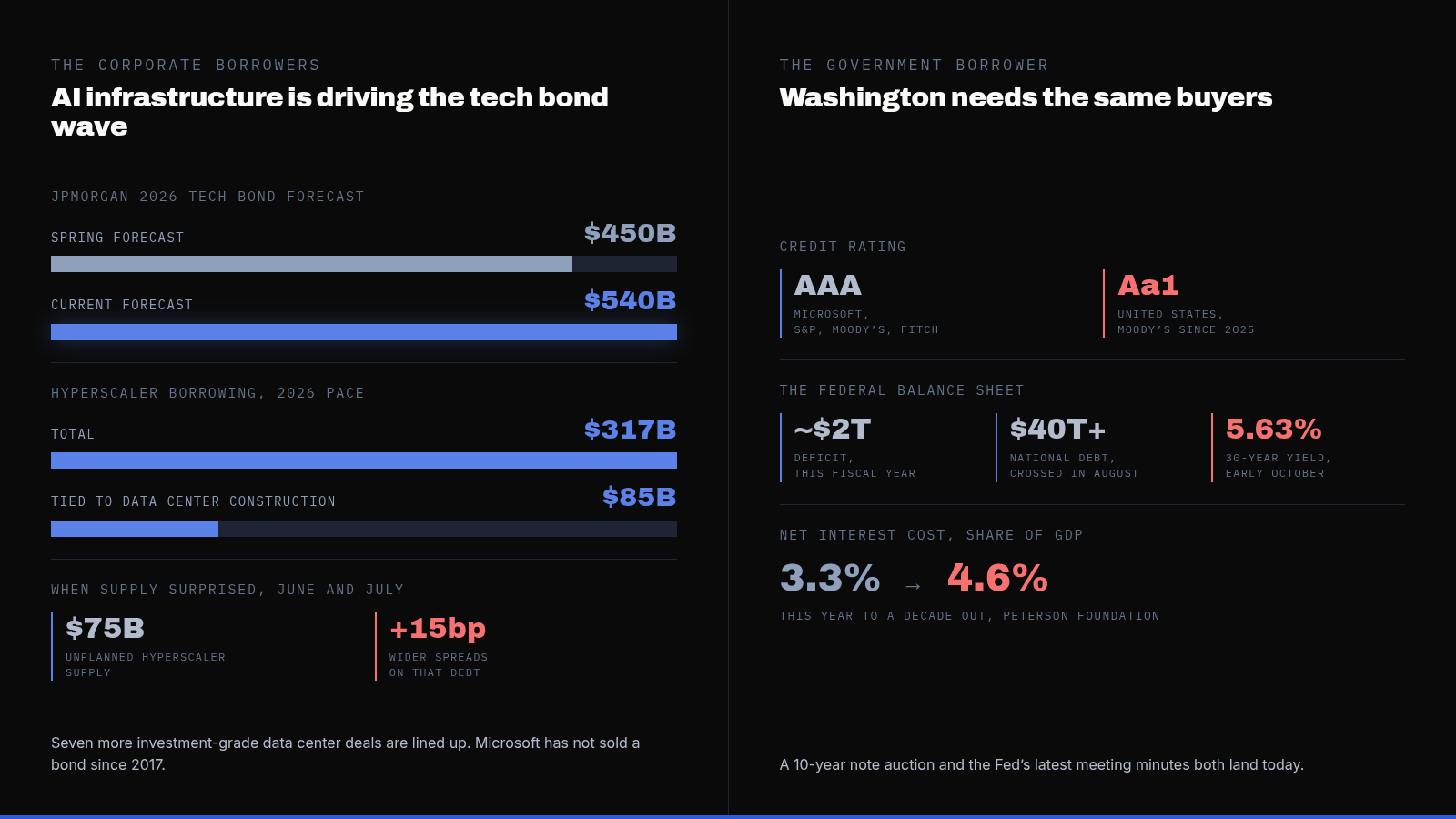
Put that number next to a second one. The federal government is running roughly a $2 trillion deficit this fiscal year, and the national debt crossed $40 trillion for the first time in August. Washington and Silicon Valley's largest borrowers are now competing for the same pool of fixed income buyers at the same time, and on paper, the government isn't winning the credit contest. Microsoft still holds a clean AAA rating from S&P, Moody's, and Fitch. The United States does not. Moody's stripped the country of its last AAA rating back in 2025, cutting it to Aa1 and citing rising interest costs and what it called unsustainable debt growth.
What Changed
Seven more investment-grade data center bond deals are lined up, according to JPMorgan's own desk, four of them tied to Oracle and OpenAI's financing partners. Meta is expected to return to the market after its next earnings report. The name strategists keep circling back to is Microsoft, which hasn't issued a bond since 2017 despite having the single best credit rating in the group. If it finally does, it would arrive as one of the largest, highest-rated borrowers fixed income investors have seen show up at once.
Demand isn't unlimited though. A surprise $75 billion in hyperscaler supply hit the market in June and July, more than dealers had planned for, and spreads on that debt widened by roughly 15 basis points in response. That's a small move in absolute terms, but it's a real one, and it's a signal that even AAA-adjacent borrowers can oversaturate a market if they show up with too much paper too fast. Oracle's own credit default swaps already trade closer to junk-rated levels than investment-grade ones, even as Microsoft, Amazon, and Alphabet's have barely moved, a reminder that not every hyperscaler is being priced the same way by the market that actually has money on the line.
Why It Matters
None of this is happening in a vacuum on the government side either. Net interest payments on federal debt are running at 3.3% of GDP this year, according to the Peterson Foundation, and are projected to reach 4.6% within a decade. On that path, interest becomes the single largest category in the federal budget by 2047, ahead of Social Security and defense. The Treasury has to keep selling bills, notes, and bonds regardless of how crowded the market gets with corporate paper, which is part of why the 30-year yield has pushed toward a 24-year high in recent sessions.
Fed Chair Kevin Warsh isn't making the Treasury's job any easier. Warsh has moved away from the kind of explicit forward guidance his predecessors gave markets, and BofA rates strategist Mark Cabana has argued the bigger problem isn't the silence itself but what's missing behind it: a credible plan for actually bringing inflation back to target. Cabana has said bond investors are looking for that plan and don't see one yet, and that gap is part of what's been pushing the long end of the yield curve higher.
September alone was the busiest month for junk bond sales all year, and high-yield spreads across the broader corporate market widened to 294 basis points around the same stretch. Credit markets are absorbing an enormous amount of new paper from very different quality tiers all at once, from Treasury bills to AAA hyperscaler bonds to the riskier end of the AI financing chain, where SoftBank is already paying its highest-ever bond yields to keep funding OpenAI's compute needs.
What to Watch Next
Two events land today that will say something about how much room is actually left in this market. The Treasury auctions 10-year notes this afternoon, a direct read on investor appetite at current yield levels. The Fed also releases minutes from its last meeting, which should show how divided policymakers actually are about cutting rates again before year end. Watch whether Microsoft finally shows up with a bond deal, and if it does, watch where it prices relative to Treasurys of the same maturity. That gap, more than any single auction result, will say the most about who investors actually trust with their money right now.
The Pulse24 Take
None of this points to an imminent crisis. A $2 trillion deficit and a $40 trillion debt load are serious numbers, but the United States still borrows in its own currency from the deepest capital market in the world, and Aa1 remains investment grade by a wide margin. What's genuinely new is the competition. For most of the last two decades, Treasurys were simply the default place a pension fund or an insurer parked long-duration money because nothing else offered comparable safety at that kind of scale.
That default status is weaker than it used to be. AAA-rated technology companies are now offering some of that same safety profile, in chunks of tens of billions of dollars, more often than at any point in years. Credit investors have more genuine alternatives to government debt than they've had in a generation, and they're starting to act like it. Watch the spread between hyperscaler bonds and comparable Treasurys over the next few months, not just the yield level on its own. That spread will tell you more about who's winning the competition for the world's savings than any single auction ever will.
How we read the data
Curious how we get from raw data to a take like this? Our Trader's Toolkit walks through the tools we lean on.
Explore the Toolkit