Pulse24 Original
CoreWeave Fell 30% Since Late September. Goldman Cut Its Price Target 24%, Then Upgraded the Stock to Buy.
October 19, 2026
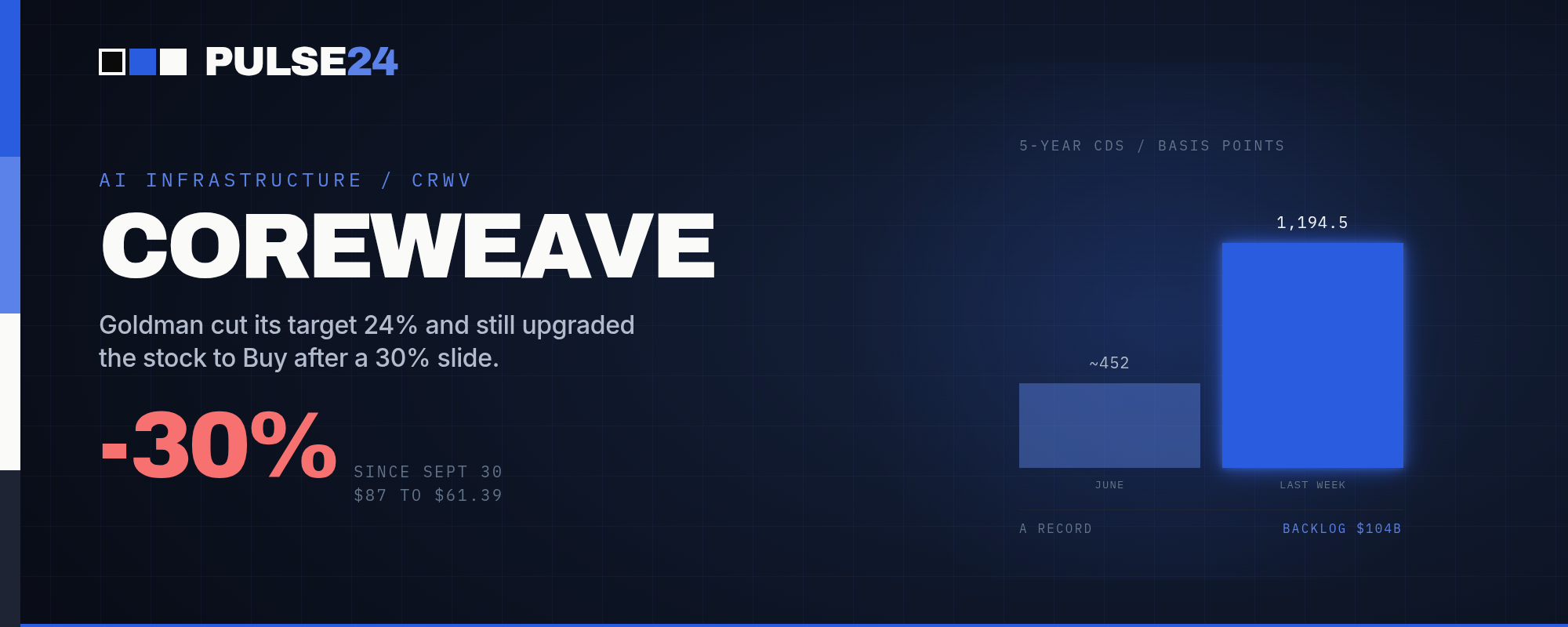
CoreWeave's stock fell roughly 30% since late September, as hot inflation data and a record spike in its credit default swaps raised doubts about its debt load. On Monday, Goldman Sachs cut its price target but still upgraded the stock to Buy, arguing the selloff outran the risk.
CoreWeave stock closed at $61.39 on Friday, down 11.91% for the day and about 30% since its $87 close on September 30. Five days earlier, the company had reported a second-quarter revenue backlog of $104 billion, a record. Both facts were true going into the weekend, and reconciling them is the whole story behind Monday's reversal.
What Changed
The stock's slide accelerated through the week of October 9. Shares fell roughly 25% over five sessions, including the 11.91% drop on Friday and a steep single-day decline earlier in the week as hotter-than-expected inflation data pushed up expectations for how long the Federal Reserve will hold rates elevated. That link matters more for CoreWeave than for most companies. The neocloud operator carried $51.61 billion in total debt and lease obligations as of June 30, split roughly between $35.1 billion in borrowings and $16.5 billion in leases, and its interest expense of $640 million in the second quarter ran nearly 13 times its $49 million operating loss. Rising rates raise the cost of rolling that debt over, and rolling it over is not optional. Data centers get built on borrowed money well before most of the contracted revenue arrives.
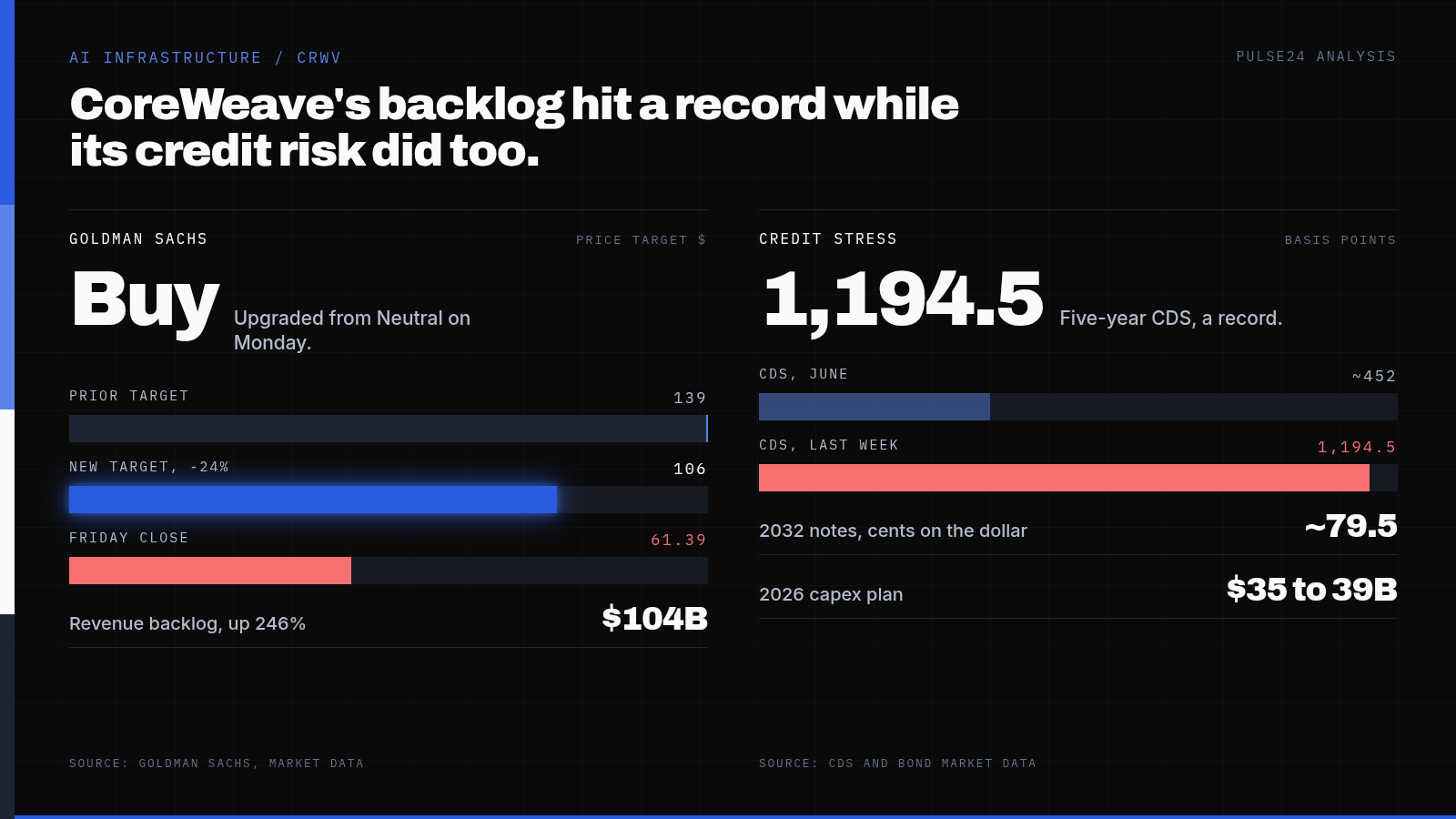
Credit markets registered the stress first. Five-year credit default swaps on CoreWeave debt jumped to a record 1,194.5 basis points last week, up from about 452 in June, and its 9.625% notes due 2032 traded near 79.5 cents on the dollar, a level bond investors generally treat as a sign of distress. That echoes what Pulse24 covered when Oracle's credit insurance on its CoreWeave-linked exposure hit a record earlier this month, and it fits a broader pattern Pulse24 has tracked in AI-linked debt issuance this year. CEO Mike Intrator pushed back in a memo to staff that was later made public, writing that "there will be periods of time when the market misunderstands and acts irrationally."
Nvidia CEO Jensen Huang, speaking at an event in Sweden midweek, offered more support. He said CoreWeave's "cost of capital is decreasing as time goes by" and that he did not expect the company to need a rescue package, despite Nvidia owning roughly 10% of it. Bank of America's Tal Liani reiterated a $140 price target the same week and raised his revenue growth forecasts, now projecting 105% growth in 2027 and 63% in 2028. Shares closed nearly 6% higher that Thursday, a preview of Monday's bigger move.
Monday brought reinforcement from a different part of the chip sector. JPMorgan analyst Harlan Sur upgraded Intel to Neutral from Underweight, holding his price target at $85, after Intel shares had fallen about 36% from their June peak. Sur pointed to steadier execution under CEO Lip-Bu Tan, early traction in custom AI chips, and tightening supply of advanced chips industry-wide, even while flagging that Intel's server CPU share has fallen from 77% to 53% and its PC CPU share from 81% to 68% over the past several years. Intel shares rose about 4% in Monday's premarket trading, and Applied Digital, another AI-infrastructure name caught up in the prior week's selling, gained more than 8%.
Why It Matters
CoreWeave's backlog is not the part anyone is disputing. Second-quarter revenue grew 112% to about $2.6 billion, and the company guided to a fourth-quarter annualized run rate of $18.5 billion to $19.5 billion, with full-year revenue seen at $12.4 billion to $13.2 billion. Those are signed customer contracts, not speculative capacity plans.
The disagreement is about timing and cost, not demand. CoreWeave's 2026 capital spending plan of $35 billion to $39 billion runs nearly three times its expected 2026 revenue. Contracted revenue arrives over several years; the capex and the interest on the debt that funds it come due now. When the Fed looks more likely to hold rates higher for longer, the cost of bridging that gap rises, and credit markets reprice before equity investors do. That is the mechanism behind CoreWeave's widening credit default swaps and discounted bonds even as its underlying growth numbers kept improving.
What Goldman and JPMorgan did on Monday was not declare the AI buildout fully funded. Goldman framed its own call narrowly, noting that "not all neoclouds are created equal," which is itself a warning against reading this as a sector-wide all-clear. The argument both firms made is more specific: the stock price fell further and faster than the underlying risk picture changed, so the ratio between price and value moved in the buyers' favor. A price target can fall and a rating can rise in the same note, because a rating answers one question, whether this is cheap relative to the risk right now, and a target answers a different one, what the business is worth. Reading the two as contradictory is a common misstep.
What to Watch Next
This week's earnings calendar will test whether Monday's bounce holds. Meta, Tesla, IBM, Netflix, GM, and AT&T all report in the coming days, and SpaceX is due Tuesday after the close. Commentary on AI capital spending plans from any of them will be read against the CoreWeave situation directly, since the same financing math, heavy near-term spending against revenue that arrives later, applies to every company building data center capacity ahead of demand.
Credit markets are the more reliable gauge than the stock price here. Watch whether CoreWeave's credit default swaps retreat from last week's record levels or stay elevated through the bounce; a rally built on two analyst upgrades means little if bond investors keep pricing in distress. The Federal Reserve's October 27-28 meeting is the other date to watch. Futures markets currently assign roughly 15% odds to an October hike and near 89% odds to one in December, and any shift in that pricing changes the cost of capital for every debt-heavy AI infrastructure name, not just CoreWeave.
The Pulse24 Take
The broader lesson here has less to do with CoreWeave specifically and more to do with reading an analyst note correctly. A downgraded price target next to an upgraded rating is not a contradiction or a hedge. It answers two separate questions honestly: what the business is worth, and whether the current price already accounts for the risk. Goldman thinks CoreWeave is worth less than it did a few months ago. It also thinks the stock fell past that lower value on the way down, which is a different claim entirely.
None of this resolves the tension underneath the AI buildout. CoreWeave's backlog is real, its debt load is real, and so is the risk that financing costs keep climbing faster than contracted revenue turns into cash. Investors buying Monday's bounce are betting the credit market overreacted last week. Those still selling are betting it didn't. Both sides are looking at the same $104 billion backlog and the same $51.61 billion in debt. They disagree only about which number moves first.
How we read the data
Curious how we get from raw data to a take like this? Our Trader's Toolkit walks through the tools we lean on.
Explore the Toolkit