Pulse24 Original
October Fed Hike Odds Fell to 15% in a Single Speech About Artificial Intelligence
October 18, 2026
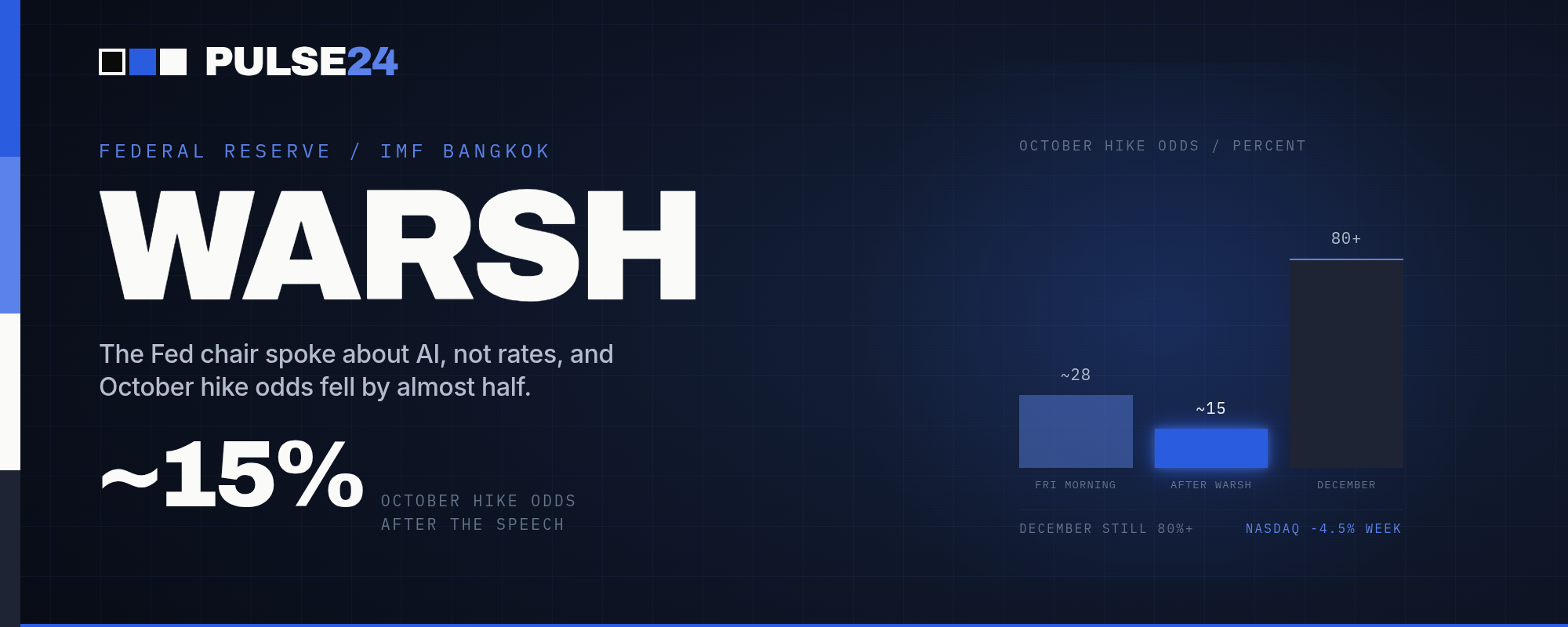
Fed Chair Kevin Warsh used his first major IMF appearance to talk about artificial intelligence, not interest rates. By the time he finished, traders had cut the odds of an October rate hike from around 28% to roughly 15%.
Kevin Warsh took the stage at the IMF and World Bank's annual meetings in Bangkok on Friday with a chance to settle the biggest question hanging over markets: will the Fed raise rates again this month. He didn't answer it. Instead, the Fed chair spent most of his fireside chat with IMF Managing Director Kristalina Georgieva talking about artificial intelligence, calling it probably the most consequential economic change of his lifetime and warning that the transition ahead could be very bumpy.
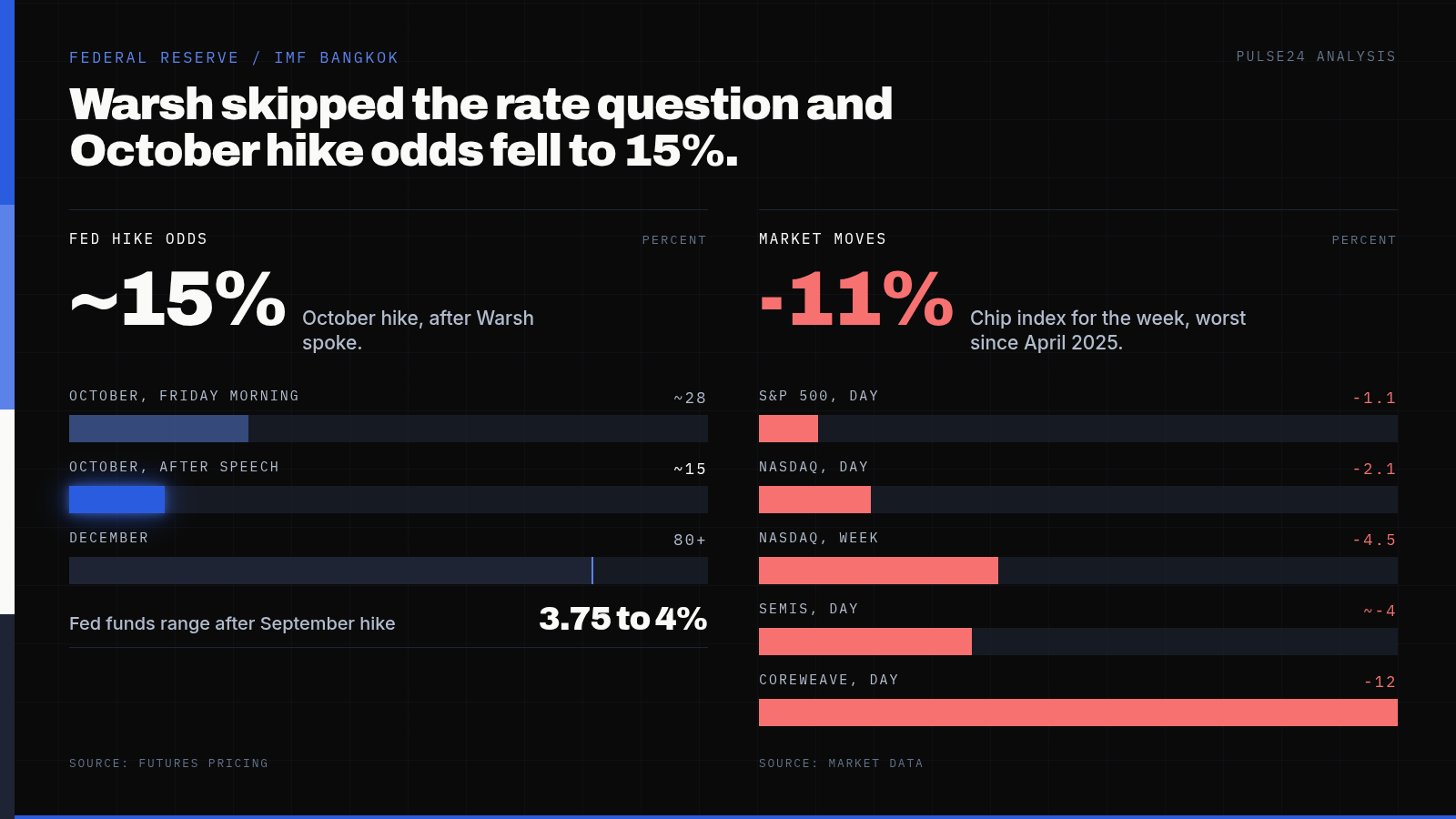
Traders took the hint anyway. Odds of a quarter point hike at the Fed's October 28 meeting, which had already cooled to around 28% by Friday morning, slid to roughly 15% by the close. Warsh never said the words "I'm leaning against a hike." He didn't have to. A tone this cautious about disruption ahead is itself a signal, even from a chair who insists, twice in the same week, that he doesn't prejudge meetings.
What Changed
Warsh's remarks came four days after September's inflation report blew past every forecast, with headline CPI at 3.7% year over year and a producer price reading that later came in at 6.3% annually, the highest since 2022. Those numbers pushed October hike odds up sharply through midweek, part of a stretch where Fed officials sent conflicting signals. Boston Fed President Susan Collins said Tuesday that rates might need to rise a bit further before year end, while billionaire investor John Arnold argued a day later that more hikes would do little to tame inflation and could do real damage instead.
Then came Friday. Rather than wade into that fight, Warsh talked about jobs, productivity, and a technology shift he thinks could reshape the economy more than anything else in his career. DBS Bank macro strategist Chang Wei Liang put it plainly afterward: an optimistic read on AI productivity, paired with no hawkish rate signal, can temper fears of back to back Fed hikes almost as effectively as a dovish statement would.
Why It Matters
Markets didn't wait for Monday to process it. The Nasdaq Composite fell 2.1% Friday and 4.5% for the week, snapping a four week winning streak. Its S&P 500 counterpart slid about 1.1% on the day and roughly 2% for the week, its fourth negative week in six. Blue chips held up noticeably better: the Dow Jones Industrial Average actually closed the week up 0.7%, its second straight weekly gain, a split that says more about index composition than about conviction. Mega cap tech and AI infrastructure names took the brunt of the selling while the rest of the market held up fine.
CoreWeave dropped 12% Friday, its second double digit decline in three trading sessions after credit markets started pricing in real doubts about its debt load earlier in the week. The Philadelphia Semiconductor Index fell almost 4% on the day and more than 11% over the week, its worst stretch since April 2025. Even Nvidia, Meta, and Tesla finished lower inside the so called Magnificent Seven, with Apple the lone member in the green. The VIX, Wall Street's volatility gauge, jumped more than 21% to just under 20, its highest close in weeks.
The split matters because of where the market's AI anxiety actually lives right now. Traders are less worried about whether the Fed hikes in October than about whether the companies that borrowed billions to build AI infrastructure can carry that debt if the payoff arrives later, or smaller, than investors assumed. AI related debt issuance has already collapsed 80% over three months, and a Fed chair musing publicly about a bumpy transition, even a well intentioned one, lands differently in that environment than it would have a year ago.
What to Watch Next
December is where the real tension sits. Odds of a hike at that meeting are still elevated, near 89% on one widely watched measure as of Thursday, and Warsh's comments did little to dent them. If October passes without action, December becomes the meeting where the Collins camp and the Arnold camp actually have to resolve their disagreement, with two more inflation reports due before then to tip the scales.
Watch for whether other Fed officials pick up Warsh's AI framing or push back on it. A chair who talks about productivity gains and bumpy transitions is laying rhetorical groundwork for patience, but patience from the top doesn't guarantee it from the rest of the committee. Also worth tracking: whether Friday's tech selloff was a one week wobble or the start of a repricing in how investors value AI infrastructure spending relative to the debt backing it.
The Pulse24 Take
Warsh ducking a question about October isn't unusual. Fed chairs do that constantly, almost as a matter of institutional habit. What stood out Friday was what he chose to do with the floor instead: make the case that AI's economic disruption deserves as much attention right now as inflation does. Markets treated that framing as informative in its own right, which is itself worth noticing. This Fed chair appears to see two risks worth managing at once, not one, and he isn't ranking them for anybody yet. For investors, the practical move here has less to do with guessing October or December correctly and more to do with noticing that the conversation at the top of the Fed has quietly widened. Positioning for a central bank that weighs AI's labor and productivity effects alongside its usual inflation math, for longer than markets currently expect, is the more useful exercise than trying to call the next vote.
How we read the data
Curious how we get from raw data to a take like this? Our Trader's Toolkit walks through the tools we lean on.
Explore the Toolkit