Pulse24 Original
December Fed Hike Odds Are Near 89%. Wall Street and Main Street Read Gold's Next Move Differently.
October 17, 2026
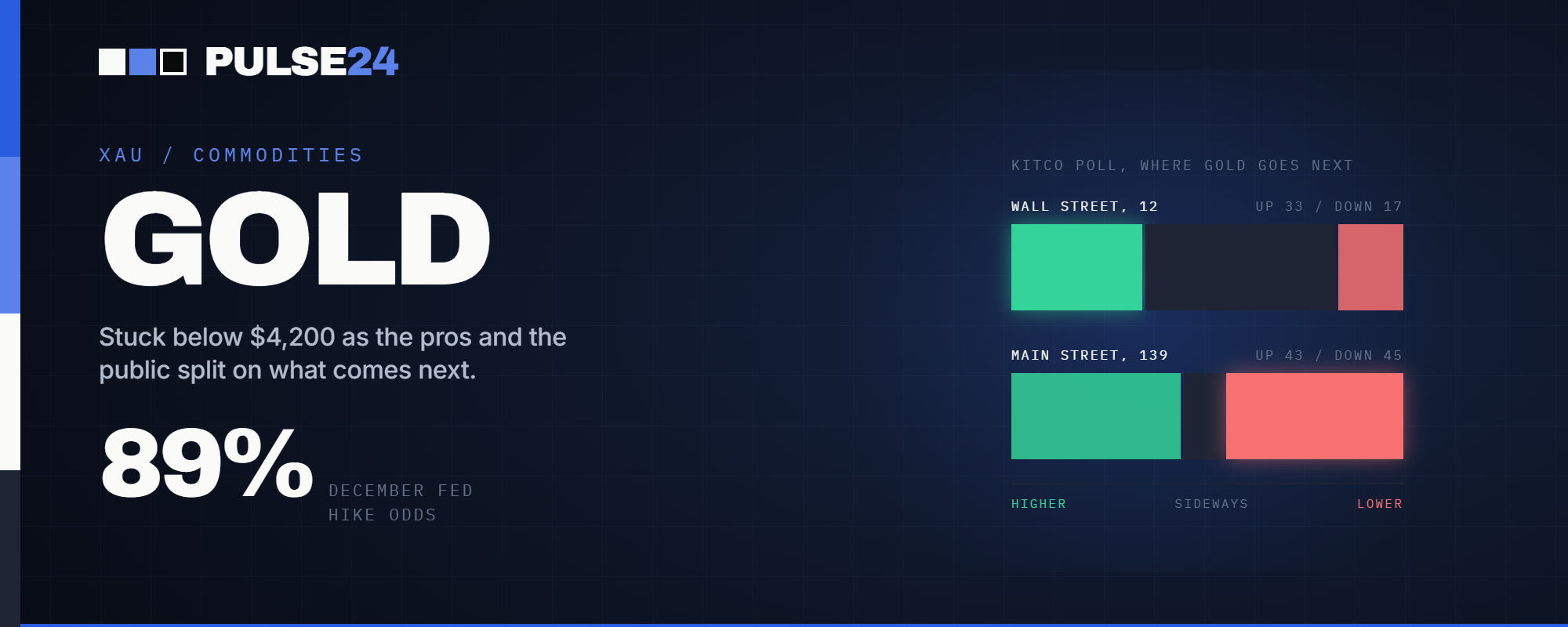
Gold spent the week pinned between $4,073 and $4,217 an ounce as traders cut the odds of an October Fed hike and raised December's to 89%. A new Kitco survey shows the pros and the public landing on opposite sides of where it goes next.
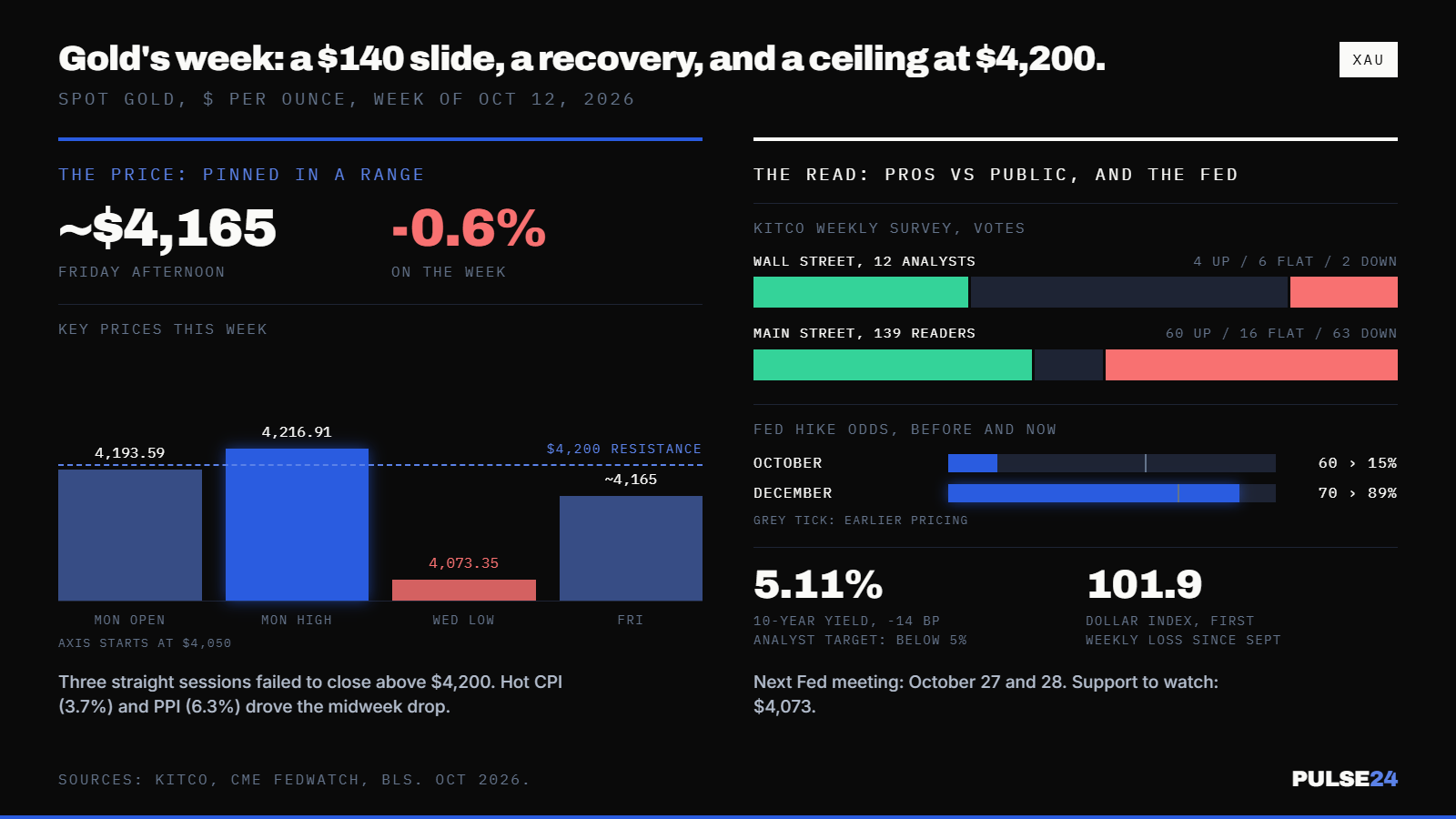
Gold opened the week at $4,193.59 an ounce and climbed to $4,216.91 by Monday afternoon. By Wednesday afternoon it had fallen to $4,073.35, a drop of more than $140 in two trading days.
Two inflation reports did the damage. Wednesday's Consumer Price Index came in at 3.7% year over year, above forecasts, and Thursday's producer price index was worse: wholesale prices rose 6.3% from a year earlier, the hottest reading since 2022 and well above the 5.3% economists expected. Gold spent Thursday and Friday clawing back most of the damage. By Friday afternoon it traded near $4,165, down about 0.6% on the week but still parked inside the same $4,100-to-$4,200 range it has occupied for most of October.
What Changed
What makes this week worth a closer look isn't the size of the swing. Gold has had bigger ones. It's that the people who cover this market for a living and the people who trade it from home are no longer reading the tape the same way. Kitco's weekly survey asked 12 Wall Street analysts where gold goes next: four said up, two said down, and six had no strong view either way. A separate reader poll drew 139 votes that broke almost the opposite direction, with 63 expecting a decline, 60 expecting a gain, and 16 calling for more of the same sideways grind.
Net it out and Wall Street leans modestly bullish while Main Street is split almost down the middle, tilting a couple of points toward a decline. That kind of gap has shown up before gold tops and bottoms in past cycles, mostly because retail sentiment tends to extrapolate the most recent move rather than anticipate the next one. It isn't a reliable signal on its own, and Pulse24 would be cautious trading off a sentiment poll alone. Paired with gold's failure to close above $4,200 for three straight sessions, though, it suggests a market that's genuinely undecided rather than quietly coiling for a breakout.
Why It Matters
The case for higher gold runs through the Federal Reserve. New York Fed President John Williams spent much of October suggesting the central bank may not need to deliver every hike currently priced into futures, and this week Fed Chair Kevin Warsh struck a similar tone without committing to anything specific. Speaking at the IMF's annual meetings, Warsh acknowledged the economy's strength but offered no guidance on October, and traders responded by cutting the odds of a hike at this month's meeting to roughly 15%, down from near 60% in the hours after September's CPI report. December reads differently. Odds of a hike there sit near 89%, up from 70% just a few weeks ago, and most big-bank forecasts have shifted to expect it.
That split matters because gold has traded as close to a pure inverse of the 10-year Treasury yield as any asset this cycle. The yield touched 5.3%, its highest level since 2000, at a recent auction, and this week it eased back to around 5.11% even as inflation data came in hot. One analyst polled by Kitco framed it simply: gold needs the 10-year back below 5% to run convincingly. Until that happens, every rally runs into sellers around round numbers like $4,200, which is close to what happened again this week.
There's a dollar angle too. The US Dollar Index was on track for its first weekly loss since early September, slipping to around 101.9, and a softer dollar is one of the more reliable tailwinds gold has. It wasn't enough on its own to push gold through resistance, but it helped the metal hold onto most of its earlier-October rally, when a record quarter of ETF inflows helped drive the move that got gold here in the first place.
What to Watch Next
The Fed's next policy meeting runs October 27 and 28, and Warsh's silence this week means the meeting itself is likely to set the next leg for gold, not anything said beforehand. Between now and then, Tuesday's housing data, Thursday's jobless claims, and Friday's flash PMI and University of Michigan sentiment readings will all shape how confidently traders price that December hike. A run of soft data would revive the case for a Fed that stays on hold well past October, the scenario gold bulls want. Hot data does the opposite, and with $4,073 having already held once as support this month, that's the level worth watching if the numbers break the wrong way.
The Pulse24 Take
Gold's story for most of this year has been one-directional: central bank buying, ETF inflows, and a softening dollar all pointed the same way for months. This week looked different. The metal ran into real resistance at $4,200, the people who trade it for a living and the people who trade it on the side landed in opposite camps, and the macro data that's supposed to settle the question, inflation against yields, sent mixed signals of its own. None of that means the gold trade is finished. It means the easy part of it might be. What happens next probably gets decided less by any single data print and more by whether Kevin Warsh's Fed actually delivers the December hike markets have already priced in, or finds another reason to wait.
How we read the data
Curious how we get from raw data to a take like this? Our Trader's Toolkit walks through the tools we lean on.
Explore the Toolkit