Pulse24 Original
SpaceX Closed $40 Billion in GPU Debt. Musk Says Most of the Industry's 200+ Neoclouds Won't Survive the Squeeze.
October 26, 2026
SpaceX secured $40 billion in debt to buy GPUs this week, using an investment-grade rating that most AI infrastructure companies don't have. Elon Musk says the financing freeze now hitting smaller cloud operators is about to get a lot worse.
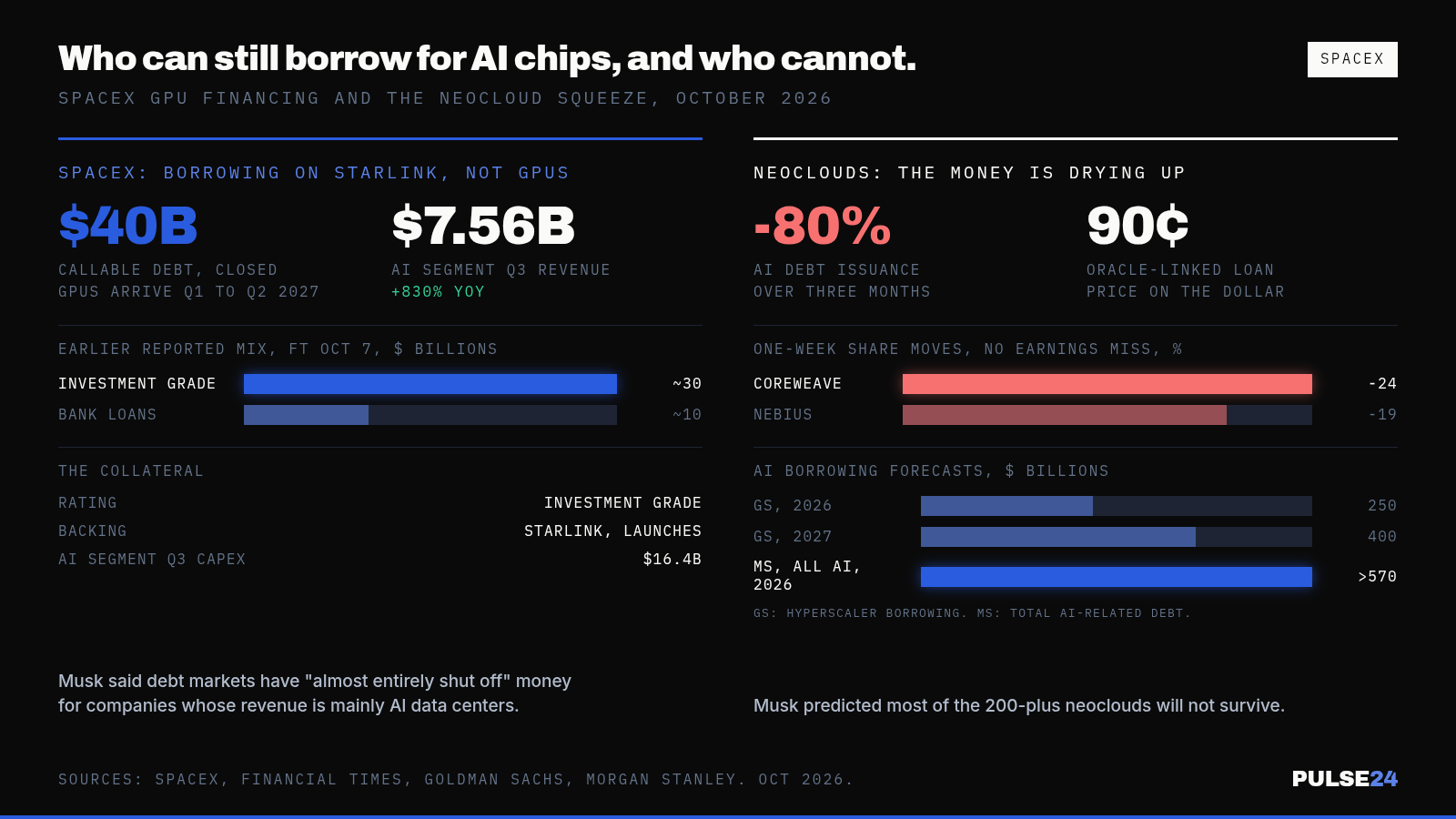
SpaceX closed $40 billion in debt financing this week to buy graphics processing units, and the company landed the deal specifically because almost nobody else can right now. Elon Musk said as much himself over the weekend. Debt markets have "almost entirely shut off access to money" for any company whose revenue depends mainly on AI data centers, he wrote. SpaceX got through because it carries an investment-grade rating, with Starlink subscriptions and rocket launches backing the loan instead of GPU rental income.
The number is specific, and so is the timeline. Musk described the financing as primarily callable debt, meaning SpaceX can repay it early, tied to GPU purchases arriving in the first and second quarters of 2027. He called it "not a major factor" for the current quarter. An earlier Financial Times report from October 7 had SpaceX in talks with Apollo Global Management for roughly $10 billion in bank loans alongside $30 billion in investment-grade debt, with Pacific Investment Management Company also involved in the discussions.
Why It Matters
The headline figure matters less than who couldn't get it. Musk's own framing drew the dividing line: companies with revenue outside AI data centers can still borrow, and companies without it increasingly can't. That second group is what the industry calls neoclouds, firms built to rent out GPU capacity to AI developers, many of them financed with debt secured against the chips themselves.
Musk predicted "guppy-level death and consolidation" among more than 200 neoclouds, adding that only a handful will make it through. He did not name specific companies in that post, but analysts covering the comments pointed straight to CoreWeave and Nebius, the sector's largest independent players, as the most exposed. Both stocks had already sold off hard before his comments; CoreWeave fell 24% and Nebius fell 19% over the past week without either company missing on earnings. The selling was about financing risk rather than results, and Musk's weekend comments support that read instead of contradicting it.
This isn't a sudden turn. AI-related debt issuance had already collapsed 80% over three months, and at least one Oracle-linked loan package was trading at 90 cents on the dollar before Musk posted anything. What changed is hearing the divide described in plain terms by someone sitting on the winning side of it, rather than inferring it from bond spreads alone.
The Numbers Behind the Divide
SpaceX can take on this kind of debt because its AI business, now reported as a Super Intelligence segment that folds in Grok and X's advertising revenue, grew 830% year over year in the third quarter to $7.56 billion. Total company revenue rose 161% to $14.58 billion. Capex for the Super Intelligence division alone hit $16.4 billion for the quarter, and the company's chief financial officer has guided to $35 billion to $40 billion in total capital spending for the fourth quarter.
Scale that up to the hyperscalers and the sums involved are far larger. Goldman Sachs projects that Amazon, Alphabet, Meta, Microsoft, and Oracle together will issue about $250 billion in bonds this year and $400 billion in 2027 to keep building AI infrastructure. Morgan Stanley puts total AI-related debt issuance above $570 billion for 2026 alone. Those are companies with cash flow and credit ratings built up over decades. The neoclouds racing to keep pace without that cushion are the ones Musk says won't all make it.
What to Watch Next
Bond spreads on AI infrastructure debt deserve more attention than equity prices right now. Reuters has reported that investors are already demanding higher yields on these bonds over concerns about both the volume of new issuance and whether AI revenue will grow fast enough to service it. A widening spread there would confirm the credit market is still tightening even if stock indexes bounce.
Consolidation announcements among smaller neoclouds are worth watching over the next two quarters, too. Musk explicitly ruled out SpaceX buying any of them, calling the idea "pointless," which removes one obvious buyer. Hyperscalers, private equity, or outright shutdowns look like the more likely outcomes for operators that can't refinance.
The Pulse24 Take
The AI buildout was never going to be funded entirely out of free cash flow, and the market is now sorting out which companies could always borrow their way through a downturn and which ones were betting that GPU rental income alone would cover the debt service. SpaceX's $40 billion deal is less a verdict on the AI trade than a signal about who gets to finance it. The easy-financing phase is ending for everyone except the companies that didn't need AI revenue to earn investment grade in the first place.
That's a narrower group than the one that's been building data centers for the past two years. Fewer, bigger neoclouds look likely by the time this credit cycle turns, and the survivors will probably look a lot more like SpaceX: diversified revenue first, GPU exposure second.
How we read the data
Curious how we get from raw data to a take like this? Our Trader's Toolkit walks through the tools we lean on.
Explore the Toolkit