Pulse24 Original
CoreWeave Fell 24% This Week, Nebius Fell 19%. Neither Missed on Earnings.
October 25, 2026
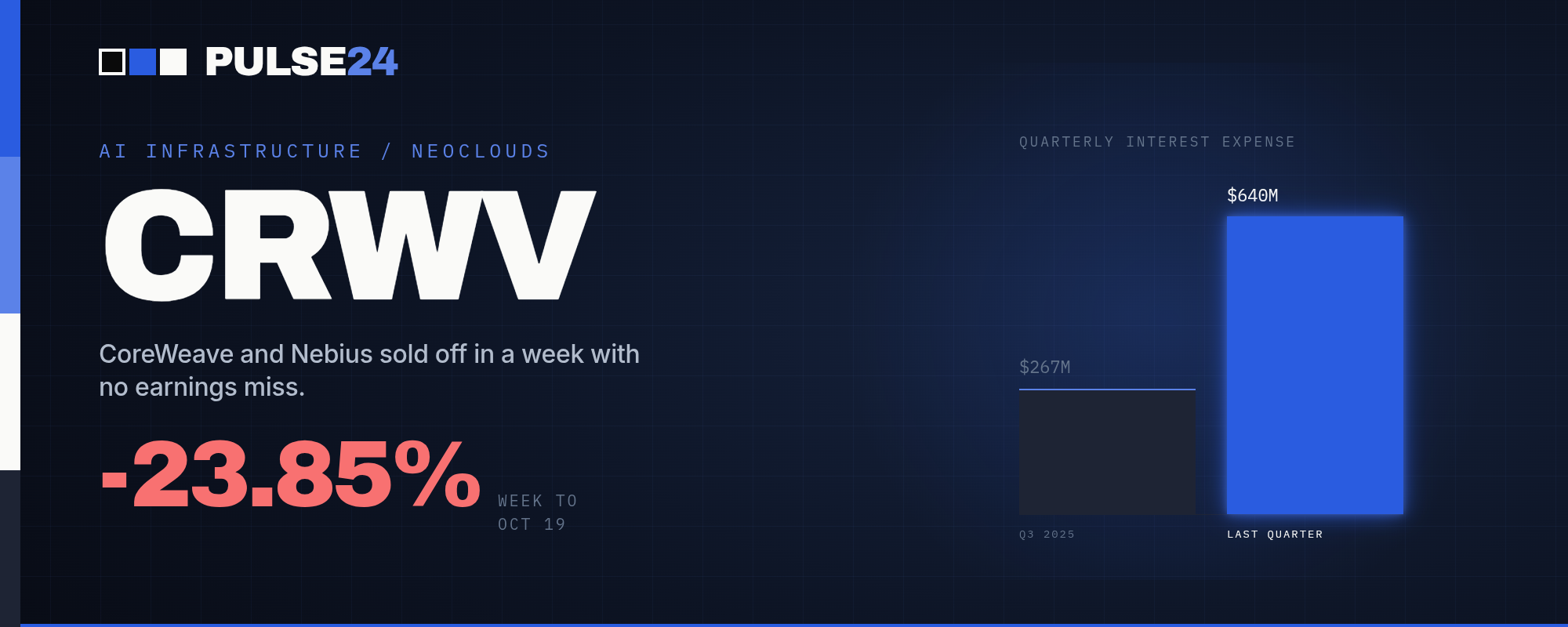
Two of the AI buildout's biggest borrowers lost a fifth of their value in five trading days, and neither reported disappointing results. A new bubble report, a grim neocloud survival forecast, and interest bills outpacing revenue are forcing a split between the AI trade and the AI bill, just as the Fed and three of the biggest hyperscalers report in the same week.
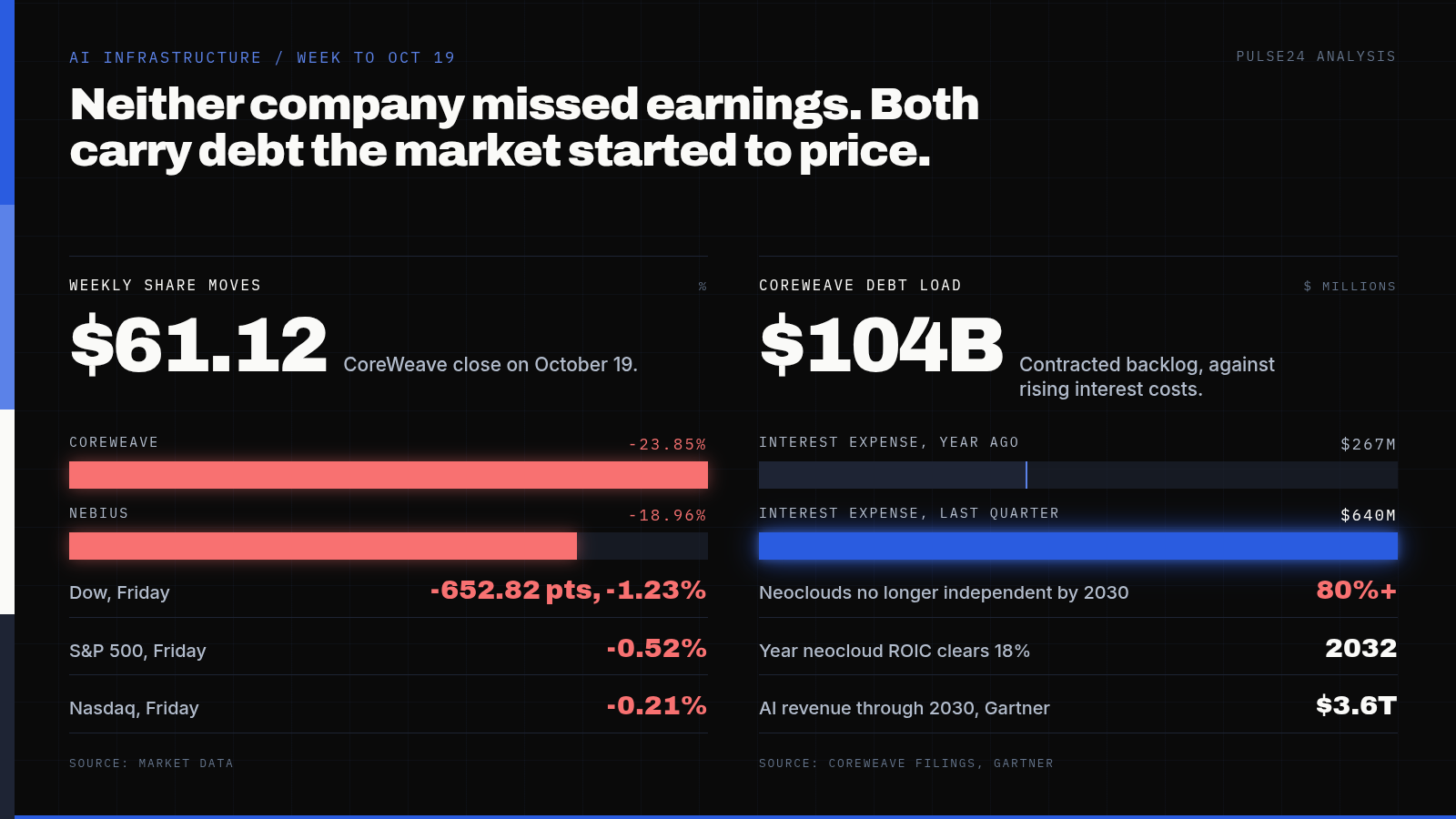
CoreWeave closed at $61.12 on October 19, down 23.85% for the week. Nebius fell 18.96% over the same five sessions. Neither company missed earnings, and neither lost a major customer. What they share is debt, and this week the market decided that mattered more than either company's order book.
What Changed
Friday closed out a rough week for stocks broadly. The Dow fell 652.82 points, or 1.23%, while the S&P 500 and Nasdaq Composite each posted a second straight weekly decline, down 0.52% and 0.21% on the day. The damage traced back to Thursday, when a steep selloff in semiconductors and Big Tech spread beyond the usual AI trade, hitting neocloud names like CoreWeave especially hard.
Two reports landed in the middle of that selloff and gave it a shape. Gartner's chief forecaster, John Lovelock, said compute capacity already exceeds demand, much of it bundled into premium products investors can't easily price, and he doesn't expect neocloud revenue to clear an 18% return-on-invested-capital threshold until 2032. Total AI revenue across enterprise and consumer markets, he forecasts, tops out at $3.6 trillion through 2030. Separately, the Open Markets Institute and the Americans for Financial Reform Education Fund published a report arguing that AI's financing has grown reliant on circular deals, arrangements where one company funds another's buildout and the recipient turns around and buys the investor's products. The report doesn't name specific transactions, but it makes a simple point: those deals are legal, and they're also very good at creating the appearance of demand that may not exist at the scale it's being priced for.
Why It Matters
CoreWeave is the clearest illustration of the mismatch worrying investors right now. The company lost $626 million in the second quarter on $2.58 billion of revenue, and its quarterly interest expense has more than doubled over the past year, from $267 million to $640 million, with guidance pointing to $860 million to $940 million next quarter. Its debt-to-equity ratio sits at 8.94. None of that is automatically fatal: CoreWeave's backlog has grown to $104 billion, and that backlog represents contracted revenue, not a hope. The problem is timing: interest comes due now, while revenue arrives over years. Goldman Sachs, which cut its price target on the stock by 24% in September before upgrading it to buy, is effectively betting the gap is survivable. This week's price action says a chunk of the market isn't so sure anymore.
Nebius tells a similar story from the European side of the same trade. It spent $8.13 billion on capital expenditures in the first half of the year and carries roughly $10 billion in convertible debt, a $775 million GPU-backed credit facility, and $12.1 billion in future lease obligations against $37.5 billion in remaining performance obligations. Both companies make money by borrowing to build data centers, then renting out the capacity under long-dated contracts. That model works as long as lenders keep pricing the risk the way they have been. AI-related debt issuance, which had already collapsed 80% over three months before this week, suggests some of them are starting to reconsider.
It also matters that this isn't an isolated AI-infrastructure story anymore. Meta's own negative free cash flow report knocked 2.7% off the Nasdaq earlier this week, and the 10-year Treasury yield's steepest single-day drop since the SVB collapse came in the same stretch. Credit markets, rate markets, and equity markets are all reacting to the same underlying question now: how much of the AI buildout is funded by real revenue, and how much is funded by the expectation of revenue that hasn't shown up yet. Anthropic's own first-half 2026 results, a net loss north of $80 billion, more than six times what it lost a year earlier, arrived in the middle of this debate as the company reportedly prepares to seek a $1.5 trillion IPO valuation. That contrast, mounting losses alongside an escalating valuation, is exactly the kind of gap Lovelock's forecast and the circular-financing report are both pointing at.
What to Watch Next
The Fed meets Wednesday, and futures markets have all but ruled out a hike, pricing the odds of an increase in the single digits to low teens, down sharply from near 37% at the end of September. A hold is the base case, but Jerome Powell's press conference will get parsed for anything about December, especially with almost every economist in a recent Reuters poll now expecting a hike by year-end. Rising rates would make the CoreWeave and Nebius problem worse, not better, since both companies' debt costs move with the broader rate environment.
Hours after that decision, Microsoft and Alphabet report earnings, with Amazon following Thursday. All three will face the same question from analysts: is AI capital spending still paying for itself? Microsoft spent $115.9 billion on capex in its last fiscal year while Azure revenue topped $100 billion, and Amazon's cloud unit grew revenue 37% last quarter, so the hyperscalers have a much better revenue base to point to than the neoclouds do. Whether that gap in the numbers is enough to keep the gap in investor confidence from widening further is the real story of this week, not any single earnings beat or miss.
The Pulse24 Take
Nothing this week proves the AI trade is broken. CoreWeave's backlog is real, the hyperscalers' cloud revenue is real, and even the bearish Gartner forecast describes consolidation, not collapse, by 2030. What changed is simpler and, in some ways, more useful: the market started pricing the financing side of AI infrastructure as its own risk, separate from whether the technology works or whether demand eventually arrives. That's a healthier way to think about this trade than treating every chip or cloud headline as automatically bullish. Debt-funded growth isn't new and isn't inherently dangerous, but it does mean the companies most exposed to it will keep trading on interest-rate headlines and credit conditions as much as on their own backlogs. Watch the spread between CoreWeave and Nebius on one side and Microsoft, Alphabet, and Amazon on the other over the next two weeks. If it keeps widening even as the hyperscalers post strong numbers, that's the market telling you it has started distinguishing between who is funding the AI buildout with cash flow and who is funding it with borrowed time.
How we read the data
Curious how we get from raw data to a take like this? Our Trader's Toolkit walks through the tools we lean on.
Explore the Toolkit