Pulse24 Original
The 10-Year Yield Dropped 19 Basis Points in a Single Day, Its Steepest Fall Since the SVB Collapse. Hedge Funds Had Their Worst Day Since Covid, Too.
October 24, 2026
The bond market just posted its sharpest reversal in more than three years, right in the middle of an AI-driven stock selloff, and Goldman's trading desk says hedge funds haven't had a day this bad since the pandemic. The whiplash says more about positioning than about where rates are actually headed.
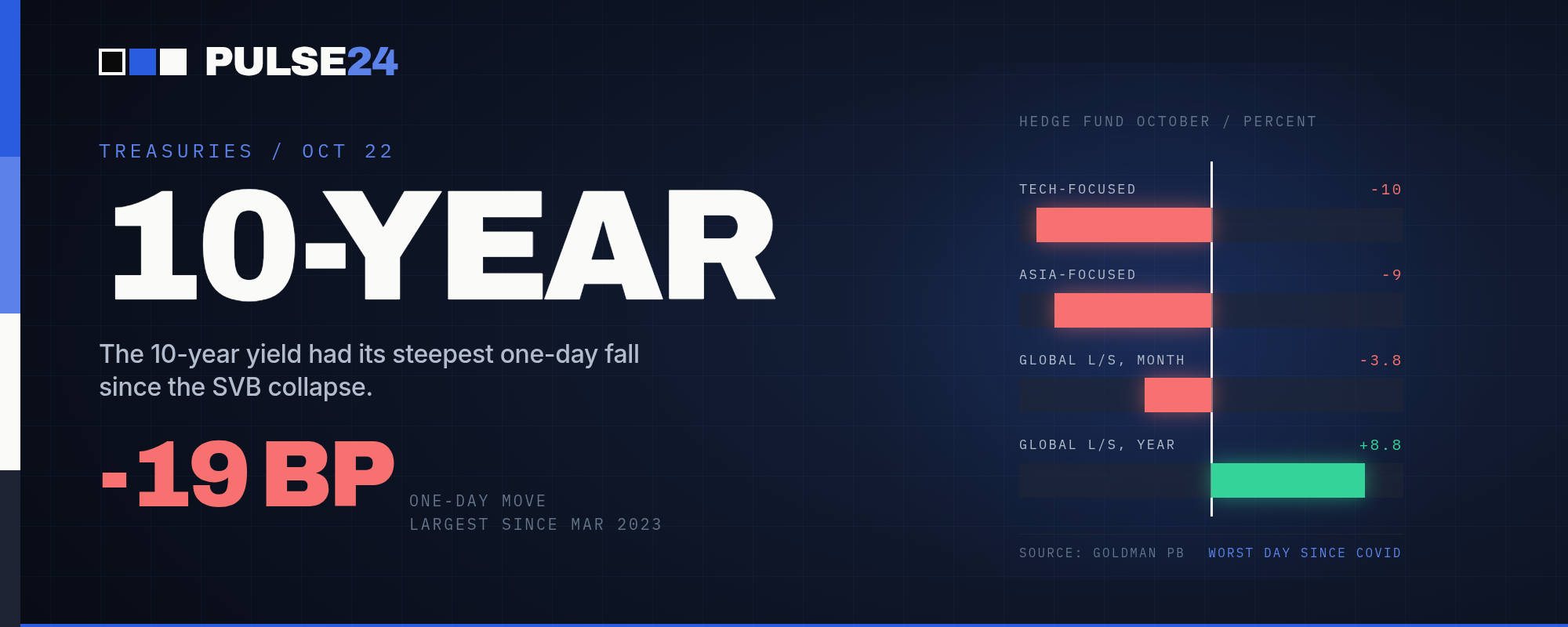
The 10-year Treasury yield fell 19 basis points on Thursday, its steepest single-session drop since March 10, 2023, the day Silicon Valley Bank collapsed. By Friday afternoon it had already clawed most of that move back, trading near 4.99%. In between, Goldman Sachs's prime brokerage unit flagged something its trading desk hadn't seen since the pandemic: every major hedge fund strategy it tracks lost more than 1% in a single day.
That combination, a bond market move big enough to evoke a banking crisis and a hedge fund drawdown broad enough to evoke Covid, happened over one trading session built almost entirely around doubts about AI spending.
What Changed
Thursday's selloff had a clear trigger. Big Tech earnings landed Wednesday night, and the market didn't like what it heard. Meta posted its first negative free cash flow in a decade, then compounded the worry by proposing a stock split paired with new non-voting shares, a structure that raised dilution concerns on top of the spending numbers. The stock fell nearly 7% intraday, its sharpest drop since July. Tesla had already cut $5 billion from its 2026 capital spending plan earlier in the week, and SpaceX guided fourth-quarter capex to $35 billion to $40 billion, a number investors read as cautious rather than aggressive. Put together, three of the most AI-capex-exposed companies in the market all signaled some version of restraint in the same 48 hours.
The Nasdaq Composite fell 2.6% on Thursday, its worst day since June. CoreWeave, which Goldman had only recently upgraded to Buy after a 30% slide, fell another 10% to a fresh 52-week low. Credit spreads on compute infrastructure debt widened. Money moved out of anything levered to the AI buildout and into government bonds, which is the mechanical reason the 10-year yield dropped so fast: when investors sell risk assets as a group, Treasuries are usually the other side of that trade.
The Fed Got Repriced, Fast
Bond yields don't move 19 basis points in a day because of stock prices alone. They move because the market's view of where the Federal Reserve is headed shifted meaningfully. The Fed raised its target range to 3.75% to 4.00% in September, its first hike since 2023, under Chair Kevin Warsh, and had signaled it could hike once more before year end. By Thursday afternoon, futures markets had pushed the odds of no further hike this year up to 24%, a sharp move from where pricing stood earlier in the week. The odds of a hike at next week's October 28 meeting fell to just 7%, the lowest reading all month. A Reuters poll had every one of 100 surveyed economists expecting a hike by December, and that December probability held around 76% in futures pricing, but it's no longer treated as a lock. Cumulative tightening priced in over the next twelve months fell to about 63.5 basis points, down from 80 to 90 basis points earlier in the month.
The two-year yield, which tends to track Fed expectations most closely, fell 18 basis points to 4.64% on Thursday. That's a bigger relative move than the 10-year made, and it's the clearer signal that traders were repricing policy, not just fleeing risk.
The Hedge Fund Angle
The more unusual story sits with hedge funds themselves. Goldman's prime brokerage data showed all three major strategy types it tracks, fundamental equity long/short, systematic, and multi-strategy, each falling more than 1% on Thursday. The desk's own note put it plainly: the strategies hadn't all fallen together like that since the Covid-era market rout in 2020. One line from the note summed up the mood: if the previous Thursday felt bad, this one was worse.
The damage wasn't evenly spread. Tech-focused funds are down roughly 10% in October through Thursday, among the worst performers tracked. Asia-focused funds, hit by China and tech holdings along with a squeeze in crowded short positions, are down roughly 9% on the month. Global fundamental long/short funds, the stock-picker category, fell 3.8% in October but are still up 8.8% for the year, a reminder that a bad week doesn't erase a strong year. The common thread across the weak performers is deleveraging: positions built on the assumption that AI infrastructure spending would keep accelerating got unwound fast once that assumption wobbled.
Why It Matters
A single day of repricing doesn't settle the AI capex debate. What it does show is how little room there is for disappointment. The market spent most of 2026 pricing AI infrastructure spending as close to unstoppable, and when three major companies signaled anything short of that in one week, the unwind was fast and broad enough to touch a Fed policy that has nothing directly to do with Meta's stock split. That's the kind of linkage that matters here: positioning risk in one corner of the market, equities geared to AI capex, can spill into Treasuries, the dollar, and rate expectations within a single session.
It also complicates the Fed's job. Oil prices jumped to a six-month high into the end of the week, adding an inflation argument for hawks just as the growth argument for staying on hold got stronger. A central bank trying to finish a hiking cycle without choking off either inflation or the AI investment boom now has two moving targets instead of one.
What to Watch Next
The Fed's decision lands October 28, and current pricing says the committee holds steady. But the real test is whether Thursday's move was a one-day positioning flush or the start of a trend. Microsoft, Alphabet, Amazon, and Apple report earnings this week, and each will face the same question Meta just did: is AI capex still accelerating, holding steady, or starting to plateau. Any answer that reads as caution could reopen Thursday's trade. Watch the 10-year yield's relationship with 5%; it closed just below that level Thursday and climbed back toward it Friday, and which side it settles on by month end will say a lot about whether the market believes the Fed is close to done. Credit spreads in compute infrastructure debt are also worth tracking, since that's where a funding squeeze would show up first if the AI capex retrenchment turns out to be real rather than a one-week scare.
The Pulse24 Take
Days like Thursday are useful precisely because they're uncomfortable. A 19 basis point move in the 10-year and a hedge fund drawdown that rivals the pandemic crash both sound like regime-change signals, and maybe one of them eventually is. But the faster, more honest read is that a market crowded into one trade, AI infrastructure spending as a near-certainty, found out how little room that trade had for disappointment. The unwind told you more about positioning than about the Fed's actual reaction function or AI spending's long-run trajectory.
None of this means the AI capex story is over. Meta, Tesla, and SpaceX all still plan to spend enormous sums; they just signaled they'd rather do it with more discipline than the market had priced in. The Fed, for its part, still looks on track to hold next week and probably hike once more by December unless the data turns. What changed Thursday wasn't the destination. It was how violently the market reacted to a small detour, and that's worth remembering the next time a single earnings call moves a hiking cycle's odds by double digits.
How we read the data
Curious how we get from raw data to a take like this? Our Trader's Toolkit walks through the tools we lean on.
Explore the Toolkit