Pulse24 Original
Every One of 100 Economists Reuters Polled Expects a Fed Hike by December. A Month Earlier, Fewer Than Four in Ten Did.
October 23, 2026
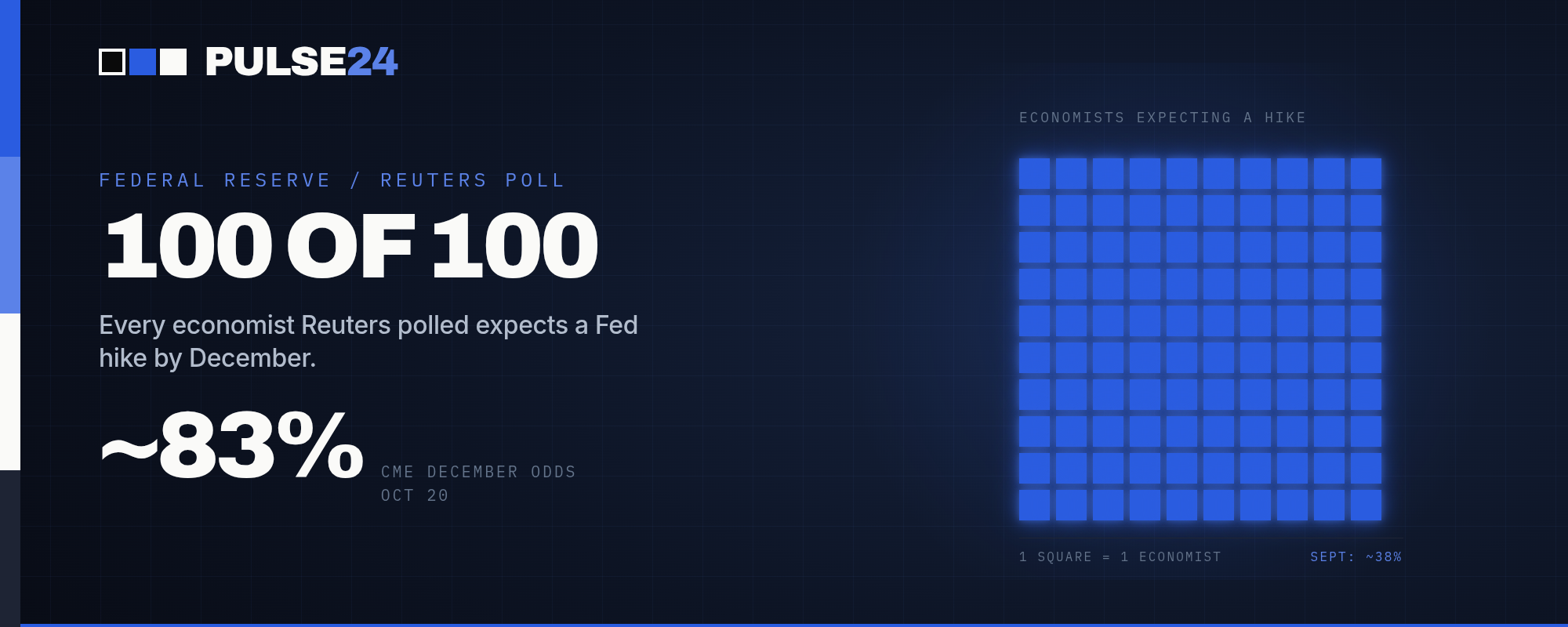
A Reuters poll of 100 economists found unanimous agreement that the Federal Reserve will raise rates again in December, a sharp reversal from a cycle that spent most of 2026 debating cuts. Futures markets have already priced most of it in, but forecasters are split on whether one hike is the end of the story or just the first of several.
Reuters surveyed 100 economists between October 16 and 20, asking each one a simple question: will the Federal Reserve raise interest rates again before the end of 2026. All 100 said yes. That is not a majority or a strong consensus. It is everyone.
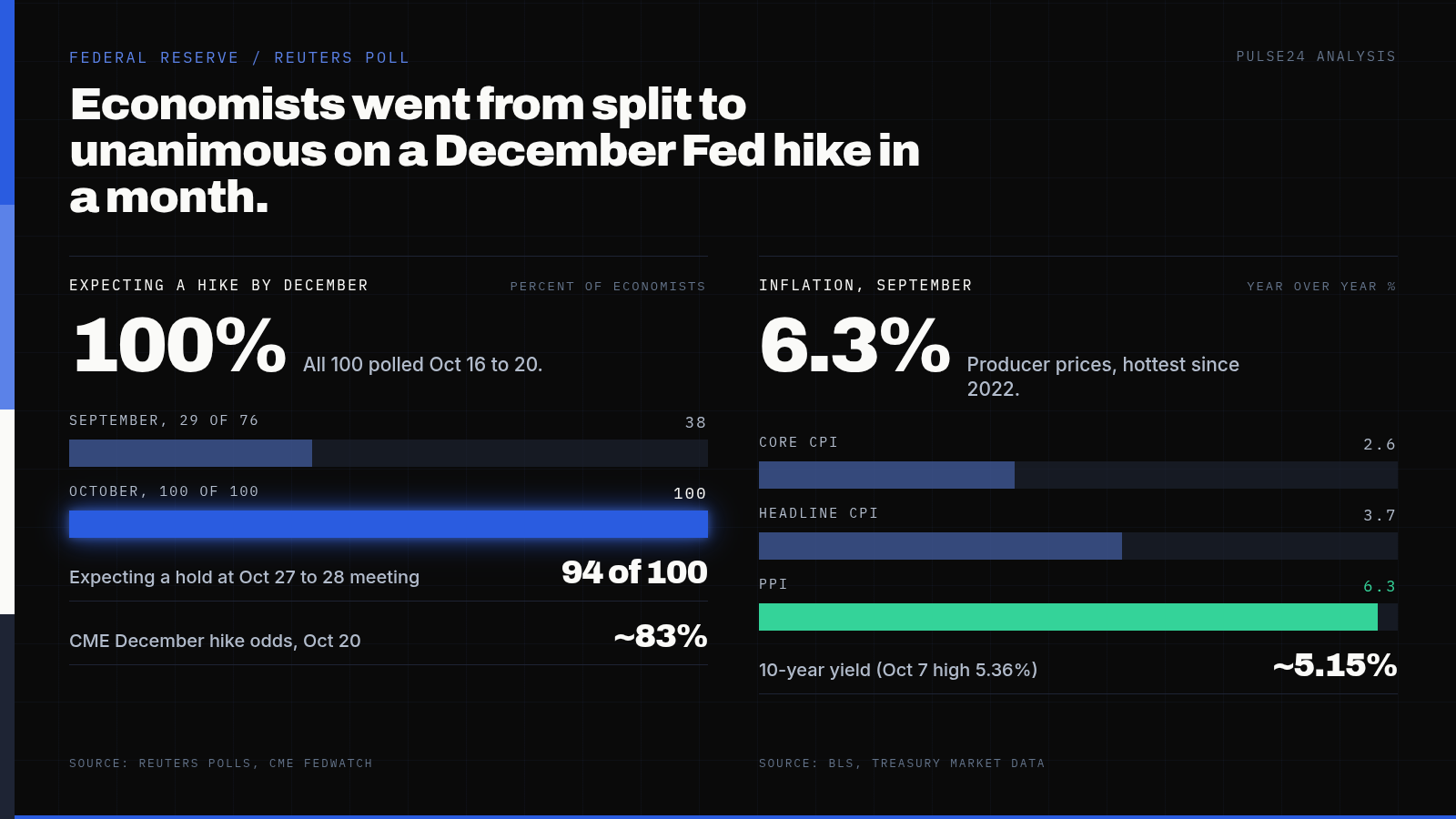
The shift happened fast. A month earlier, fewer than half of economists expected a December hike at all, with one survey pegging the figure at 29 of 76, or roughly 38%. All 100 now agree. Separately, 94 of the 100 expect the Fed to hold its benchmark rate at its current 3.75% to 4.00% range when it meets October 27-28, treating that pause as the bridge to December rather than an alternative to it.
What Changed
Three pieces of data did most of the work. September's consumer price index rose 3.7% year over year, with the core reading, which strips out food and energy, at 2.6%. Both came in hotter than the Fed wanted heading into its blackout period, the stretch before a meeting when officials stop giving public signals. Wholesale prices added to the case: September's producer price index rose 6.3% year over year, the hottest wholesale-inflation reading since 2022. September payrolls, by contrast, came in soft, the one release pulling in the other direction.
Housing added a similar wrinkle. September housing starts fell 5.2% to an annualized 1.221 million units, and permits dropped to a three-and-a-half-year low of 1.400 million. That lines up with builder confidence sinking to a 14-year low even as builders cut list prices at a record pace. Weak housing data would normally argue against tightening. Here, forecasters read it as a reason the Fed can wait until December rather than a reason to skip a hike altogether.
Futures markets had already started pricing this in. CME's FedWatch tool showed roughly 17% odds of an October hike and about 83% odds of a December move as of October 20, a sharp shift from where things stood when October hike odds first doubled on the September inflation surprise and then cooled to 15% after a dovish-sounding speech from Fed Chair Kevin Warsh in Bangkok. The debate in futures markets isn't really about whether the Fed hikes anymore. It's about how many times.
How Many Hikes
Thirty-eight of the 92 economists who answered that specific question expect at least two further hikes, more than double the roughly one in five who said so in September. About 60% of forecasters see the policy rate peaking in the 4.00% to 4.25% range, which only holds if December turns out to be the last move. The rest expect the Fed to keep going into 2027, and the median forecast now has core PCE inflation, the Fed's preferred gauge, running more than a full percentage point above the 2% target for several more quarters, not returning to target until 2028 at the earliest.
Morgan Stanley economist Michael Gapen framed the risk bluntly: the Fed, in his view, may ultimately need to hike more than his own forecast currently assumes. Mizuho Securities economist Alex Pelle was the sharpest critic of the Fed's decision to wait. Skipping a hike in October, he said, is "the wrong call from a policy point of view." His own base case for December is a standard quarter-point move, but he puts better odds on the Fed going 50 basis points than on it not moving at all.
The Market's Reaction So Far
Prices have mostly absorbed the shift already, which is why the response has looked more like a grind than a shock. The 10-year Treasury yield sat at roughly 5.15% on October 21, down from the 5.36% high it touched on October 7, itself the highest level since 2002. Dollar index futures traded near 101.69, still below the 52-week high of 102.95 set earlier in the cycle. Stocks barely blinked: the S&P 500 closed at 7,757.17, up 0.58% on the day and within 1.1% of its record, while the VIX held near 16.68, a reading with no hint of panic in it. Gold, which was testing resistance near $4,200 back when December hike odds first crossed 89%, has since eased into the $4,113 to $4,132 range.
What to Watch Next
The next week carries more weight than usual. A flash composite PMI reading is due out today, with consensus looking for 58.4, landing squarely inside the blackout period that began October 17 and runs through the Fed's decision. The FOMC vote itself lands October 28 at 2 p.m. Eastern, followed by Chair Warsh's press conference. The awkward part is that the data most likely to confirm or undercut the December call, the Q3 GDP advance estimate and September's PCE inflation reading, both arrive October 29, a full day after the Fed has already voted. The committee will make its October decision without the one inflation gauge it arguably weighs most heavily for that specific meeting, which means markets will spend the following weeks trading the December path on numbers the Fed itself didn't have yet.
New York Fed President John Williams added a reminder of how fluid these calls can be. Futures have priced roughly 90% odds of a further hike in 2027, and Williams has said he may not need to deliver one at all. If a view this fresh and this unanimous can still be wrong about where rates head a year out, a single Reuters poll calling December with total agreement is worth taking seriously, not as gospel.
The Pulse24 Take
One hundred out of one hundred is a rare number, and rare numbers deserve a little suspicion rather than blind trust. Consensus forecasts have gotten this cycle wrong before, and the Fed itself has spent much of 2026 doing the opposite of what futures markets priced a few months ahead of time. What makes this round different is where the signal is coming from. It isn't a Fed official hinting at a plan. It's inflation data that keeps landing hotter than expected, inside an economy where housing and parts of the labor market are genuinely losing momentum. Firm prices next to softening growth is an uncomfortable mix for a central bank that would rather be cutting, and it's the kind of mix that doesn't resolve cleanly in one direction. The more useful question for the next week isn't whether the Fed hikes in December. Yields, the dollar, and gold have already priced most of that in. It's whether today's PMI reading, the GDP and PCE data landing the day after the meeting, and anything Chair Warsh says at the podium start building a real case for a second hike in early 2027. If the 38 of 92 economists betting on more than one move are right, December is the easy call. The harder one comes after it.
How we read the data
Curious how we get from raw data to a take like this? Our Trader's Toolkit walks through the tools we lean on.
Explore the Toolkit