Pulse24 Original
Anthropic's IPO Filing Shows an $80.7 Billion Loss. Wall Street Still Wants to Pay Up to $2 Trillion for It.
October 26, 2026
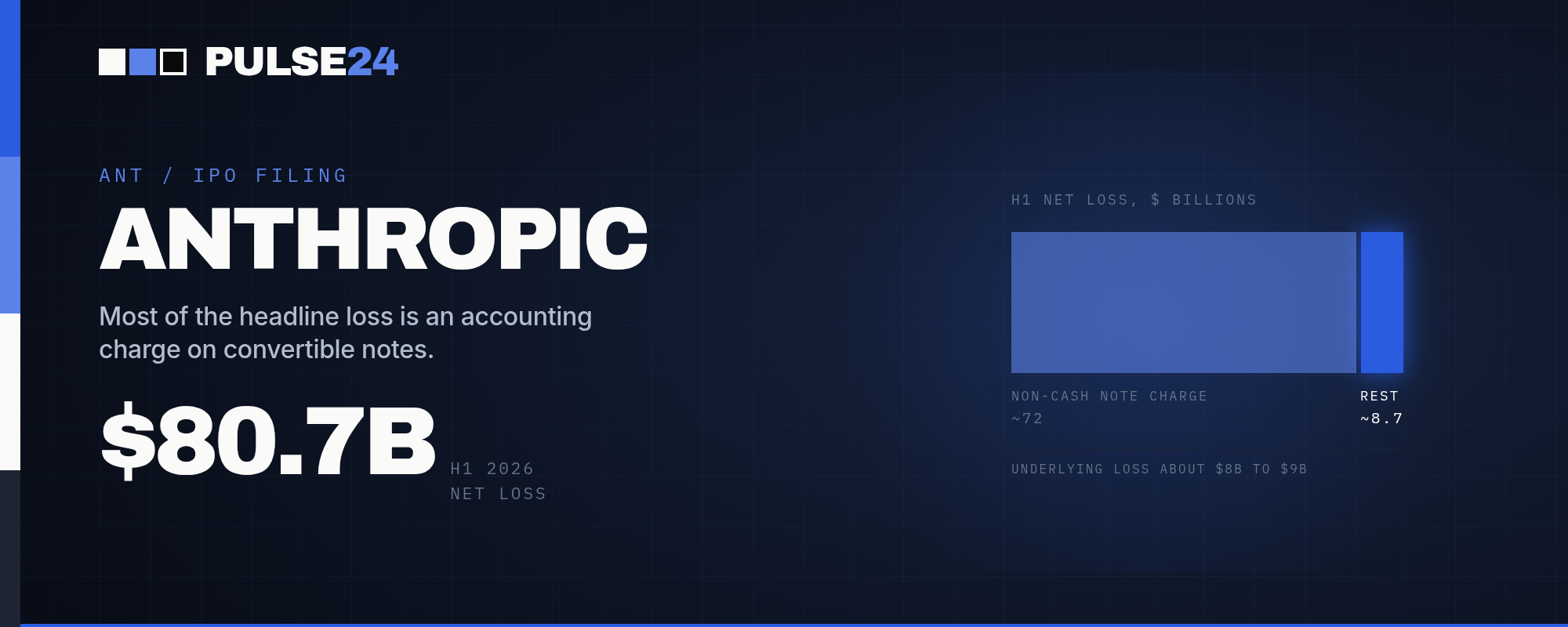
Anthropic's S-1 filing shows revenue up 13.5 times year over year, alongside an $80.7 billion net loss that's mostly a non-cash accounting charge tied to its own funding structure. The same filing lays out roughly $430 billion in compute commitments spread across Broadcom, Google, Amazon, and Microsoft.
$16.3 billion. That's what Anthropic brought in during the first half of 2026, according to the S-1 registration statement it filed Monday with the Securities and Exchange Commission, already more than triple the $4.6 billion it made in all of 2025. It's also less than a fifth of the net loss the company reported for the same six months: $80.7 billion, nearly double the $42 billion Anthropic lost across the entirety of last year, inside half the time.
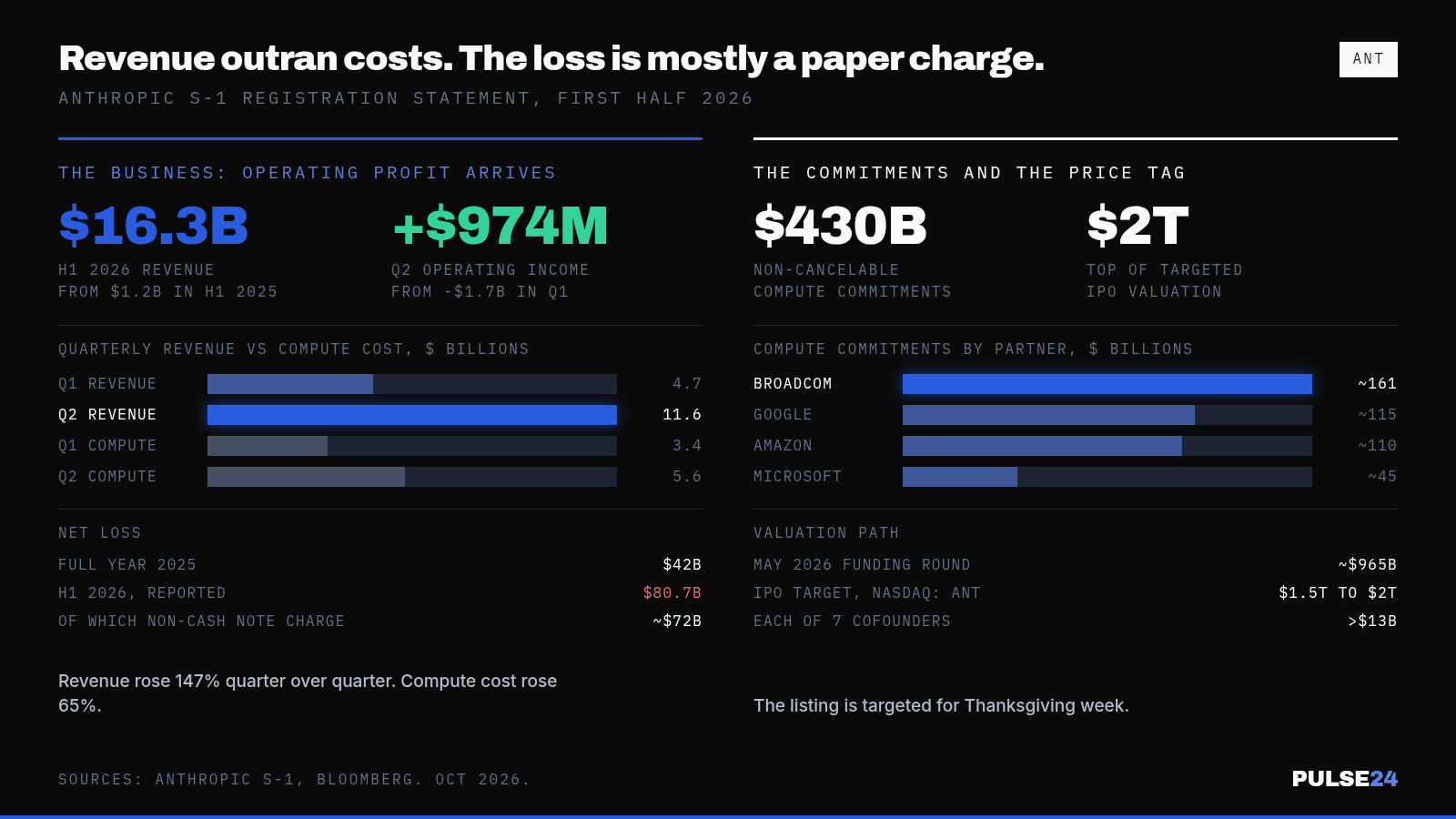
Start with where that $80.7 billion actually comes from. Roughly $72 billion of it has nothing to do with cash leaving the building. It's a non-cash charge tied to convertible notes Anthropic has issued to investors, including Amazon, notes that get marked up in value every time the company's private valuation climbs. That valuation has climbed a lot this year, from about $965 billion at a funding round in May to a targeted $1.5 trillion to $2 trillion at the planned IPO. Strip the charge out and the underlying loss for the half falls to somewhere near $8 billion to $9 billion. Large by any normal company's standard, but a different story than the headline number suggests.
What Changed
The filing is the first time public markets get a full, audited look inside a frontier AI lab's books, rather than a leaked term sheet or an analyst's estimate. An earlier disclosure in August put Anthropic's revenue growth at 14-fold to an $11.5 billion annualized run rate, enough on its own to send Marvell, FormFactor, and Applied Materials sharply higher that day. The audited numbers in the S-1 confirm that trend held: quarterly revenue jumped from $4.7 billion in the first quarter of 2026 to $11.6 billion in the second, a 147% increase. Compute costs rose too, from $3.4 billion to $5.6 billion, but only by 65%. Revenue grew roughly twice as fast as the single biggest cost line beneath it, and that shows up in the operating numbers: a $1.7 billion operating loss in the first quarter turned into $974 million of operating income in the second.
That shift matters given what's been happening elsewhere in AI financing. AI-related debt issuance collapsed 80% over roughly the same stretch, with one Oracle-linked loan package backing a data center build trading at 90 cents on the dollar, a sign credit markets have started doubting whether AI infrastructure spending generates enough revenue to cover its own financing. Anthropic's quarter doesn't settle that argument on its own. It is, though, the first real data point from a frontier lab suggesting the revenue side of that ledger can, at least for one quarter, outgrow the compute bill sitting against it.
The filing also puts a number on how large that compute bill has become. Anthropic spent $8.9 billion renting compute in the first half of 2026, nearly four times what it spent over the same period a year earlier, plus $482 million building its own data centers under a program it calls Anthropic Direct. Layered on top of that are non-cancelable compute commitments of roughly $430 billion: about $161 billion with Broadcom, $115 billion with Google, $110 billion with Amazon, and $45 billion with Microsoft. The Broadcom figure includes the $42 billion loan Broadcom agreed to extend Anthropic earlier this month to help cover a $125.2 billion TPU lease, a sum that was already drawing scrutiny for matching Anthropic's entire 2025 net loss almost to the dollar. These aren't spending plans. They're contracts, and they now sit in a public filing that chip and cloud investors can read line by line.
Why It Matters
Pull back and the Anthropic filing is really two stories stapled together. One is about a single company's income statement, where the picture is messier but arguably better than the loss number implies. The other is about financing structure, and that one deserves more scrutiny. Amazon holds about $6.2 billion of Anthropic's convertible notes, which convert into roughly 1.84 billion nonvoting shares at the IPO, and Google's financing agreement allows for up to $20 billion, reducible if Google exercises an option tied to a 14.99% ownership cap. These aren't arm's length loans from a bank. They're financing deals between Anthropic and the same companies selling it compute, a pattern already drawing scrutiny elsewhere in AI infrastructure, including SpaceX's recent $40 billion GPU debt raise and Elon Musk's own comment that most of the industry's 200-plus neoclouds won't survive the current squeeze.
Whether that circularity matters depends on which side of the trade an investor sits on. For Broadcom, Google, Amazon, and Microsoft, a public, audited count of $430 billion in contracted revenue from a single customer is about as clean a confirmation as AI infrastructure investors have gotten this cycle that demand is real and committed, not just promised on an earnings call. For Anthropic, it means the company has effectively pledged a large share of its future revenue to four counterparties before it has a single quarter of GAAP profitability to show public shareholders. Both of those things are true at once, and the IPO is where public markets get to decide which one matters more.
What to Watch Next
Anthropic is targeting a Thanksgiving-week debut on the Nasdaq under the ticker ANT, led by Goldman Sachs and Morgan Stanley, with a size meant to match or exceed SpaceX's record $75 billion raise from June. OpenAI shelved its own IPO plans back in September over unfinished safety work, leaving Anthropic as the only one of the two largest AI labs actually racing toward a public listing this year, which puts extra weight on how this debut gets priced and received. Watch where the final price lands inside that $1.5 trillion to $2 trillion range. Pricing at the low end would suggest investors are discounting the loss headline more than Anthropic hoped; pricing at or above $2 trillion would say the market is comfortable reading past the convertible-note charge to the underlying operating trend. Also worth tracking is the lockup structure: some employees can sell shares on the first day of trading, with further lockup expirations on days 27, 48, 62, and 76, well ahead of the standard 180-day schedule, which could add supply to the stock earlier than most newly public companies see. And watch Broadcom, Google, Amazon, and Microsoft's own earnings calls in the coming weeks for any new detail on how each is accounting for its side of that $430 billion in commitments.
The Pulse24 Take
The headline number here, an $80.7 billion loss, is built to go viral and is mostly misleading as a measure of the underlying business. A quieter story sits underneath it: a company whose revenue grew faster than its compute bill for one quarter, wrapped inside a financing structure so entangled with its own suppliers that separating real demand from circular bookkeeping will take more than one earnings cycle to sort out. Markets reacted Monday like the operating trend is what matters: the Nasdaq Composite rose roughly 0.8%, with Nvidia, Broadcom, Micron, Intel, and AMD all trading higher. Meta was the outlier, falling after it separately announced plans to raise up to $95 billion for its own AI infrastructure build-out, a stock still skittish about AI capex since it posted negative free cash flow for the first time in a decade last quarter. Whether Monday's reaction holds up is likely to be decided less by the Thanksgiving-week pricing than by whether Anthropic's third quarter, whenever it eventually reports one as a public company, shows operating income growing again or shrinking back.
How we read the data
Curious how we get from raw data to a take like this? Our Trader's Toolkit walks through the tools we lean on.
Explore the Toolkit