Pulse24 Original
Microsoft's AI Spending Came In $5 Billion Below Forecast. Alphabet's Jumped $27 Billion in a Year, and the Stock Fell 10%.
October 29, 2026
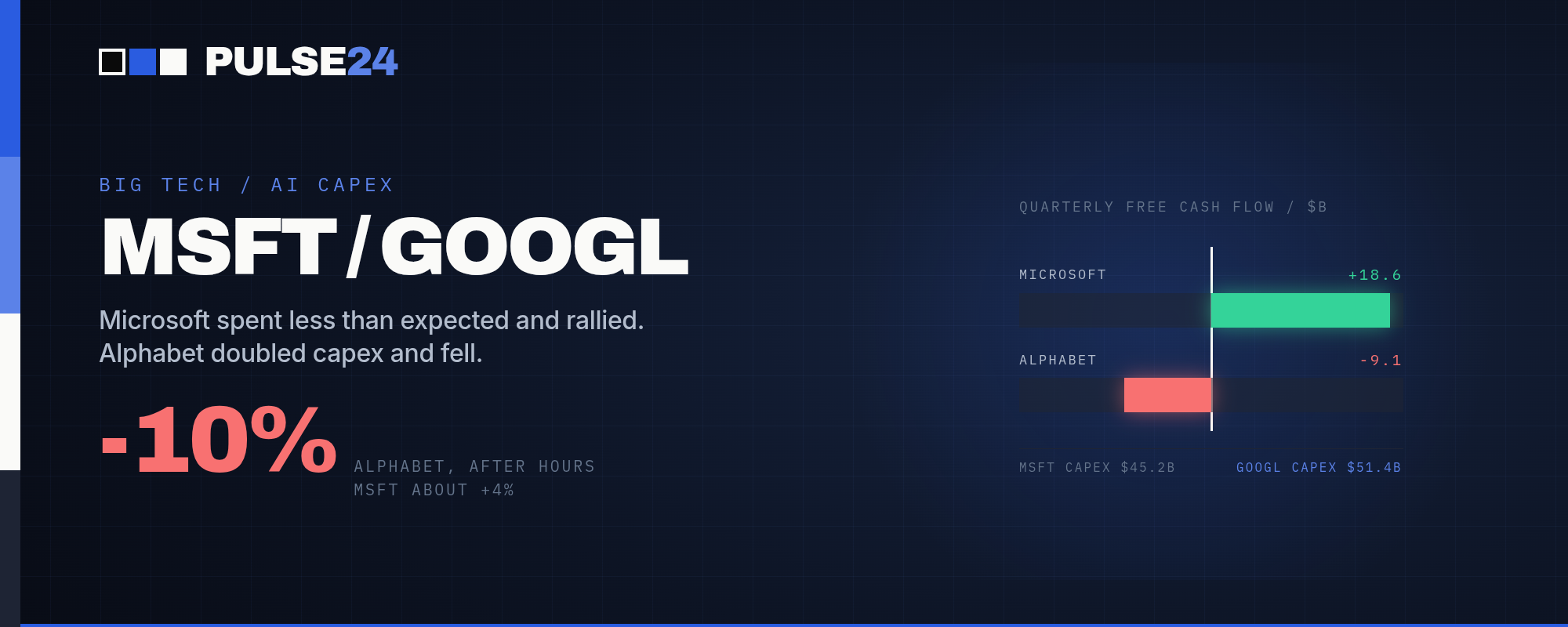
Microsoft and Alphabet reported AI infrastructure earnings within hours of each other, and Wall Street drew a sharp line between them. Capex discipline and a free cash flow beat earned Microsoft a 4% rally, while a capex surge and deepening cash burn cost Alphabet roughly a tenth of its value in after-hours trading.
Two of the biggest spenders on AI infrastructure reported earnings within hours of each other on Wednesday, and Wall Street reached opposite verdicts by the next morning. Microsoft's stock rose. Alphabet's fell by double digits. Both companies posted double-digit revenue growth and cloud businesses firing on all cylinders, so the split didn't come down to demand. It came down to money: how much each company spent building out AI infrastructure, and how comfortably that spending fit inside the cash the business generated.
Investors had circled this earnings double-header for days, aware the two reports would say as much about the broader AI buildout as about either company individually. What they got was close to a natural experiment: similar topline growth stories attached to opposite capital-spending outcomes, judged by the market within minutes of each release.
What Changed
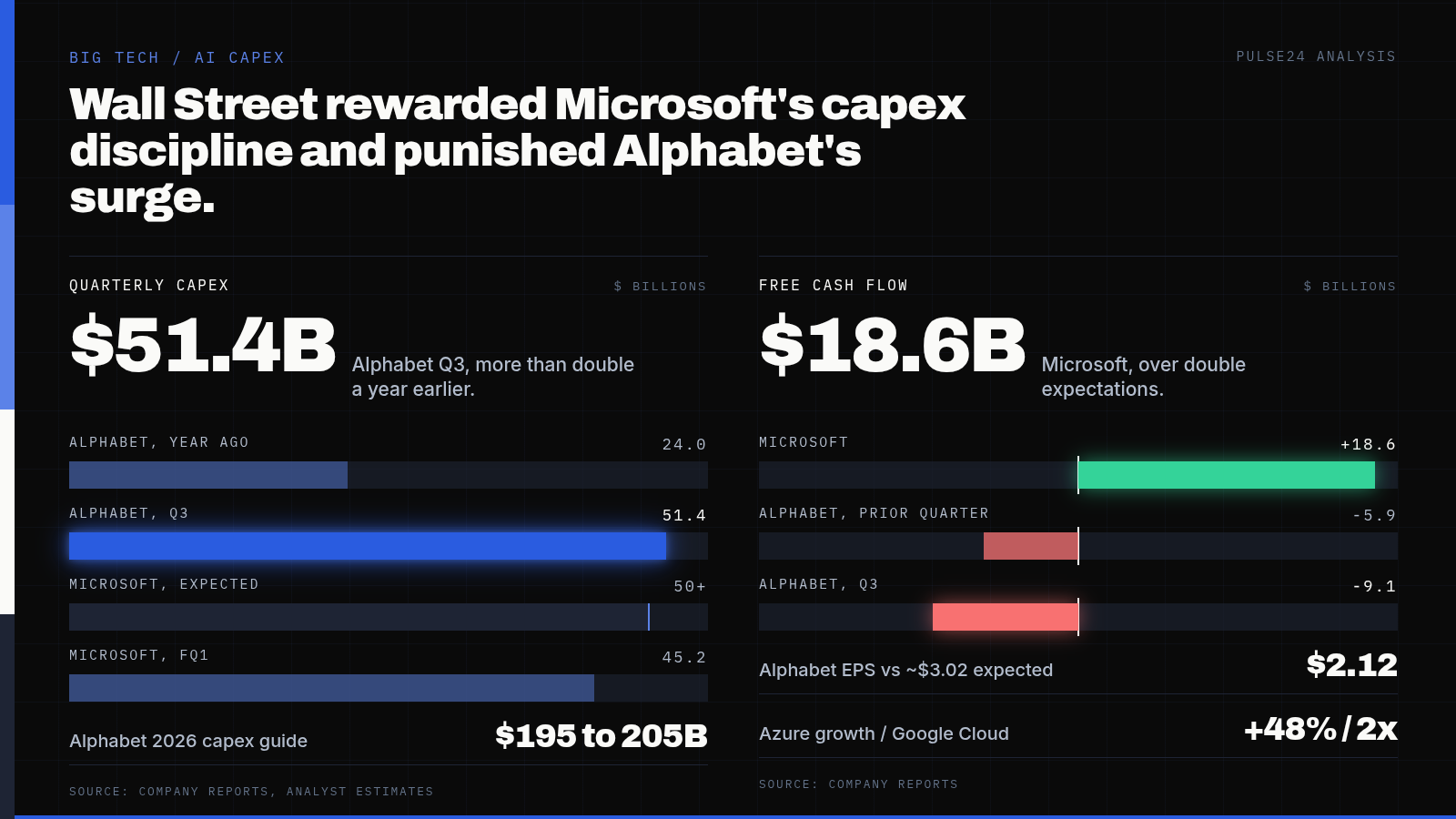
Microsoft spent $45.2 billion on capital expenditures and investments in its fiscal first quarter, which ended September 30. That came in roughly $5 billion below the $50 billion-plus Wall Street had modeled heading into the report. Despite the spending, Microsoft generated $18.6 billion in free cash flow, more than double what analysts had projected, and chief financial officer Amy Hood told analysts the company expects to stay free cash flow positive through fiscal 2027 even as total capex climbs toward $170 billion for the year. Revenue rose 19% to $92.3 billion, net income climbed 32% to $36.6 billion, and Azure, broken out as a standalone dollar figure for the first time, grew 48% to $33.2 billion.
Alphabet's quarter told a different story with similar ingredients. Revenue rose 25% to $127.6 billion, just short of the $127.97 billion analysts expected, and Google Cloud revenue more than doubled to $30.7 billion, with operating profit of $11.1 billion and a margin of 36.2%, management's strongest proof yet that its AI infrastructure bet is paying off commercially. But capital expenditures hit $51.4 billion for the quarter, more than double the $24 billion spent a year earlier, and free cash flow swung to negative $9.1 billion, worse than the negative $5.9 billion posted in the second quarter. Earnings per share landed at $2.12, nearly a dollar below the roughly $3.02 analysts expected, after an $8.2 billion charge tied mostly to an unrealized loss on Alphabet's equity stake in SpaceX, whose valuation slipped during the quarter. Alphabet left its full-year 2026 capex guidance unchanged at $195 billion to $205 billion and told investors to expect another step up in 2027.
Why It Matters
More than a year into the current AI infrastructure buildout, investors have stopped grading every hyperscaler on the same curve. Growth alone no longer earns a pass. Meta discovered that six days earlier, when its free cash flow swung negative for the first time since the company went public in 2012 and the stock fell 7.5% even after beating revenue estimates. Alphabet's Wednesday reaction looks like the same lesson repeated: a healthy, fast-growing cloud business wasn't enough to offset a capital-spending number that outpaced the cash coming in the door.
Microsoft's reception shows what the alternative looks like. Hood's team kept capex below the figure Wall Street had priced in, argued the spending is producing more revenue per dollar over time, and backed that claim with cash flow that beat expectations by a wide margin. Investors rewarded discipline, not restraint for its own sake. Microsoft isn't spending less than Alphabet in absolute terms; its own full-year guidance of roughly $170 billion sits in the same order of magnitude as Alphabet's $195 billion to $205 billion range, and both companies are spending tens of billions of dollars every quarter. What moved the stocks was the gap between what each company had promised and what it delivered, in both directions.
The market had already signaled this shift before Wednesday. CoreWeave and Nebius fell double digits earlier the same week even though neither company missed earnings, as analysts raised doubts about whether neocloud providers could ever earn an adequate return on invested capital. Big, profitable hyperscalers aren't facing that existential question, but they're being judged by a version of the same standard: not growth by itself, but growth that converts into cash investors can count.
What To Watch Next
The next data point arrives from Amazon, which is scheduled to report its own third-quarter results and capex plans on October 29. If Amazon's spending also comes in below its prior guidance while free cash flow holds up, that would reinforce Wednesday's apparent rule: markets will tolerate enormous AI spending as long as a company can show the spending is becoming more efficient, not less. A result that mirrors Alphabet's instead, heavier spending paired with thinner near-term cash generation, would suggest the market's new scrutiny is sector-wide rather than company-specific.
Alphabet's next quarter is worth watching closely too. Management has guided for 2027 capex to rise again, and investors will want to see Google Cloud's margin expansion keep offsetting that spending, or at minimum some sign that free cash flow stabilizes rather than keeps deteriorating. A third straight quarter of widening cash burn would be a harder story to defend than a single rough print.
The Pulse24 Take
Microsoft and Alphabet reported on the same night, and investors reached opposite verdicts within hours. Both companies showed cloud businesses growing by double digits or more, with margins moving in the right direction, so demand for AI infrastructure clearly wasn't the issue. The split came down to capital discipline: Microsoft under-spent its own guidance and still generated cash well above forecast, while Alphabet spent more than double what it had a year earlier and watched its cash flow deteriorate for a second straight quarter. For a market that spent the better part of two years rewarding almost any AI capex number as proof of ambition, this week read like the start of a more selective phase, one where the size of the spend matters less than whether a company can show it is converting that spend into something investors can bank on.
How we read the data
Curious how we get from raw data to a take like this? Our Trader's Toolkit walks through the tools we lean on.
Explore the Toolkit