Pulse24 Original
The Fed Decides Wednesday. Microsoft and Alphabet Report That Same Afternoon.
October 25, 2026
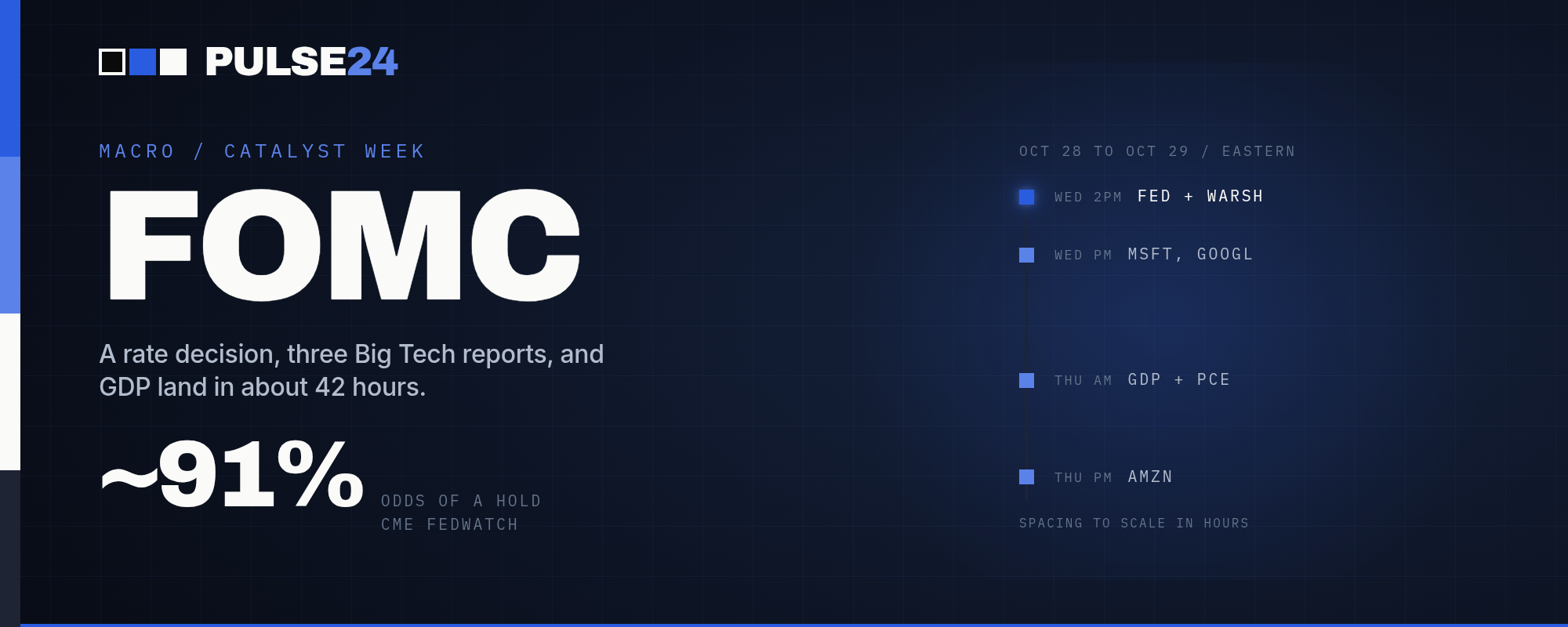
Four catalysts that each move markets on their own land within about 42 hours this week: the Fed's rate decision Wednesday, Microsoft and Alphabet earnings that same afternoon, Amazon's report Thursday evening, and the PCE inflation data Thursday morning. It's the first real test of whether this year's roughly $725 billion in hyperscaler AI spending can answer the doubts that hit CoreWeave, Nebius and Meta over the past two weeks.
The Federal Reserve announces its rate decision at 2pm Eastern on Wednesday. Microsoft and Alphabet report earnings six hours later, after the closing bell. Amazon follows Thursday evening, and Thursday morning, hours before any of those calls happen, the Commerce Department publishes the first reading of third-quarter GDP alongside the PCE price index, the inflation gauge the Fed actually targets.
Markets have treated each of these catalysts as a single-day event before. Compressed into one stretch of about 42 hours, they turn this week into one where a cautious line from Fed Chair Kevin Warsh, a soft capital spending number from one hyperscaler, or an inflation print that runs above forecast could move Treasury yields, the dollar, and the Nasdaq within the same 24 hours.
What's Converging This Week
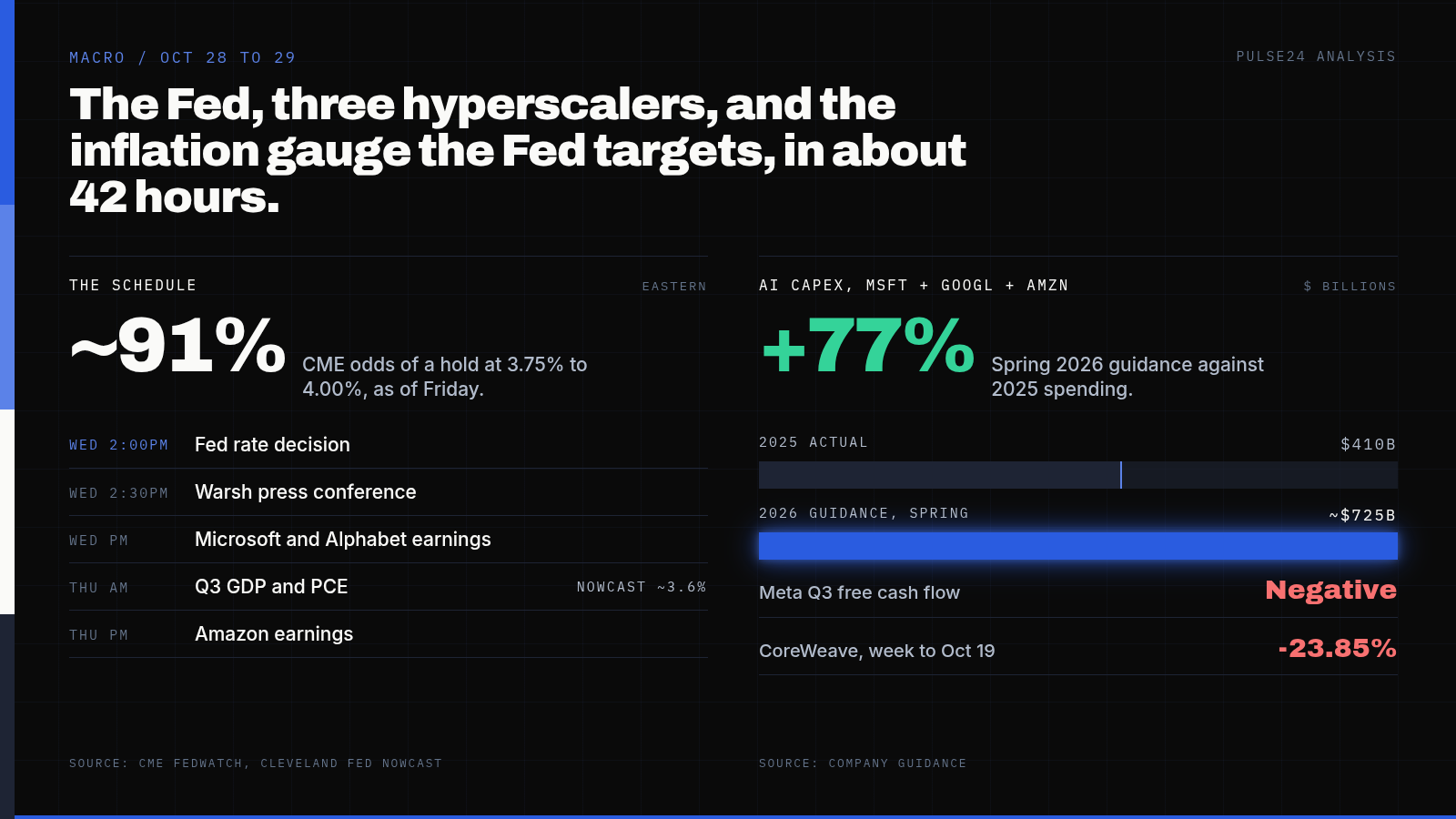
Start with the Fed. Futures markets are not expecting a move Wednesday. CME's FedWatch tool put the odds of a hold at roughly 91% as of Friday's close, and a Reuters poll of 100 economists published this week found unanimous agreement that the next hike comes in December, not this month. The fed funds range has sat at 3.75% to 4.00% since the September meeting, and most forecasters expect Chair Kevin Warsh's post-meeting remarks to matter more than the decision itself, given September's hotter-than-expected CPI reading and that unanimous view on a December move.
Wednesday afternoon, Microsoft kicks off its fiscal 2027 with first-quarter results, and Alphabet reports its third quarter, both after the close. Amazon reports its third quarter Thursday evening. All three are among the four companies, along with Meta, that have driven the buildout of AI data centers over the past two years. When they last gave full-year capital spending guidance in the spring, the combined total for 2026 came to about $725 billion, up 77% from $410 billion in 2025, according to Jefferies analyst Brent Thill. Microsoft alone had guided to roughly $190 billion for the calendar year. This week's reports are the first opportunity to see whether those numbers climbed further, held steady, or started to bend.
Thursday's economic data arrives on its own schedule, 8:30am Eastern, hours before Amazon's report. The headline number is the first estimate of third-quarter GDP, with the Atlanta Fed's GDPNow model tracking growth near 3.5% as of October 20. The other is the PCE price index, where the Cleveland Fed's nowcast points to headline inflation near 3.6% year over year and a core reading near 3.1%, both above where they sat in August.
Why It Matters
The AI capex question didn't start this week. CoreWeave fell 24% and Nebius fell 19% over the past week even though neither company actually missed on earnings, a sign that investors are pricing AI infrastructure stocks on the assumption that spending has to show returns soon, not eventually. Three days before that, Meta posted its first negative free cash flow since going public in 2012, even as it raised its own 2026 capex guidance. The market's reaction in both cases was similar: growing revenue and rising spending weren't enough without a clearer account of when the spending pays off.
That makes Wednesday and Thursday a genuine test rather than a routine earnings cycle. If Microsoft, Alphabet, and Amazon raise their 2026 and 2027 capital spending guidance again while also showing AI-related revenue growing fast enough to justify it, the market likely treats this as validation of the buildout rather than more of the anxiety that hit CoreWeave and Meta. If any of the three signals a slowdown, hedges its language, or reports cloud growth that undershoots estimates, the reaction could extend well beyond that single stock, given how closely chip and data-center names have traded together this month.
The Fed decision adds a second layer. A hold is priced in, so Wednesday's statement and Warsh's press conference matter mainly for what they say about December and beyond. Gold closed Friday near $3,996, its first close under $4,000 since mid-July and down 4% on the week, while the 10-year Treasury yield sits near 5%. Both moves reflect a market that has grown more confident a December hike is coming. A surprise shift in that language, in either direction, would ripple through rate-sensitive assets before the hyperscaler earnings even open for trading Wednesday.
What To Watch Next
The order these events land in matters. GDP and PCE data hit Thursday morning before Amazon reports that evening, leaving a full trading day for the market to digest the inflation numbers before the next earnings call. If PCE comes in meaningfully above the Cleveland Fed's 3.6% nowcast, it could harden expectations for a December hike well before anyone hears from Amazon.
Capex language deserves as much attention as the dollar figures. Investors have shown this month that raising spending guidance alone doesn't satisfy them. What moved CoreWeave, Nebius and Meta was the absence of a clear timeline for returns. Reports that pair a capex increase with specific revenue or margin commitments tied to AI products are likely to land better than ones that simply restate the growth story.
Friday's trading session, after all four catalysts have landed, will say more about where this debate stands than any single headline this week. A session that resembles last Thursday's selloff would suggest the market's patience is still thin. One that looks like a relief rally would suggest Wednesday and Thursday answered enough of the open questions.
The Pulse24 Take
Markets don't usually get four separate, independently important catalysts crammed into two days. This week they do, and the lineup is built to settle an argument that's been building since Meta's cash flow turned negative and CoreWeave sold off on earnings that weren't actually bad. Microsoft, Alphabet, and Amazon get a chance to either confirm that roughly $725 billion in AI spending has a path to paying for itself, or add to the list of hyperscalers the market is losing patience with. The Fed's decision is almost beside the point by comparison, since a hold is already priced in. What nobody can model in advance is how three earnings calls and one inflation report land in the same stretch of hours, and that's exactly why this week is worth watching more closely than most.
How we read the data
Curious how we get from raw data to a take like this? Our Trader's Toolkit walks through the tools we lean on.
Explore the Toolkit