Pulse24 Original
The Fed Held Rates at 3.75% to 4% in a 10-2 Vote. Two Governors Wanted to Hike Right Now.
October 28, 2026
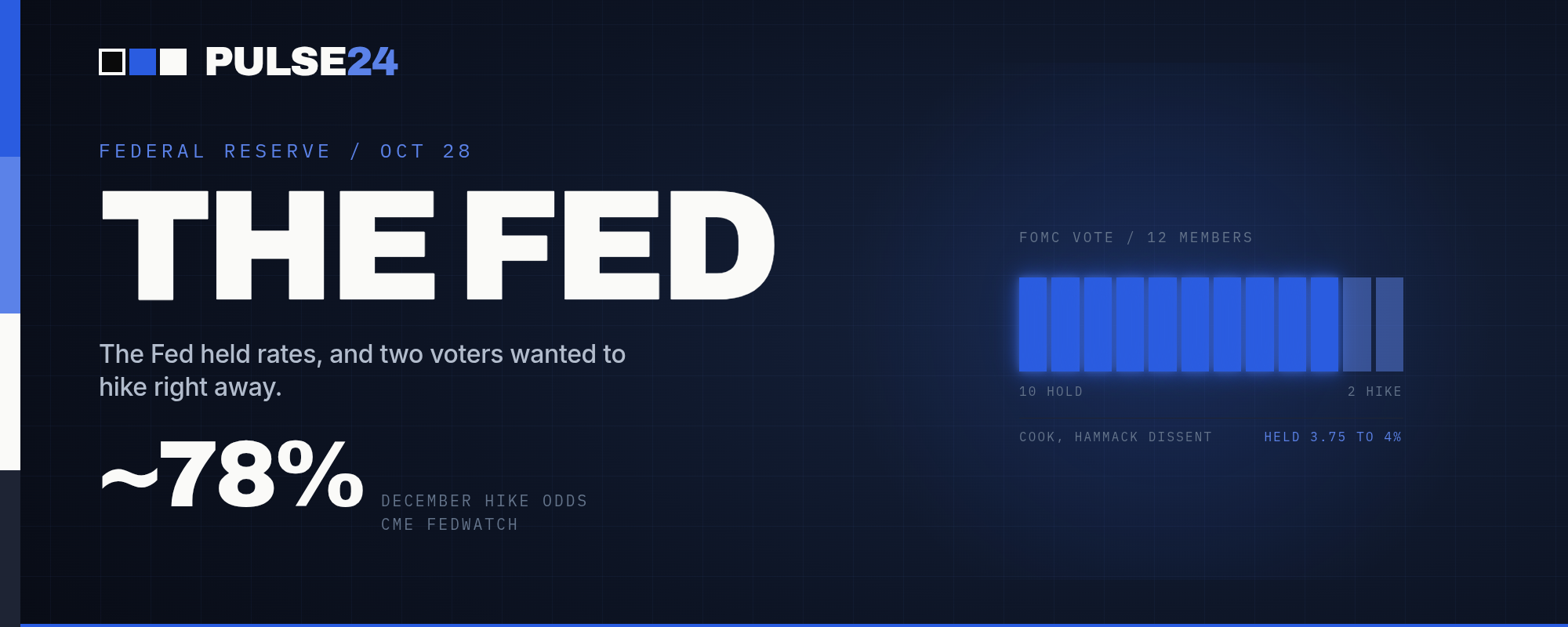
The Federal Reserve held its benchmark rate at 3.75% to 4% on Wednesday, but the 10-2 vote included two governors who wanted to raise it immediately. Markets are now pricing better than three in four odds of that hike landing in December instead.
Ten of the Federal Reserve's twelve voting members chose to hold interest rates steady on Wednesday. The other two wanted to raise them immediately.
The Federal Open Market Committee kept its target range at 3.75% to 4%, exactly where it sat coming into the meeting. Governor Lisa Cook and Cleveland Fed President Beth Hammack broke from the majority, both preferring a quarter point increase to 4% to 4.25%. Hammack's dissent was the expected one; she has been among the more hawkish voices on the committee all year. Cook's was not. Fed watchers had been looking at Dallas Fed President Lorie Logan or Minneapolis Fed President Neel Kashkari as the likelier second dissenter, two policymakers who have leaned hawkish all year, with Cook generally read as closer to the committee's center.
Wednesday's meeting was also the last one before next week's midterm elections, a detail Fed Chair Kevin Warsh addressed directly when reporters raised it. He said politics played no role in the committee's deliberations.
What Changed
The policy statement itself shifted in a way that matters more than the vote count. September's version described the economy as growing at a "solid" pace. October's upgraded that to "expanding at a strong pace," a small wording change that points to a committee more confident in growth and therefore less worried about moving too fast. The inflation language held steady: the Fed still calls it "elevated."
One sentence disappeared entirely. September's statement said a hike would support a timely return of inflation to the Fed's 2% target. That line is gone. In its place, October's statement says the Committee needs more information before it can set a policy stance aimed at that same return to target. Read alongside the upgraded growth language, it reads like a committee buying time rather than committing to a direction.
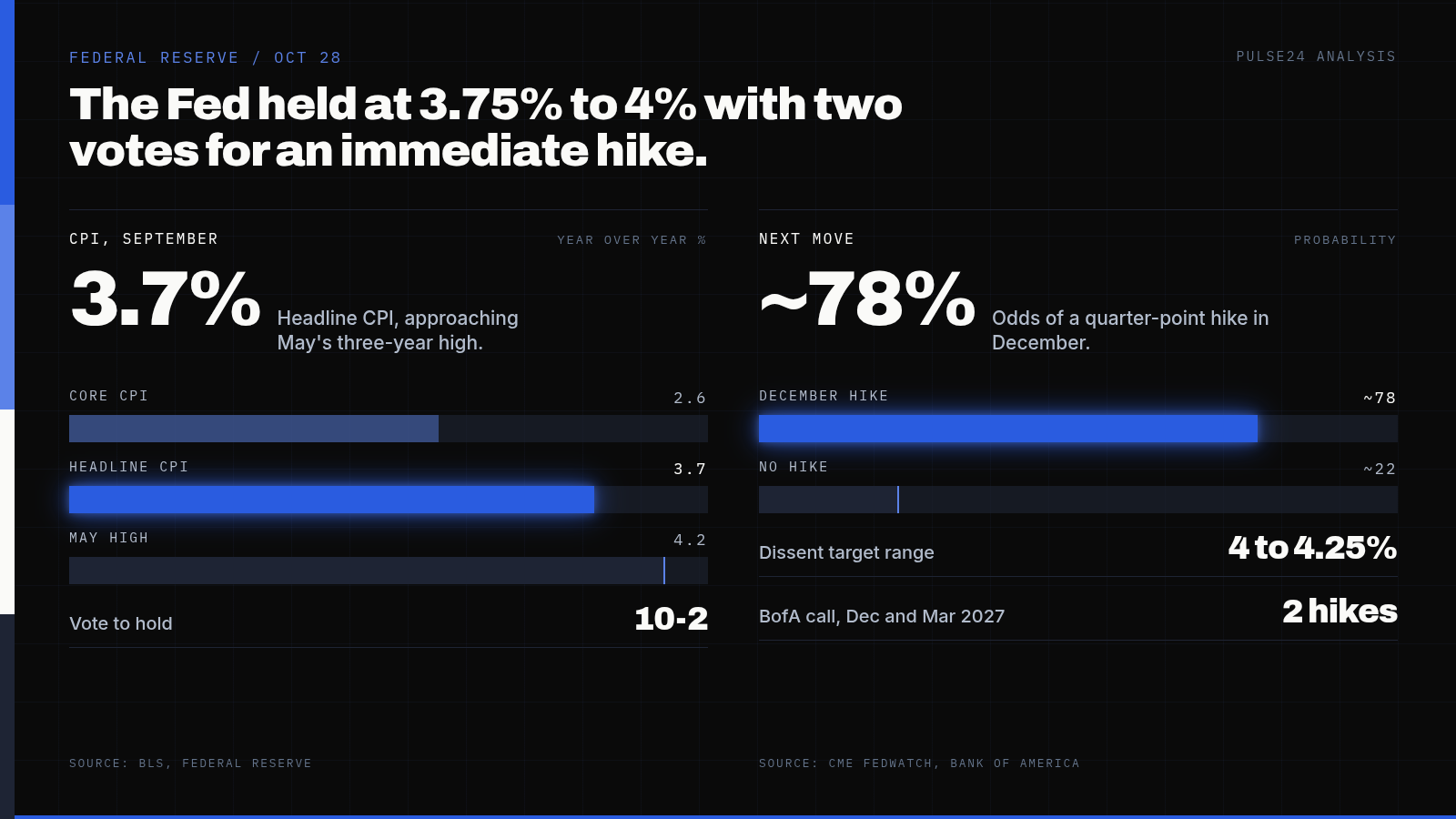
The backdrop explains the caution. September's hike, the first since 2023 and Chair Kevin Warsh's first as the Fed's leader, came alongside September payrolls data that landed soft: nonfarm payrolls rose by just 29,000, and the prior two months were revised down by a combined 60,000. At the same time, September CPI rose 3.7% year over year, up from August's 3.4% and pushing back toward the 4.2% three-year high the economy touched in May. Core CPI, which strips out food and energy, rose 2.6%, beating forecasts and marking its highest reading since May. A softening labor market next to inflation that refuses to fall is exactly the kind of setup that splits a committee, and this week's gold selloff had already been pricing that tension in before Wednesday's statement even landed.
Why It Matters
Markets had already decided the real decision wasn't today's. Going into Wednesday, CME FedWatch had priced roughly 90.6% odds that the Fed would hold, a figure that only became that lopsided after a weak September jobs report scrambled expectations in early October. The bigger number sits in December: traders are pricing roughly a 78% probability of a quarter point hike at the Fed's next meeting, which would push the range to 4% to 4.25%. That lines up with Reuters' poll of 100 economists from two weeks ago, when every single one expected a December hike, a consensus that would have looked unlikely a month before that.
Two hawkish dissents in one meeting add weight to that consensus rather than undercutting it. Hammack's vote was a known quantity. Cook's wasn't, and a policymaker who isn't usually grouped with the committee's hawks voting for an immediate hike signals that the case for raising rates has support beyond the usual suspects. Bank of America still expects two more hikes, one in December and another in March 2027, though its economists call the December move a low conviction bet and see risk of additional hikes stretching into June or September 2027 if inflation stays sticky.
Stocks barely reacted. The Dow and S&P 500 edged higher in the minutes after the 2pm statement, and the Nasdaq held roughly flat. A market that already expects the Fed to act in six weeks doesn't need to reprice much when the Fed does exactly what was expected today. The more useful signal isn't the equity reaction. It's whether Treasury yields, which were already sitting close to 5% heading into the decision, and the dollar, which had clawed back above the 102 level on its index, keep grinding higher into December or start to fade if Thursday's data comes in soft.
What to Watch Next
Thursday brings the heavier test: September's PCE inflation reading and the first look at third quarter GDP, both due at 8:30am ET. PCE is the Fed's preferred inflation gauge, and a soft print could put a dent in that roughly 78% December probability faster than anything said in Wednesday's press conference. A hot one would do the opposite.
Earnings add another layer. Microsoft and Alphabet report after Wednesday's close, and their capital spending commentary is likely to matter more for the Nasdaq's direction this week than anything the Fed said. Watch too for how Cook and Hammack explain their votes in public remarks over the coming days. Two hawkish dissents in one meeting is rare, and knowing whether the pair see this as a one time call or an opening argument for December will say a lot about how contested that next decision really is.
The Pulse24 Take
The headline from Wednesday's meeting is the hold. The more interesting story is who dissented. Hammack voting for a hike surprised no one. Cook doing the same thing surprised plenty of people who had their money on Logan or Kashkari playing that role. When a policymaker who isn't known as a hawk ends up voting with one anyway, it usually means the data crossed a threshold for her personally, not that committee politics did the persuading.
None of this means December is settled. A soft PCE print on Thursday or a run of cooler data over the next six weeks could pull that roughly 78% probability back down just as quickly as it climbed. What does look settled is that the disagreement inside the Fed now resembles the disagreement in the market itself. When even the committee's center starts drifting toward the hawks, the number worth watching may not be the funds rate. It may be how many meetings pass before the holdouts and the majority land in the same place.
How we read the data
Curious how we get from raw data to a take like this? Our Trader's Toolkit walks through the tools we lean on.
Explore the Toolkit