Pulse24 Original
Wall Street Is Nearly Unanimous on a December Fed Hike. Gold Is Still Down More Than $130 From Its October High.
October 28, 2026
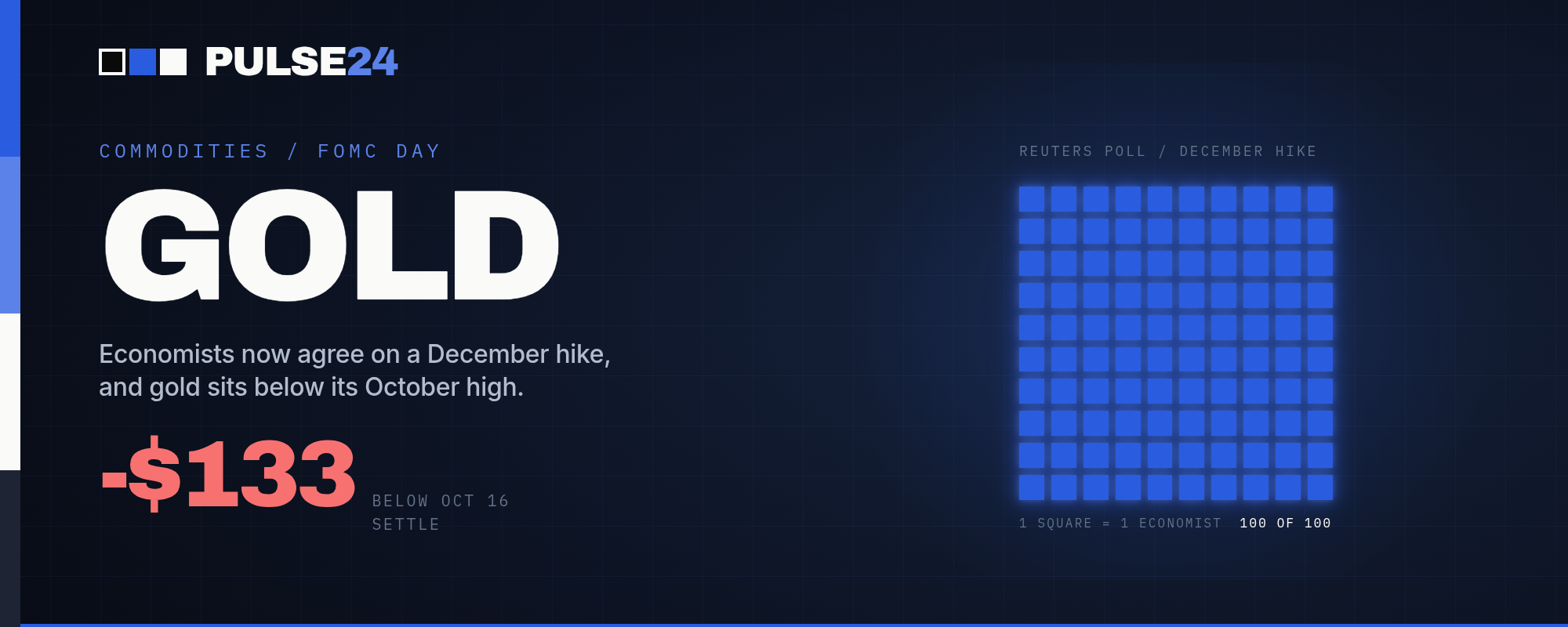
Every economist in Reuters' latest poll now expects the Fed to raise rates again in December, even though today's meeting is expected to end in a hold. Gold is still trading more than $130 below its mid-October level, and the market's rate-path consensus looks tighter than it has in months.
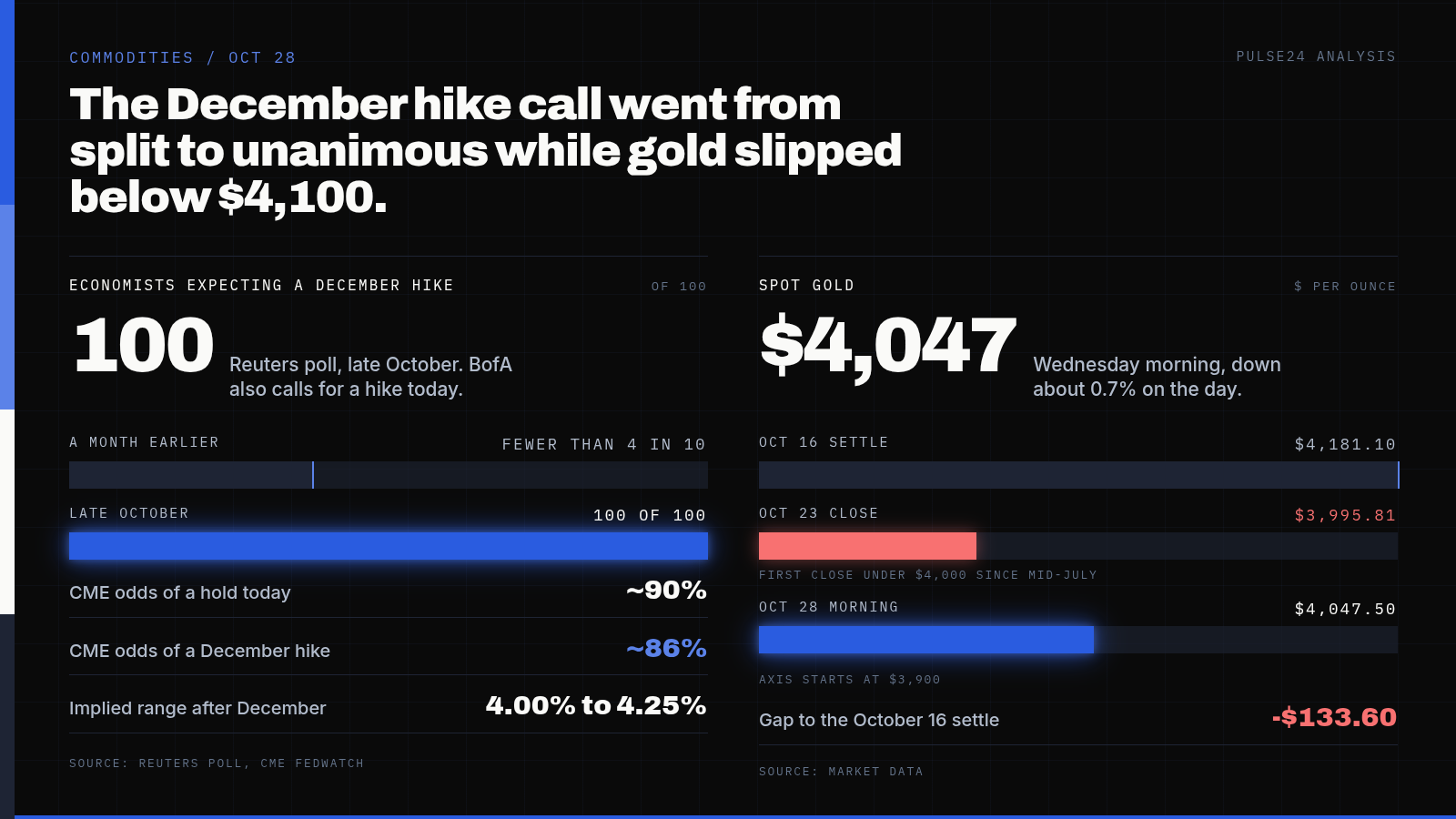
Every one of the 100 economists Reuters polled in late October now expects the Federal Reserve to raise rates again in December. A month earlier, fewer than four in ten said the same thing. That shift from split to unanimous is the kind Wall Street rarely produces, and it has set up a Fed funds range of 4.00% to 4.25% as the base case for year-end. BofA Global Research stands apart from that consensus, sticking with its call for a hike at today's meeting too, which would put the full-year total at half a point instead of a quarter.
What Changed
That is a strikingly tight consensus for a Fed that spent most of this year being second-guessed in both directions. Traders were pricing in cuts as recently as January. Then Kevin Warsh took the chair, and a single October speech on artificial intelligence was enough to send hike odds for this very meeting as high as 15% at one point, before settling back down as the data cooperated. That poll, taken in late October, marked a dramatic reversal from a month earlier, when fewer than four in ten economists expected a hike by year-end.
Today's meeting itself is expected to be the quiet part. CME FedWatch has settled at roughly 90% odds of a hold at 3.75% to 4.00%, with the small remainder split between a surprise hike and, far less likely, a cut. The Fed funds range already reflects a quarter-point hike from September, so today is widely read as a pause before the Fed moves again, not a change in direction. Warsh takes questions at 2:30pm ET, half an hour after the statement lands, and that press conference is where traders expect the real signal about December to show up.
Why It Matters
Gold has been pricing this shift for two weeks, and not gently. Spot prices settled at $3,995.81 on October 23, the first close below $4,000 since mid-July and the metal's worst week since June, with December futures down about 4.1% over five trading days. Silver fell even further that week, and mining stocks like Newmont dropped harder still, the kind of move that shows up when leveraged positions get unwound all at once rather than when sentiment simply cools.
Gold has clawed back some of that loss since, trading near $4,047.50 this morning, but it remains roughly 3% below where it sat before the slide started. The mechanics are straightforward even if the emotions around gold rarely are. A Fed that holds steady today while a near-unanimous Street expects another hike in six weeks keeps real yields elevated and the dollar firm, both of which raise the opportunity cost of holding a metal that pays no interest. The ten-year Treasury yield has held close to 5% this week, and the dollar index has pushed back above 102 after giving back part of its earlier 18-month high. Neither number needs to move much further to keep pressure on bullion.
Not every strategist reads the selloff as structural. Roukaya Ibrahim, chief commodities strategist at BCA Research, has noted that gold's deviation from its 200-day moving average is now as stretched as it was in late July, and she attributes the drop more to liquidity-driven selling than to any shift in the fundamental case for gold. She still isn't rushing to call a bottom. "I'm not super bullish over the near term," she said this week. Ole Hansen, head of commodity strategy at Saxo Bank, has described the market as a battle between short-term technical traders looking for further downside and longer-term investors whose underlying demand remains intact. Both views can coexist. A trade can look oversold and still have further to fall before the longer-term buyers take control.
What to Watch Next
Today's decision and the 2:30pm press conference are the first checkpoint, and markets will parse Warsh's language for anything that nudges December odds away from 86%. Big Tech earnings land in the same window, with Microsoft and Alphabet reporting after today's close, adding another variable to a market that already has plenty to digest this week.
Thursday brings the heavier data: September's PCE inflation reading and the first look at third-quarter GDP, both due at 8:30am ET. Either number could move December odds meaningfully in either direction, since the current 86% probability still leaves room to shift. For gold specifically, the levels worth watching are $4,000 on the downside, which has acted as a psychological floor through this slide, and $4,181.10 on the upside, the October 16 settlement that would need to be reclaimed before the bearish case built over the past two weeks starts to look wrong.
The Pulse24 Take
The interesting part of this story isn't whether the Fed moves today. Almost nobody expects that. It's how quickly Wall Street went from split to nearly unanimous on December, and how much of that shift gold has already absorbed before the data even arrives. Markets pricing in a well-telegraphed outcome isn't unusual. What's less common is seeing a hundred forecasters who disagree about plenty else land on the same number at the same time.
That kind of consensus can be self-fulfilling right up until it isn't. A single soft inflation print on Thursday or a more dovish turn of phrase from Warsh at 2:30pm could put a dent in odds that currently look almost too clean. Gold's rebound off its October 23 low suggests at least some of the market isn't fully convinced the hike is a lock either. Investors watching this space don't need to bet on December outright. Watching how gold trades around Thursday's data, and whether it can reclaim ground above $4,100, says as much about where conviction actually stands as any single probability on a FedWatch screen.
How we read the data
Curious how we get from raw data to a take like this? Our Trader's Toolkit walks through the tools we lean on.
Explore the Toolkit