Pulse24 Original
CoreWeave Fell 9.5% on an Election, Not an Earnings Miss. Gold Rose Almost 3% on the Same Vote.
November 4, 2026
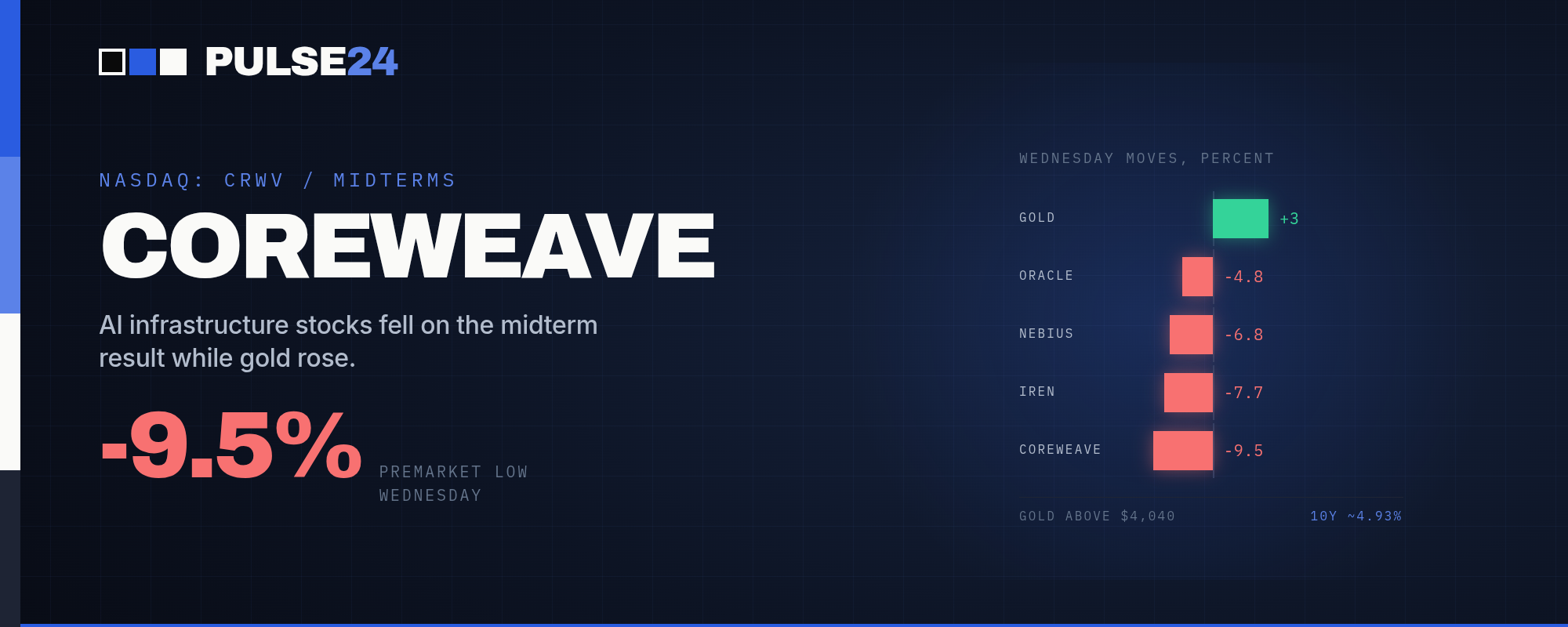
Democrats swept both chambers of Congress and Texas's governorship overnight, and markets split the reaction in two: gold jumped almost 3% on fiscal worry while CoreWeave, Oracle, Nebius and IREN all sold off on fears that a tougher political climate slows the AI data center buildout.
Gina Hinojosa won Texas's governorship on Tuesday night, the first Democrat to do it since Ann Richards left office in 1995. By the preliminary count, with roughly two-thirds of precincts in, she beat three-term incumbent Greg Abbott by something close to 57% to 41%. It was one result among many. Democrats also took back full control of the House and Senate, flipping the chambers Republicans had held through most of President Trump's second term.
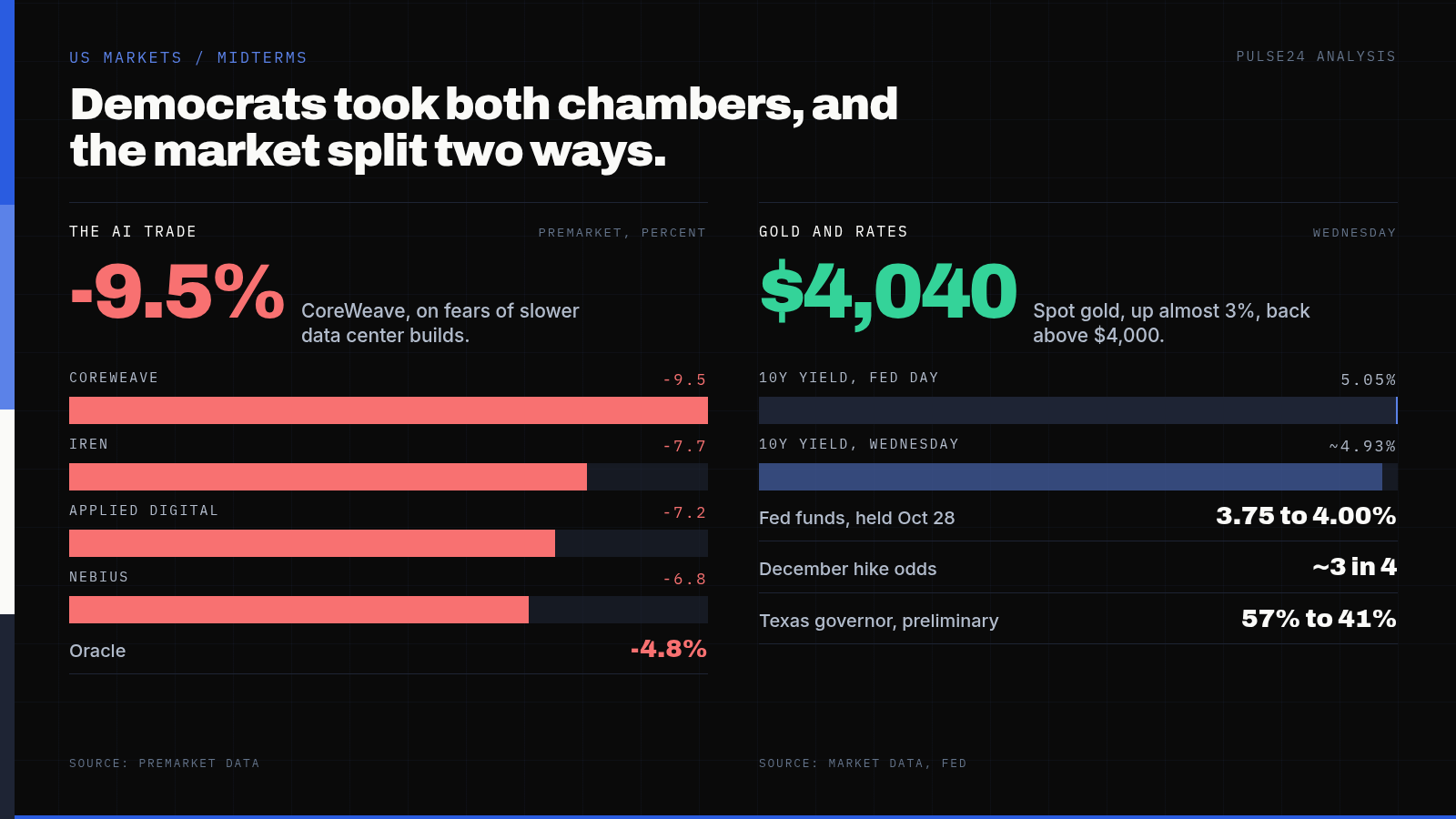
Markets spent Wednesday morning deciding what that meant, and they came up with two different answers at once. Gold spiked almost 3% to north of $4,040 an ounce, clawing back the $4,000 mark it had fallen through just two trading days earlier in an unusual stretch where the metal, the dollar and yields were all sliding together (see gold's one-year low earlier this week). The dollar index slipped toward 101, and the 10-year Treasury yield eased to about 4.92%, down from the 5.05% level it touched the day the Fed last met.
AI infrastructure stocks told the opposite story. CoreWeave dropped as much as 9.5% in premarket trading. Oracle fell near 4.8%. Nebius slid about 6.8%, IREN gave up close to 7.7%, and Applied Digital lost around 7.2%. None of the five had an earnings event scheduled that morning. The selling started because several governors-elect who campaigned against data center expansion won their races, raising the odds that permitting and electricity costs for new facilities get harder, not easier, from here.
Virginia and New Jersey elected governors who ran explicitly on reining in the industry. Governor-elect Abigail Spanberger in Virginia called on tech companies to pay their "fair share" toward grid upgrades. New Jersey's Mikie Sherrill campaigned on legislation that would require data center operators to help fund grid modernization and renewable power. In Georgia, Democrats Alicia Johnson and Peter Hubbard unseated two Republican incumbents on the state's Public Service Commission, the body that sets electricity rates; Hubbard's pitch was that utilities were cutting "sweetheart deals" for big tech while residents paid more for power.
Texas carried the sharpest version of that argument into a statewide race for the first time. Abbott had already announced a freeze on new data center permits before election day, an acknowledgment that the issue was costing him votes even in a state built around courting that kind of investment. Hinojosa ran on making the freeze permanent until lawmakers write in stronger protections for residents' electricity bills and water use. A September poll found only 44% of Americans would welcome a data center in their own neighborhood, and Tuesday's results suggest that number is starting to show up at the ballot box.
Why It Matters
None of this changes the demand side of the AI buildout. Hours before polls closed, AMD reported data center revenue that nearly doubled to $8.5 billion (see AMD's latest results), and private equity firms have piled billions of leveraged dollars into facilities meant to meet that kind of demand (see the debt behind that buildout). What changed Tuesday is the political cost of building the supply side fast enough to match it. CoreWeave borrowed at roughly 15% interest to fund its own expansion earlier this year (see that financing deal), and a company carrying that kind of debt load has very little room for permitting delays or new utility surcharges, which is part of why it was the hardest hit of the group.
The gold move is its own kind of signal. A Democratic Congress is usually read as a drag on deficit discipline, and heavier federal borrowing would normally push yields higher rather than lower. Instead, yields fell and gold rose together, the same unusual pairing that showed up two days earlier when gold slid under $4,000 even as the dollar and yields dropped too. Capital Economics' Hamad Hussain said the sweep "appears to have boosted gold prices" because investors are more worried about the fiscal outlook, not less. StoneX's Rhona O'Connell had flagged the same risk before the vote, warning that a Democratic Congress paired with a Republican White House sets up "fiscal brinkmanship, institutional friction, both leading to uncertainty."
That uncertainty lands on top of a Fed that is already leaning hawkish. The October 28 meeting ended in a 10-2 vote to hold rates at 3.75% to 4.00%, with Fed governor Lisa Cook and Cleveland Fed President Beth Hammack both pushing for an immediate quarter-point hike (see the Fed's hawkish hold). The policy statement called inflation "elevated relative to the Committee's 2 percent goal," and futures markets still put the odds of a December hike somewhere between 76% and 85%, depending on whose calculation you trust. A Fed still debating whether to raise rates, a Congress that just became more expensive to legislate with, and a tech sector facing new state-level friction all touch the same underlying question: who ends up paying for this cycle's spending. Investors spent Wednesday morning trying to reprice all three pieces at once.
What to Watch Next
Friday's delayed October jobs report is the next hard data point, and it carries real weight for whether the Fed's December 9 meeting delivers the hike markets are now pricing in (see the central bank hiking wave this report feeds into). Watch whether the data center backlash spreads beyond the handful of races where it clearly mattered this week, especially in states with planned mega-projects and rising electricity rates. Georgia's new Public Service Commission majority will set an early precedent on whether utility regulators start shifting more grid cost onto tech companies rather than ratepayers. And watch CoreWeave and its peers specifically. A sector financed this heavily with debt has little buffer if permitting slows just as AI capital spending is supposed to be accelerating.
The Pulse24 Take
Election nights rarely move markets this cleanly, and this one still split the reaction in half instead of picking a direction. Gold traders read a sweep as more fiscal risk and bought a safe haven. AI infrastructure investors read the same sweep as regulatory risk and sold the leveraged end of the trade. Both reactions can be correct at the same time, and that is probably the more useful lesson than either number on its own. The AI buildout has run for two years on the assumption that capital and electricity would both show up wherever Nvidia's customers needed them. Tuesday's results are the clearest sign yet that local voters, not just utility boards, now get a vote on that assumption too.
How we read the data
Curious how we get from raw data to a take like this? Our Trader's Toolkit walks through the tools we lean on.
Explore the Toolkit