Pulse24 Original
Up to 30% of America's AI Data Centers Are Now Owned by Private Equity. The Debt Behind Them Is Starting to Show Stress.
November 1, 2026
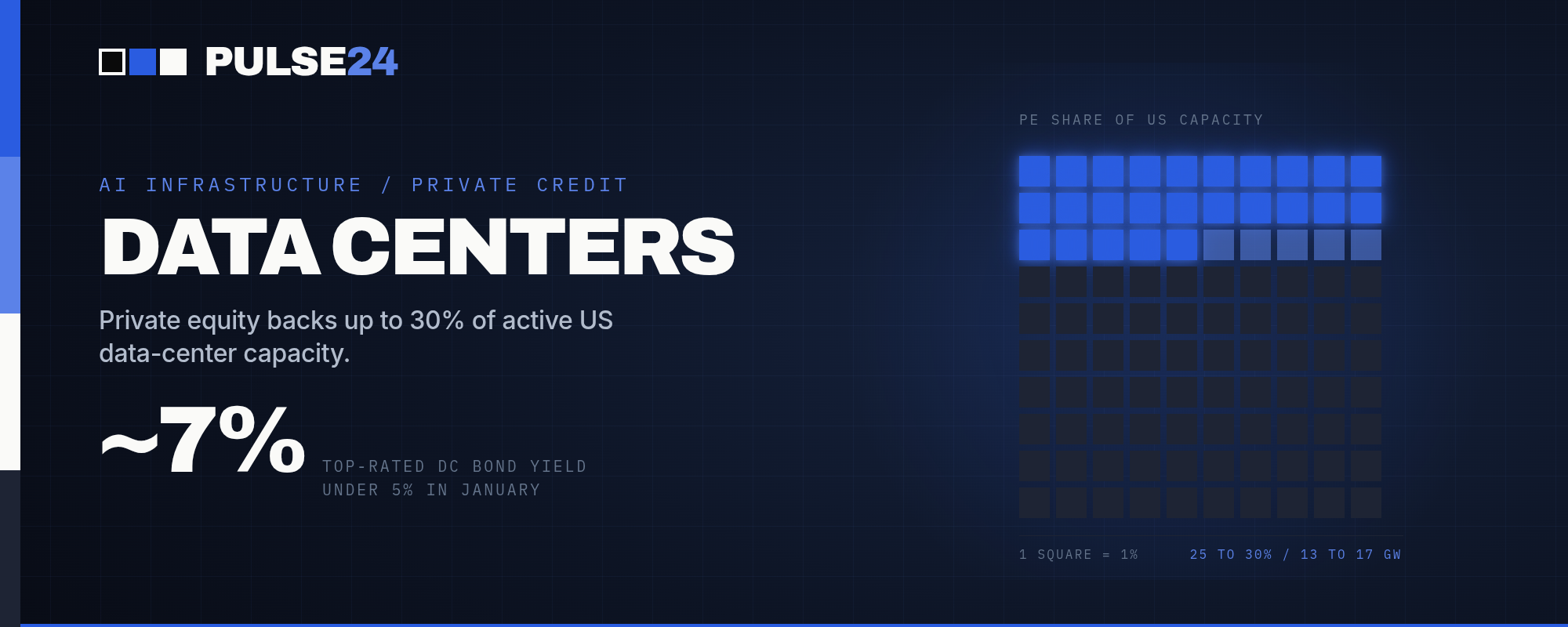
Private equity firms now back as much as 30% of America's active AI data-center capacity, and the debt funding that buildout is getting more expensive. Yields on the best-rated data-center bonds have climbed from under 5% to near 7% this year, and credit default swaps on Oracle, SpaceX, Nvidia and Meta all hit fresh records last month.
Seventy-eight private equity firms now back somewhere between 13 and 17 gigawatts of America's data-center capacity. That's according to a report Americans for Financial Reform published on October 29, and the number lands between a quarter and nearly a third of everything currently running in the country, spread across 670 facilities that most renters, homeowners and even most retail investors have never heard of.
Five names account for most of it: Brookfield Asset Management, Ares Management, Blue Owl Capital, DigitalBridge and Apollo. Together they control about 17% of existing US capacity and 30% of what's still being built. None of them show up in the earnings calls that move AI stocks. All five are deeply exposed to how this buildout actually gets paid for.
What Changed
Big Tech has spent the last two years pushing AI infrastructure costs off its own balance sheet, and private equity has been glad to pick them up. Amazon, Microsoft, Alphabet, Meta and Oracle have increasingly shifted toward leasing capacity from specialized operators rather than building and owning it outright, a move that transfers financing risk to outside firms even as the underlying compute keeps expanding.
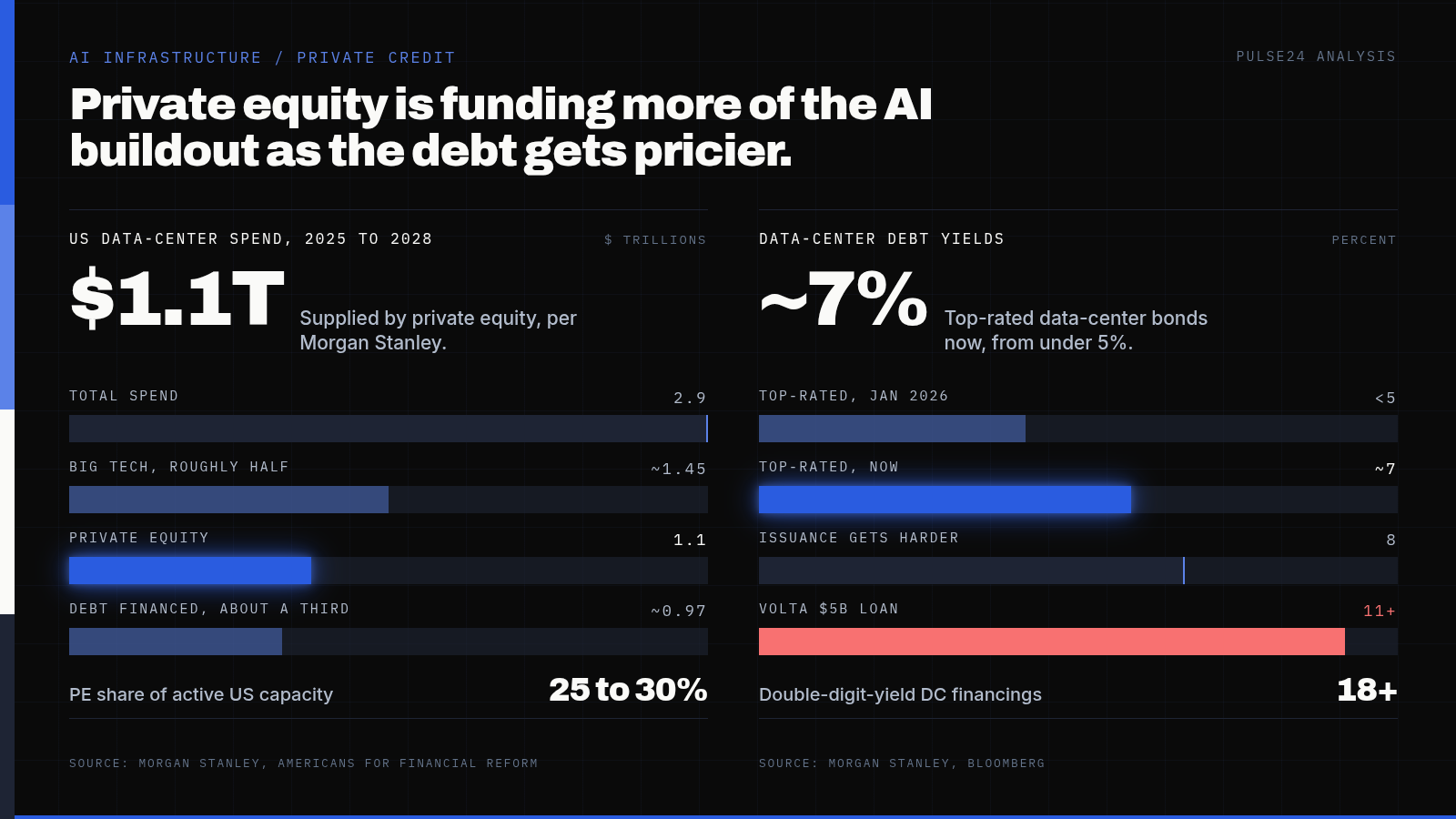
Morgan Stanley puts the total price tag at $2.9 trillion in data-center spending between 2025 and 2028, with roughly half coming from Big Tech directly and private equity supplying an estimated $1.1 trillion, more than a third of the total. About a third of all that spending is expected to be financed with debt, and the Americans for Financial Reform report counts more than $200 billion in outstanding private-credit loans to AI-related sectors already on the books.
Some of that lending is already public record. Blackstone's private-credit arm has lent CoreWeave $12 billion since 2023, the kind of borrowing Pulse24 flagged when CoreWeave had to pay 15% interest to raise cash this fall. Apollo's MidCap Financial unit lent $3.5 billion in January to Valor Equity Partners for an acquisition later leased to xAI. SpaceX closed its own $40 billion in GPU-backed debt earlier this year, one of dozens of similar deals across an industry Musk has said won't all survive.
Why It Matters
The ownership structure matters less on its own than what it implies about financing cost, and cost is where the real stress is showing up. Morgan Stanley's Carolyn Campbell says the highest-rated data-center bonds yielded under 5% at the start of 2026. They're close to 7% now, and she says issuance gets significantly harder once yields approach 8%, a threshold the market is no longer far from testing.
Riskier deals are already there. Volta Infrastructure, a newer AI computing provider, had to accept a steeper discount and a higher rate from JPMorgan and Goldman Sachs on a $5 billion syndicated loan, pushing its yield above 11%. Bloomberg counts at least 18 data-center financings in the junk-bond and leveraged-loan markets that now carry double-digit yields. Combined data-center ABS and CMBS issuance sits near $22 billion this year, little changed from 2025, which on its own might look like stability. It isn't, because the mix of what's getting financed has shifted toward riskier, pricier debt even while the headline volume holds steady.
Credit default swaps tell a sharper version of the same story. Protection against default on Oracle, SpaceX, Nvidia and Meta debt all touched fresh records last month, a sign that bond investors are pricing in more default risk around AI infrastructure than they were a year ago. None of these companies is in distress today. What's changed is how much it now costs the market to insure against the possibility that one of them eventually is.
Lenders are noticing the same pattern. One large European bank's technology lending desk told Bloomberg it's nearing its sector exposure limit, and offloading risk to someone else can take around five months, slow enough to crimp the pace of new loans. A Willis Towers Watson survey found insurers are approaching their own data-center exposure caps. Diameter Capital Partners put the doubt plainly, questioning whether the industry assumed there was unlimited debt capital available to finance what's now a $5.5 trillion buildout. Citadel Securities' Tucker Roberts framed the risk as a buyer shortage rather than a lending freeze: the challenge may not be finding guarantors, but finding anyone willing to hold the risk once it's written.
This is the same caution Pulse24 has tracked building for months. Banks got cold feet midway through Broadcom's $63 billion financing deal for Anthropic earlier this year, and it took Broadcom's own CEO working the phones over a weekend to keep it together. The pattern keeps repeating: enormous sums still get raised, but increasingly only after lenders extract a steeper price or a faster exit.
What To Watch Next
Three things will say more about where this goes than any single headline. First, whether yields on investment-grade data-center bonds actually cross the 8% line Morgan Stanley flagged as the point where new issuance gets meaningfully harder. A sustained move through it would mean some projects currently in the pipeline don't get financed at all. Second, whether credit default swap levels on Oracle, SpaceX, Nvidia and Meta keep climbing or stabilize once the current earnings cycle finishes. A plateau would suggest the market sees this as a one-time repricing rather than the start of something worse. Third, whether any of the roughly 40% of US data-center projects due to finish this year that are already considered at risk of delay actually slip, since a visible delay is usually what triggers the contract exit clauses that have made some lenders walk away from deals already.
Private equity's own appetite is worth tracking separately. KKR has been avoiding remote sites that would be hard to re-lease if a tenant walked away, and Carlyle has passed on several transactions outright. If two of the industry's largest players are getting pickier about which data centers they'll finance, that's a more honest signal than any single bond yield.
The Pulse24 Take
The AI buildout has always rested on a bet that compute demand will keep growing faster than anyone can finance the data centers to supply it. For most of 2025 and the first half of 2026, that bet looked safe enough that banks, private credit funds and now insurers kept writing bigger checks at roughly the same price. What's changed isn't the demand side of that equation. It's the price of capital on the supply side, and prices in debt markets tend to move well before anyone announces a problem.
None of this means the AI infrastructure boom is about to collapse. Issuance volume is still roughly flat year over year, and $22 billion in ABS and CMBS deals getting done is not a market that's closed. But a market where the best-rated borrowers are paying two percentage points more than they were ten months ago, and where credit insurance on the biggest names just hit records, is a market that's starting to price in doubt it wasn't pricing in before.
The more useful question for investors isn't whether private equity's quiet dominance of data-center ownership is good or bad. It's whether the firms writing these loans are being compensated enough for the risk they're taking on, or whether, like a lot of lending cycles before this one, the answer only becomes obvious after it's too late to matter.
How we read the data
Curious how we get from raw data to a take like this? Our Trader's Toolkit walks through the tools we lean on.
Explore the Toolkit