Pulse24 Original
Broadcom's CEO Spent His Weekend Saving a $63 Billion AI Financing Deal. Banks Had Started Getting Cold Feet.
October 27, 2026
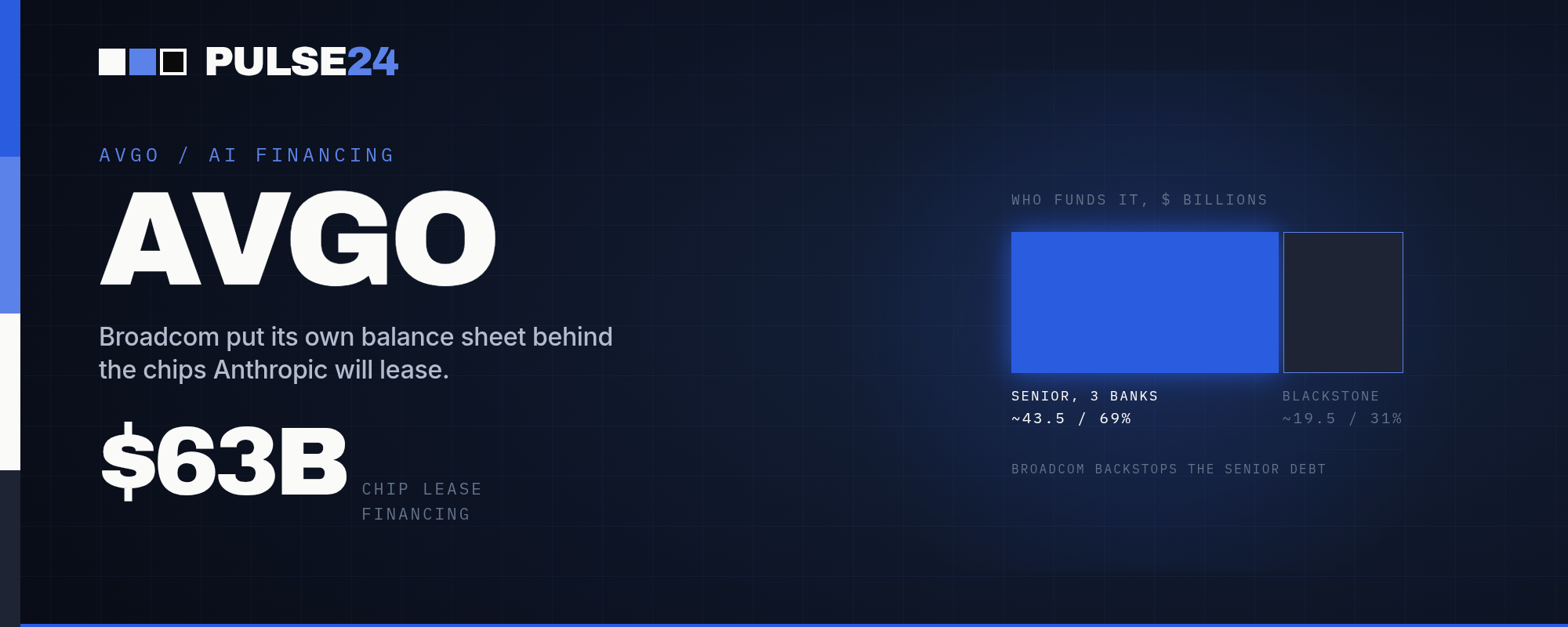
Broadcom, three Wall Street banks, and Blackstone finalized $63 billion to finance the AI chips Anthropic will lease starting in 2027, but getting there took a weekend of last minute concessions after lenders grew nervous. The deal landed the same day Anthropic filed for an IPO disclosing an $80.7 billion loss.
Hock Tan spent part of this past weekend doing something a semiconductor CEO shouldn't have to do two weeks after reporting record revenue: talking nervous bankers off the ledge. The deal on the table was $63 billion, the largest piece of financing tied to Anthropic's AI buildout to date, and by the weekend several of the lenders involved were reportedly having second thoughts about staying in it.
Tan had flagged the risk himself two weeks earlier. At an October 12 investor conference, he said plainly that "what I think might be the biggest constraint is capital." He wasn't exaggerating. By the following weekend, capital was exactly what nearly derailed his own company's biggest financing deal of the year.
What Changed
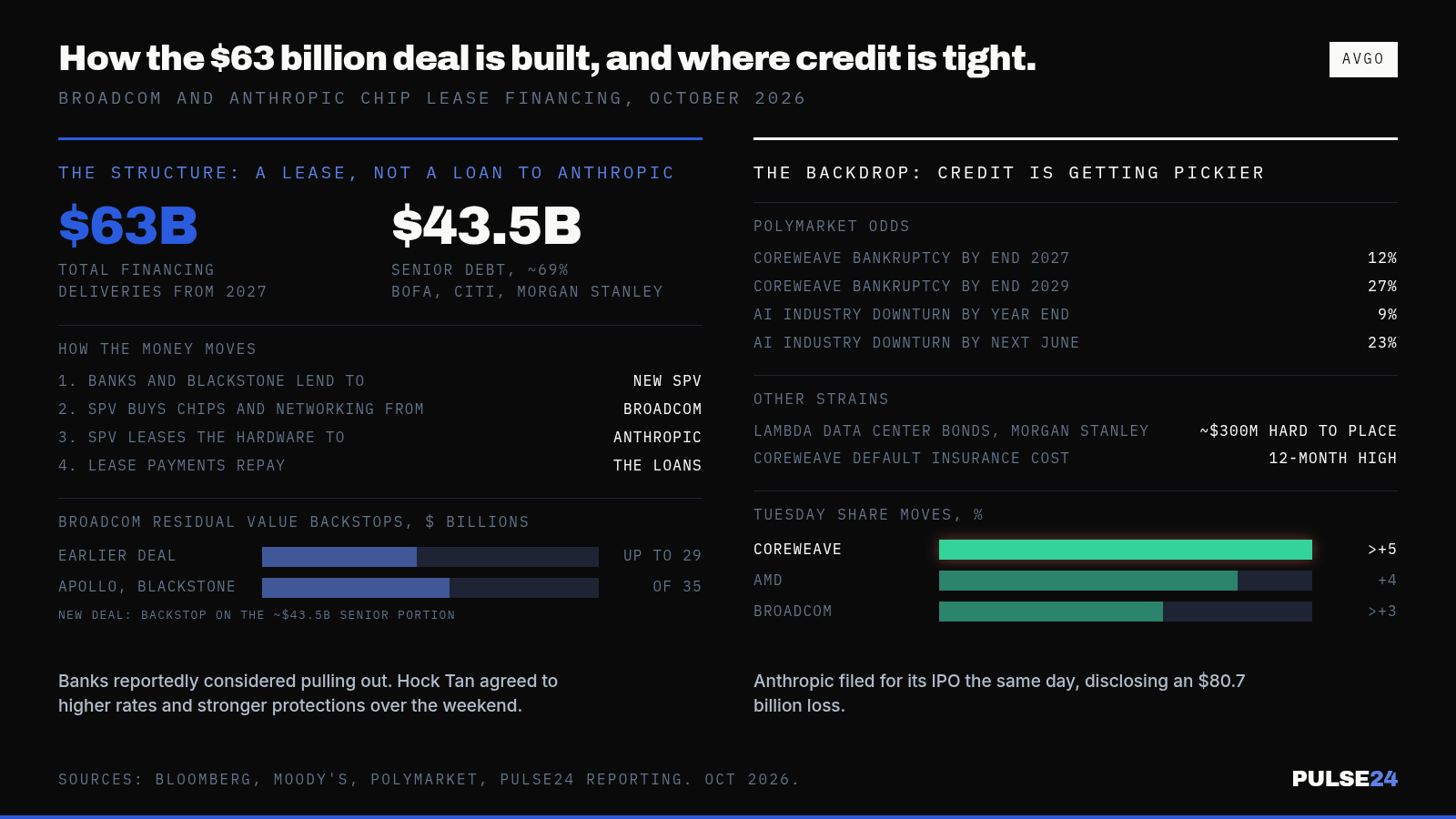
The agreement, announced Monday, routes the money through a newly formed special purpose vehicle that will borrow the $63 billion, use it to buy Broadcom's AI chips and networking equipment, and lease that hardware to Anthropic once deliveries begin in 2027. Anthropic's lease payments are what eventually repay the loans.
Bank of America, Citigroup, and Morgan Stanley are arranging the senior portion, roughly $43.5 billion or about 69% of the total, according to people familiar with the deal. Blackstone is taking the riskier, subordinated slice below that senior debt. Broadcom itself is on the hook too: the company is providing residual value support on the senior financing, a guarantee that could leave it absorbing losses if Anthropic defaults and the equipment ends up worth less than the loans assume.
That backstop isn't new, but it is growing. Broadcom made a similar commitment, up to $29 billion, on a $35 billion financing package arranged earlier this year with Apollo and Blackstone. Moody's has called Broadcom one of the strongest large technology companies by balance sheet, while also warning that stacking several of these deals back to back raises the company's own risk exposure, even if each one looks manageable in isolation.
Getting there wasn't smooth. Banks grew hesitant about committing billions more to AI chip financing as interest rates climbed and doubts grew about how fast the industry's spending commitments can be repaid. Tan held last minute talks with bank executives over the weekend and agreed to higher interest rates and stronger financial protections to keep the lenders in the deal. By Monday, when the agreement and Anthropic's IPO filing were announced within hours of each other, Tan's message had shifted from warning to reassurance: "This validates that there is capital available to finance such growth."
Why It Matters
Anthropic's IPO filing landed within hours of this financing deal, and the two documents tell the same story from different angles. The filing showed an $80.7 billion loss even as bankers discussed a valuation as high as $2 trillion. A company burning that much cash needs its infrastructure paid for somehow, and a lease financed largely off someone else's balance sheet is one way to keep that spending from sitting directly on the books investors will be scrutinizing during the roadshow.
It also fits a pattern that's become hard to miss this earnings season. Meta raised up to $95 billion in new stock the same week, while CoreWeave has been borrowing at junk bond yields near 15% for similar infrastructure. Broadcom's financing lands somewhere between those two extremes: not equity, but not unsecured debt either. Lenders only agreed once Broadcom itself absorbed a meaningful chunk of the downside, which is effectively the market's way of saying it still doesn't fully trust Anthropic's credit on a standalone basis.
SpaceX took a related but distinct route in October, closing $40 billion in debt secured directly against its GPUs rather than asking a hyperscaler partner to backstop it. Each of these deals is a different answer to the same question investors keep circling back to: who actually absorbs the loss if AI demand doesn't show up fast enough to justify the spending. So far, the answer keeps shifting toward whoever has the strongest balance sheet in the room, not whoever is actually running the data centers.
The stress is visible elsewhere in credit markets too. Morgan Stanley has reportedly struggled to place roughly $300 million in bonds tied to a Lambda data center project, even after nearly doubling the yield on offer. The cost of insuring CoreWeave's own debt against default hit a 12 month high last week. Prediction markets on Polymarket are pricing a 12% chance CoreWeave files for bankruptcy by the end of 2027, rising to 27% by the end of 2029, with a separate market putting the odds of a broader AI industry downturn at 9% by year end and 23% by next June. None of that is a crisis yet. It is, at minimum, a sign that the easiest money in this buildout has already been spent.
What to Watch Next
Deliveries under the Broadcom deal aren't due until 2027, which gives Anthropic's business, and its pending IPO, time to either justify the bet or not. Moody's warning about cumulative exposure is worth revisiting if Broadcom signs another deal this size before then; one guarantee is a vote of confidence, three or four start to look like concentrated risk sitting on a single company's balance sheet. The Fed's rate decision lands Wednesday, and Microsoft and Alphabet report earnings that same afternoon, both of which will shape how expensive financing like this stays for everyone else still trying to fund their own AI buildouts.
Watch chip and neocloud stocks too. AMD, Broadcom, and CoreWeave all rallied Tuesday on the news, extending a two day run for semiconductor shares, but that same group has whipsawed sharply in both directions for weeks on little more than headlines about financing structure. The market seems to want confirmation that capital keeps flowing to AI infrastructure. It hasn't yet decided whether the terms it's flowing on are a sign of strength or a sign that the easy part of this buildout is over.
The Pulse24 Take
A $63 billion financing deal getting done is, on its face, good news. It says capital markets are still willing to fund the AI buildout at this scale. Look at how it got done, though, and the signal turns more mixed: banks needed convincing, Broadcom had to put its own balance sheet behind the risk, and the rate landed higher than the terms Tan was reportedly hoping for. None of that was true when financing AI infrastructure was still easy money, and it clearly isn't easy anymore. The AI trade hasn't stopped being fundable; it has gotten pickier about who eats the risk first, and increasingly that's whoever holds the strongest credit, not necessarily whoever is building the data center. That's a healthier market than one where nobody asks the question. It also means the next deal that doesn't get done might end up mattering more than the next one that does.
How we read the data
Curious how we get from raw data to a take like this? Our Trader's Toolkit walks through the tools we lean on.
Explore the Toolkit