Pulse24 Original
Three Central Banks Are Set to Hike Rates in One Week. The Fed Is Waiting on a Single Jobs Report to Decide If It's Four.
November 1, 2026
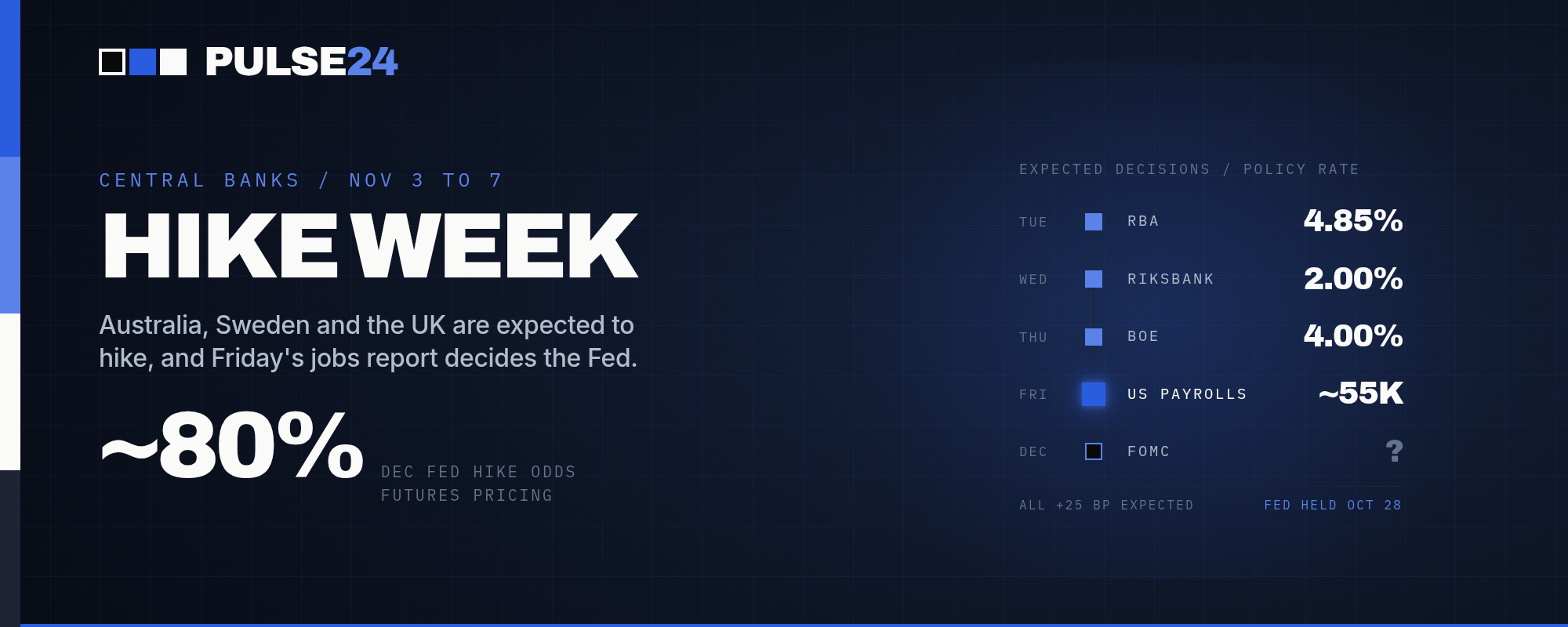
The Reserve Bank of Australia, Sweden's Riksbank, and the Bank of England are all expected to raise rates this week, a synchronized tightening move that would have looked unlikely a year ago. Friday's US jobs report decides whether the Fed ends up making it four in December.
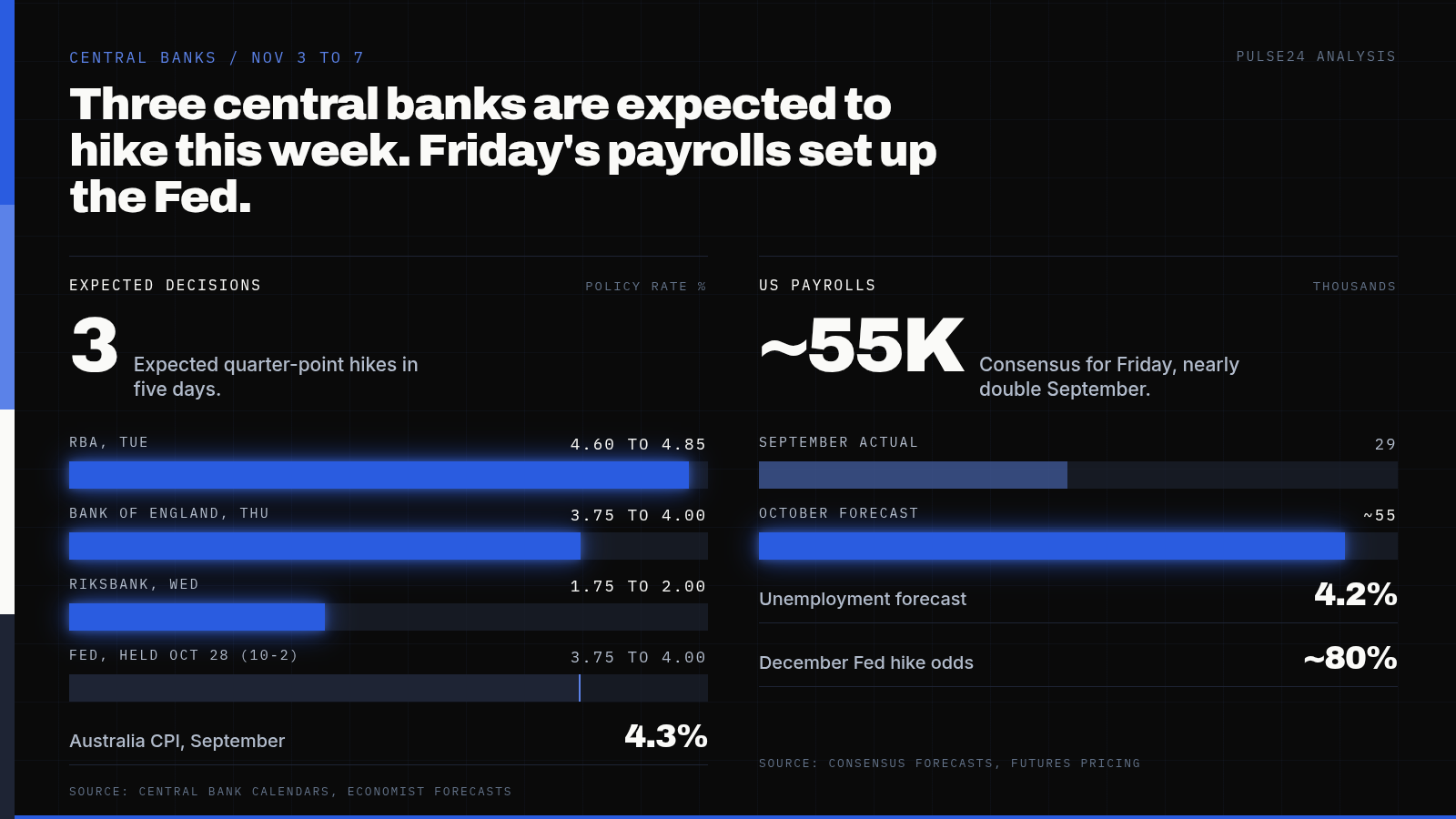
4.85%. That's where the Reserve Bank of Australia is expected to push its cash rate on Tuesday, a fifth increase this year and a fresh multi-year high. It won't be alone for long. Sweden's Riksbank is forecast to raise its policy rate to 2.00% from 1.75% on Wednesday, and the Bank of England is expected to deliver its own quarter-point hike, to 4.00%, on Thursday, after a year spent sounding hawkish without actually moving.
Three hikes, three currencies, five days. Each bank is arriving at the same decision from its own data: inflation readings that refused to cooperate, labor markets that stayed tighter than forecasters expected, and policymakers who ran out of patience waiting for price pressure to fade on its own.
What Changed
The RBA's move would be its fifth hike of 2026, following quarter-point increases on February 3, March 17, May 5, and September 29. That adds up to a full percentage point since February, with Tuesday's decision priced as the more likely outcome, though probability estimates vary by model from just under 60% to above 80%, following an Australian inflation print of 4.3% in September, well above the RBA's 2% to 3% target band.
The Bank of England's case looks similar on paper but different in sequencing. The BoE has held near 3.75% for most of 2026 while talking about tightening rather than delivering it. Economists now expect Thursday's meeting to follow through with a move to 4.00%, extending the hawkish lean the committee signaled in September, when it voted 6 to 3 just to hold.
Sweden's Riksbank is a smaller story by comparison, but a quarter-point hike to 2.00% would still mark its own confirmation that rate increases are no longer the exception among developed economies.
Why It Matters
The Federal Reserve isn't on this week's calendar, but it's the reason the week matters. The Fed held its benchmark at 3.75% to 4% on October 28, a decision that looked calm until the vote count: 10 to 2, with two sitting governors already pushing to raise rates immediately (The Fed Held Rates at 3.75% to 4% in a 10-2 Vote. Two Governors Wanted to Hike Right Now.). Futures pricing puts December hike odds near 80%, and this week's data, Friday's jobs report especially, is what moves that number from here.
Not every central bank is racing to catch up. The Bank of Japan said in October that inflation had already reached its 2% target and still didn't raise rates to match it (The Bank of Japan Says Inflation Has Hit Its 2% Target. It Still Won't Raise Rates to Match.). That split is becoming the real story in global rates: some central banks are responding to inflation they can already see, others are holding back out of concern for growth they haven't seen yet.
Gold has already told part of this story. The metal closed October at $3,875.52 an ounce, down from $4,176.81 on October 1, a monthly decline of roughly $301, or about 7.2%. Nearly half of that came in a single session: gold fell $121.21, or 3.03%, on October 30 alone. The slide extends a move Pulse24 flagged ten days earlier, when gold was down more than $130 from its October high and Wall Street was already leaning toward a December Fed hike (Wall Street Is Nearly Unanimous on a December Fed Hike. Gold Is Still Down More Than $130 From Its October High.).
Equities felt it too. The Nasdaq fell 2.9% this past Friday, its worst session since June, even as the 10-year Treasury yield fell on the same day, an unusual pairing when hike odds are rising rather than falling (Nasdaq Fell 2.9% Friday, Its Worst Session Since June. The 10-Year Yield Fell Too, Even With a December Hike Still Priced In.). Stocks down, yields down, hike odds up: that combination usually means traders are more worried about growth than about inflation, even while pricing in more tightening.
What To Watch Next
Monday opens with the US ISM Manufacturing index, expected at 54.7, up slightly from September's 54.5. The S&P Global flash reading already climbed to 56.0 in October, a 53-month high, so a soft ISM print would be the outlier, not the trend.
Tuesday brings the US midterm elections alongside the RBA decision. All 435 House seats, 35 Senate seats, and 36 governorships are up. Prediction markets give Democrats roughly 94% odds of winning the House and 69% odds for the Senate, with a full Democratic sweep priced near 70%, a split outcome near 24%, and a Republican sweep at just 7%. Markets have historically cared less about which party wins a midterm than about what the result implies for fiscal policy over the following two years.
Wednesday adds the eurozone's flash inflation reading for October. September's reading came in at 3.8%, the highest since September 2023, with core inflation at 2.5%, and economists are watching for another firm print. A hotter number would put the European Central Bank in the same position the RBA and BoE are already in.
Friday's jobs report is the week's real decision point. Economists expect payrolls to rise by roughly 55,000, nearly double September's 29,000 gain, with unemployment holding near 4.2% and average hourly earnings up 0.3% on the month. A strong number would likely lock in a December Fed hike. A weak one would hand the doves their best argument yet to wait.
Currency markets are already positioning for the outcome. The dollar index sits near 101.8, little changed on net, while the euro has slipped to about 1.1157, after touching its lowest level since May 2025. A strong payrolls print would likely push the euro lower still; a weak one could send it back toward its recent highs.
The Pulse24 Take
Weeks with this many rate decisions packed together are rare, and weeks where three G10 central banks move in the same direction are rarer still. For most of 2024 and 2025, the dominant debate in developed-market rates was how fast central banks could cut without reigniting inflation. That debate has effectively flipped. Inflation didn't fall fast enough, demand didn't cool as expected, and central banks are now admitting, one meeting at a time, that the easing cycle ended earlier than most forecasts assumed.
The more interesting question isn't whether the RBA, Riksbank, and BoE hike this week. Markets already expect they will. It's whether a single US jobs report on Friday ends up deciding the Fed's next move more than months of inflation data did. An 80% probability isn't a certainty, and payroll reports have surprised in both directions all year.
For investors, the lesson isn't to chase every rate decision as it lands. It's to notice when the direction of travel shifts across several economies at once, because that kind of shift tends to show up in gold, in currencies, and in long-duration assets well before any single central bank finishes explaining itself.
How we read the data
Curious how we get from raw data to a take like this? Our Trader's Toolkit walks through the tools we lean on.
Explore the Toolkit