Pulse24 Original
The Bank of Japan Says Inflation Has Hit Its 2% Target. It Still Won't Raise Rates to Match.
October 30, 2026
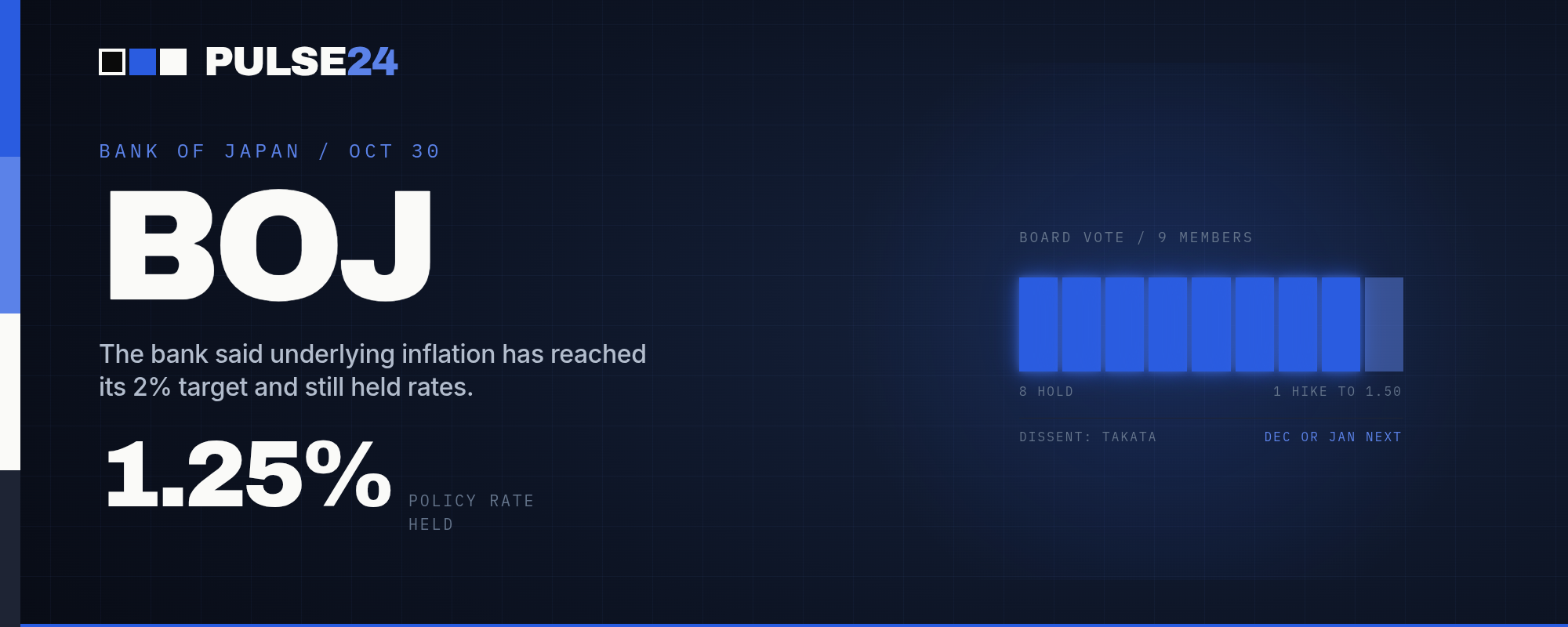
Japan's central bank held its policy rate at 1.25% on Thursday, even as it declared underlying inflation consistent with its 2% target for the first time in years. One board member wanted a hike anyway, and markets are now debating whether December or January brings the next one.
Eight of the nine Bank of Japan board members voted to leave the policy rate exactly where it was on Thursday: 1.25%. The one who didn't, Hajime Takata, wanted to take it straight to 1.5%.
The vote itself wasn't the news. What the BOJ said in the statement that came with it was. For the first time in years, the bank declared that underlying inflation, stripped of temporary swings like subsidies and import costs, is now running consistent with its 2% target. Japan spent three decades trying to get inflation up to begin with. Thursday's statement was the closest the BOJ has come to saying it finally got there.
What Changed
Context matters here. Japan exited negative interest rates in March 2024, its first hike since 2007. Since then the BOJ has raised rates five times: to 0.25% in July 2024, 0.50% in January 2025, 0.75% in December 2025, 1.00% in June 2026, and 1.25% in September 2026, a 31-year high. Thursday marked the first meeting since that run where the board chose to pause rather than push further.
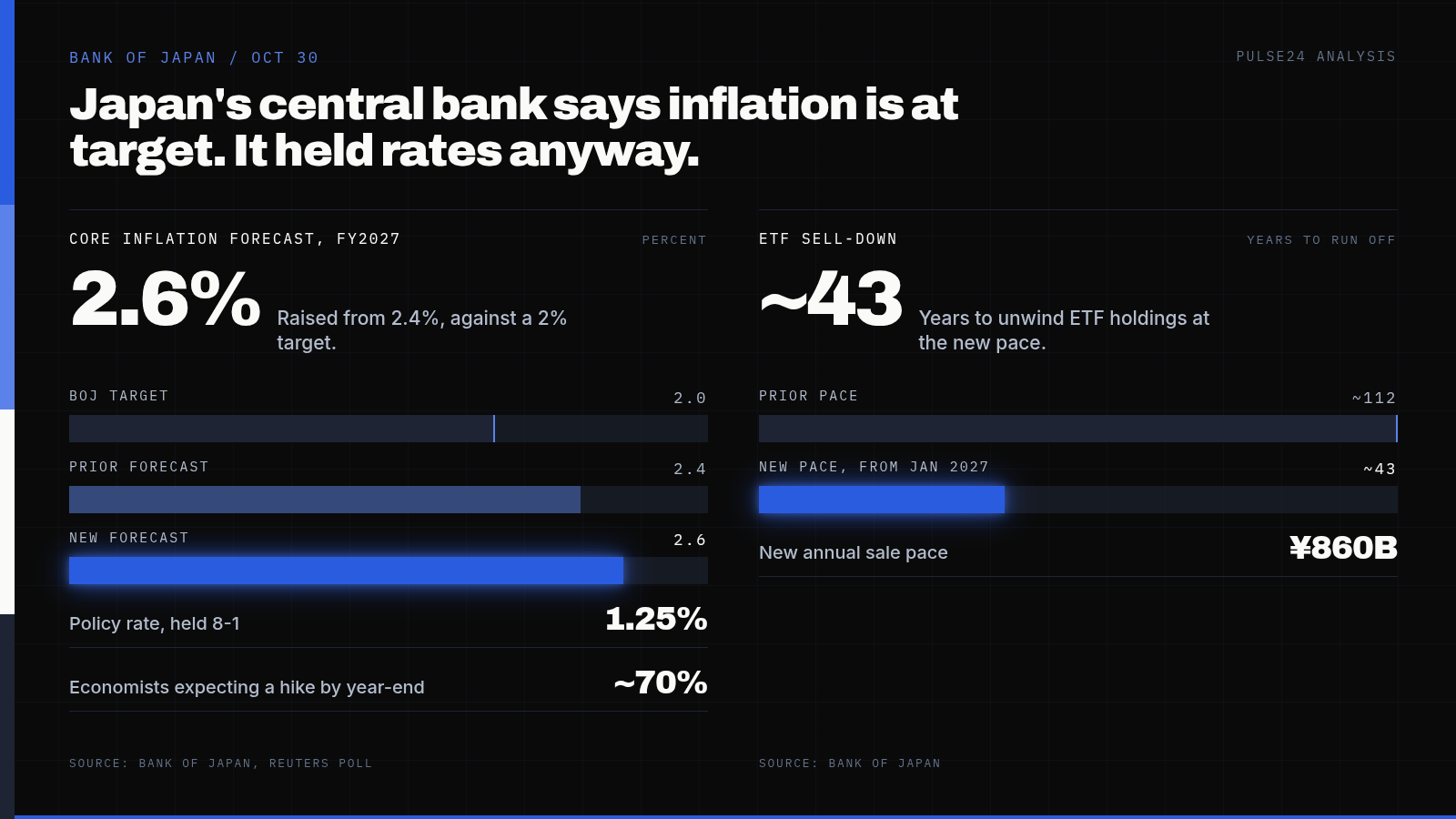
The pause arrived alongside an upgraded inflation forecast rather than a downgraded one. The BOJ raised its core inflation forecast for fiscal 2027 to 2.6%, from 2.4% in July. Its forecast for this fiscal year held at 2.5%, and fiscal 2028 stayed at 2.0%, right at target. Growth forecasts moved at the margins too: fiscal 2026 GDP was revised up to 0.7% from 0.6%, while fiscal 2027 slipped to 0.7% from 0.8%. Put plainly, the BOJ now expects a touch more inflation and a touch less growth next year than it did three months ago.
That shift tracks with Japan's core inflation data hitting a nine-month high heading into this meeting, which is part of why economists had already been debating whether the BOJ would move now rather than wait.
The bank also used Thursday's meeting to speed up an unrelated but consequential cleanup job. It will raise the pace of its ETF sell-down to roughly 860 billion yen a year starting in January 2027, more than double the prior 330 billion yen pace. That shortens the runoff timeline for the equity holdings the BOJ built up over more than a decade propping up the stock market, from an estimated 112 years to about 43. It's a smaller lever than the rate decision, but it's one more sign the BOJ is unwinding crisis-era tools rather than adding to them.
Why It Matters
A central bank holding rates while sounding more confident about inflation is a specific combination, and it tends to precede a hike rather than signal a pause for its own sake. Hirofumi Suzuki at SMBC read Thursday's statement as the BOJ effectively confirming underlying inflation has reached its target already. Masahiko Loo at State Street expects the next move to land in January rather than December, with a base case for where rates eventually settle running around 1.75%, half a point above where they sit now.
The disagreement over timing matters less than the agreement on direction. This is at least the third time this year Takata has pushed the board to move faster than it's willing to go, after dissents in April and July. A board member arguing for a bigger hike at three separate meetings in one year isn't a fluke.
The timing lines up with the Fed's own decision two days earlier, when policymakers held the federal funds rate at 3.75% to 4% in a 10-2 vote, with two governors also pushing for a hike rather than a cut. Two of the world's most important central banks are now in the same position: holding steady while flagging they might move again before year-end, just arriving there from opposite ends of the inflation fight.
That divergence is exactly what drives the dollar-yen trade. The yen spent most of the second half of 2026 grinding weaker even as the BOJ kept hiking, because US yields stayed high enough to keep the carry trade attractive. Through September, the yen averaged about 156.4 per dollar, down roughly 1.5% on the month. A BOJ edging toward the end of its hiking cycle, paired with a Fed that isn't cutting either, leaves the yen's fate riding more on what happens in Washington than on what happens in Tokyo.
What to Watch Next
The next two BOJ meetings, in December and then January, are now the real test of Thursday's signal. A December hike would mean the bank moved faster than its own board majority looked willing to go as recently as this week. A January hike would match what more economists already expected, and would suggest Thursday's hawkish language was about managing expectations more than announcing an imminent move.
Also worth tracking: the BOJ's own commodity assumption, buried in the technical annex, has Dubai crude falling from around $105 a barrel to about $70 over its three-year forecast window. That's a notably lower oil path than where prices have actually traded this year. If oil stays elevated instead, it's one more input that could push the BOJ's own inflation forecasts higher at the next review.
A Reuters poll taken before the meeting found close to 70% of economists expecting a hike by the end of the year, with the rest split between January and later. Nothing in Thursday's statement walked that back. If anything, the inflation upgrade gives the board's hawks more ammunition heading into the next vote.
The Pulse24 Take
Thursday's real news was the written admission buried inside an otherwise unsurprising hold: Japan's central bank is now willing to say, on paper, that the inflation problem it fought for three decades has flipped. That's a bigger deal for how investors should think about Japan than one 25 basis point decision in either direction.
For US investors, the practical takeaway has less to do with Japan itself and more to do with what a genuinely hawkish BOJ does to global bond markets and the yen carry trade that's helped fund a chunk of this year's risk appetite. If Japanese yields keep climbing while the Fed holds its own line, the cost of borrowing yen to buy anything else, from US tech stocks to emerging market debt, rises with it. That risk builds slowly. Markets have a habit of noticing slow risks only once they've already arrived.
How we read the data
Curious how we get from raw data to a take like this? Our Trader's Toolkit walks through the tools we lean on.
Explore the Toolkit