Pulse24 Original
Nearly 70% of Economists Now Expect a December BOJ Hike. A Month Ago, That Share Was About Half.
October 21, 2026
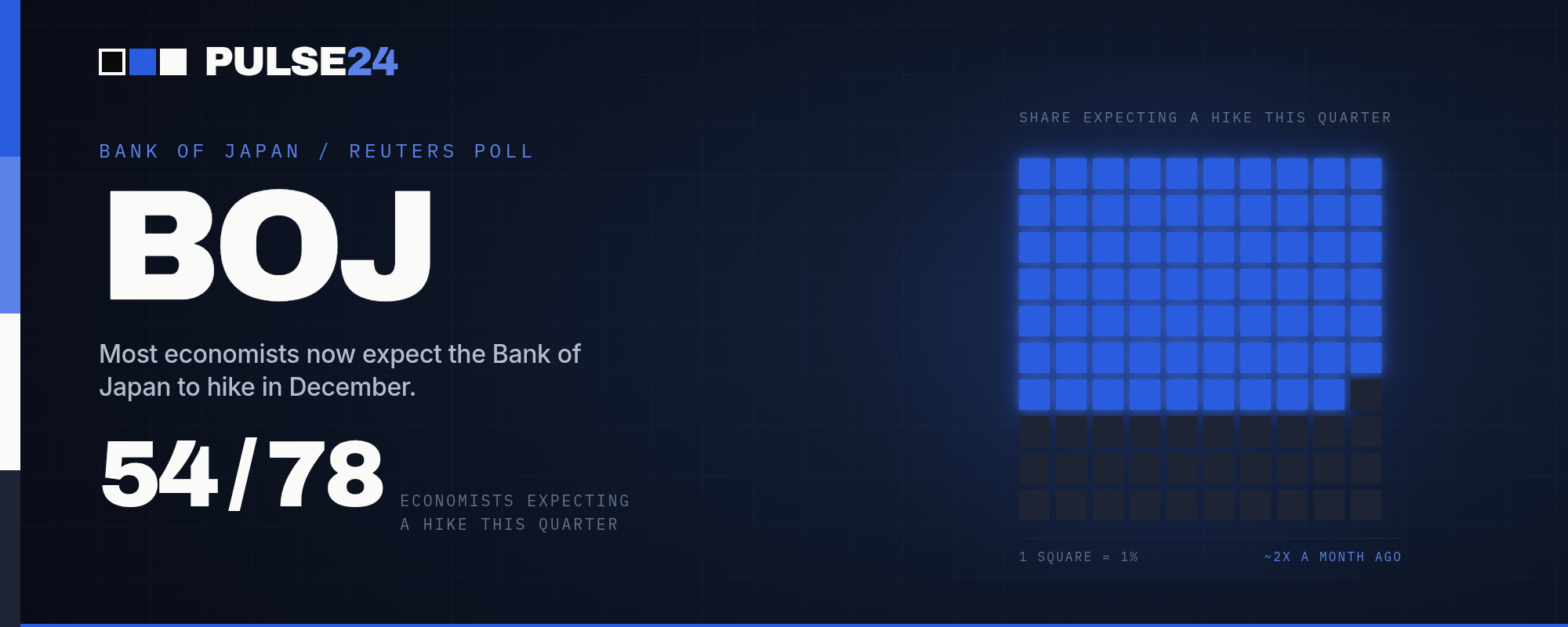
A Reuters poll of 78 economists found that 54 now expect the Bank of Japan to raise its policy rate to 1.50% this quarter, nearly double the share who said so a month ago. The terminal rate debate is shifting higher too, with half of respondents now betting on 2% or above by the end of the hiking cycle.
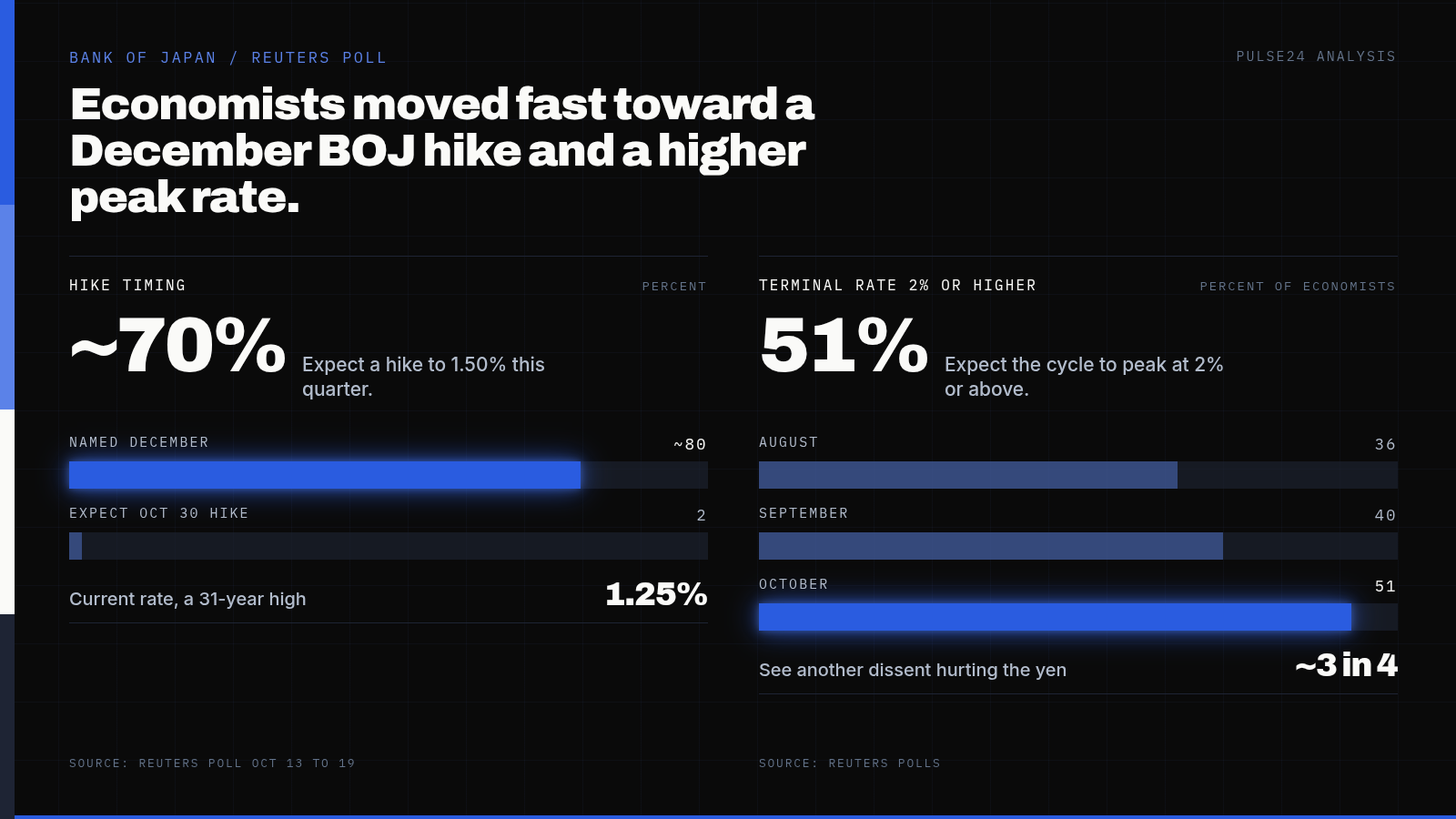
Fifty-four out of 78. That's how many economists in Reuters' latest monthly survey now expect the Bank of Japan to raise rates again before the year is out, nearly double the number who thought so a month earlier. The poll ran from October 13 to 19, and it puts the odds of a hike this quarter just under 70%. The preferred timing isn't close: about 80% of economists who named a month picked December, while only 2% think the move comes at the BOJ's October 30 meeting.
A shift of that size in four weeks is unusual for a central bank that has spent years being criticized for moving too slowly. It reflects a currency that remains fragile and an inflation picture that keeps running hot. Those pressures were on full display this week, when the deputy governor used a parliamentary appearance to push back against the idea of waiting any longer.
Why the Timeline Moved
The BOJ's benchmark rate already sits at 1.25%, the highest since 1995, after the board's September 18 increase. That hike didn't stop the yen from sliding toward the level that triggered Japan's last currency intervention, and the currency remains fragile even now. It's trading roughly 4% stronger than the 164-per-dollar low it touched earlier this year, a partial recovery rather than a resolution.
Deputy Governor Ryozo Himino gave markets a fresh reason to bring the timeline forward on October 21, telling parliament that underlying inflation is already "quite close to 2%" and that financial conditions remain accommodative even after last month's increase. His warning was pointed: delaying further tightening, he said, could ultimately "hurt the economy in the long run." Part of the inflation pressure traces to rising fuel and raw material costs, he added, and part of it comes from something unusual for a central banker to cite: strong global AI demand, which he said is supporting Japanese exports and capital spending.
The Terminal Rate Keeps Climbing
December's move, if it happens, probably won't be the last one. Sixty percent of economists surveyed, 39 of 65, expect the policy rate to reach 1.75% by the end of June 2027, a median that hasn't budged since September's poll. The ceiling above that is what's moving. Among a separate group of respondents, close to half still see 1.75% as the terminal rate, but the share betting on 2% or higher rose to 51%, up from 40% in September and 36% in August. Two months of drift like that suggests economists see less of a hard stop to this cycle than they did over the summer.
Not everyone agrees the economy needs that much tightening. Takeshi Minami of Norinchukin Research Institute put it plainly: "The economy is not overheating to the extent that would warrant consecutive rate hikes." That skepticism has company inside the BOJ too. Reuters has reported that several board members would rather wait for more data on how September's hike is filtering through credit conditions and household spending before committing to another increase in quick succession.
Politics Is Part of the Price Action
Monetary policy in Japan right now can't be separated from fiscal policy. Two board members nominated under Prime Minister Sanae Takaichi, who favors looser fiscal policy, voted against September's increase. Nearly three-quarters of surveyed economists, 23 of 32, said another split vote at a future meeting could weigh further on the yen, since dissent signals friction over how independently the BOJ can act.
The Takaichi government is targeting around 40 trillion yen, about $251 billion, in new bond issuance for fiscal 2027. Junya Takemoto of Sumitomo Mitsui Banking Corporation said the government is "likely keen to increase JGB issuance as a source of funding for growth investment." Fifteen of 23 economists who answered that specific question still expect issuance to stay below the 40 trillion yen threshold regardless.
What to Watch Next
October 30 now looks like a formality. The real decision point is December 17 to 18, when the BOJ's board meets again before year-end. Between now and then, the yen's range against the dollar matters most. A stronger yen going into the meeting gives the board more room to hike without reviving the intervention debate. A renewed slide back toward 164 would do the opposite, and it would likely coincide with another look at whether a board dissent shows up alongside it.
Japan isn't tightening in isolation. Separate Reuters polls now show economists expecting both the Federal Reserve and the European Central Bank to raise rates in December as well, a similar reversal from pause bets played out at the ECB over the past month. Three major central banks moving the same direction at the same meeting cycle would be unusual after years of diverging paths, and it carries implications for global bond yields and the dollar that extend well past Tokyo.
The Pulse24 Take
A poll isn't a rate decision, and economists have misjudged BOJ timing before. Japan's hiking cycle has already moved faster than most forecasters expected back when it began, and the yen still hasn't gotten the relief that was supposed to come with it. What stands out here is how much the distribution of outcomes has shifted in two months, from a terminal rate debate centered on 1.75% to one where half of economists now see 2% or higher.
That shift matters for more than Japanese savers. Japan remains one of the largest external holders of US Treasuries, and a central bank moving faster and further than expected changes the calculus on how much Japanese capital stays parked abroad versus heading home to capture rising domestic yields. Add a government leaning on bond issuance partly to soften the pace of hikes, and the BOJ's December decision stops looking like a local story. It becomes a test of how much room Tokyo has left to normalize policy before fiscal and currency pressures start pulling against each other.
How we read the data
Curious how we get from raw data to a take like this? Our Trader's Toolkit walks through the tools we lean on.
Explore the Toolkit