Pulse24 Original
Japan's Fastest Hiking Cycle Since 1990 Still Hasn't Saved the Yen From 157
October 17, 2026
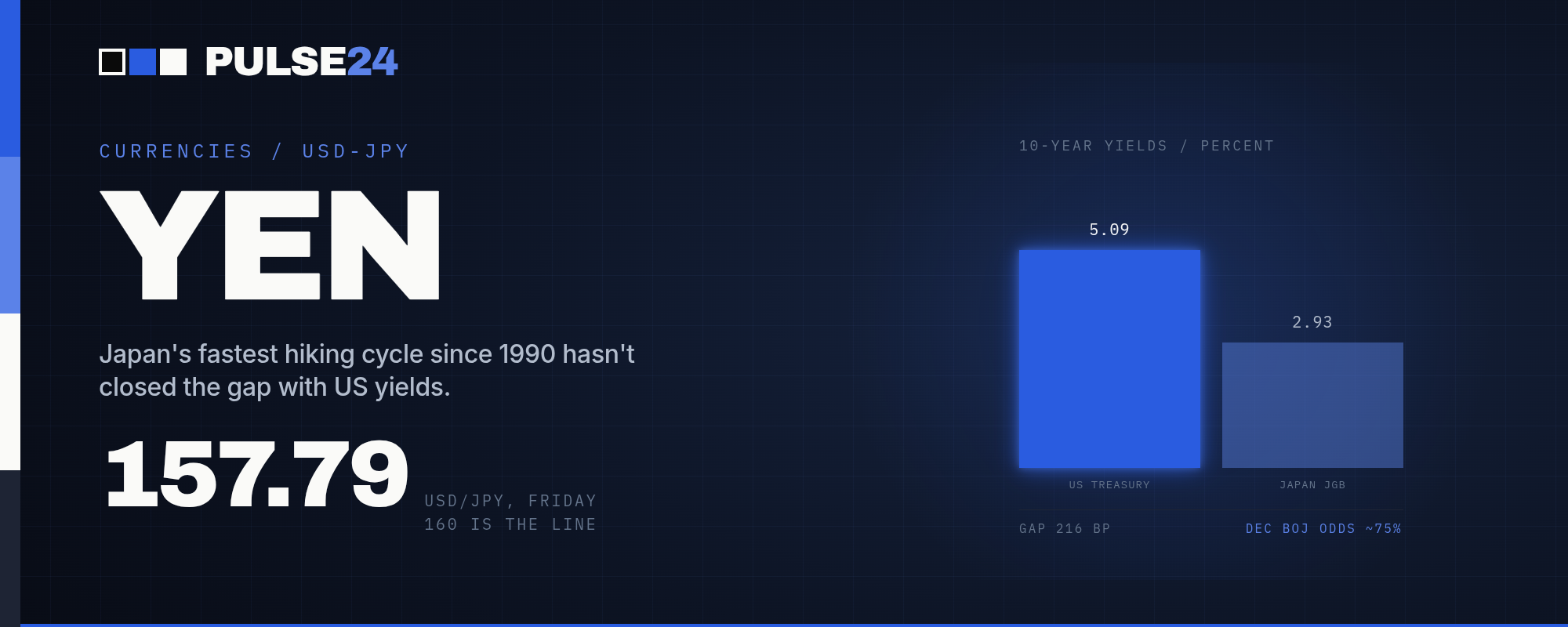
Japan's finance minister is threatening to intervene in currency markets again, even as the Bank of Japan hikes at its fastest pace since 1990. The yen still can't shake a 216-basis-point gap with US bonds, and 160 per dollar remains the line nobody wants tested again.
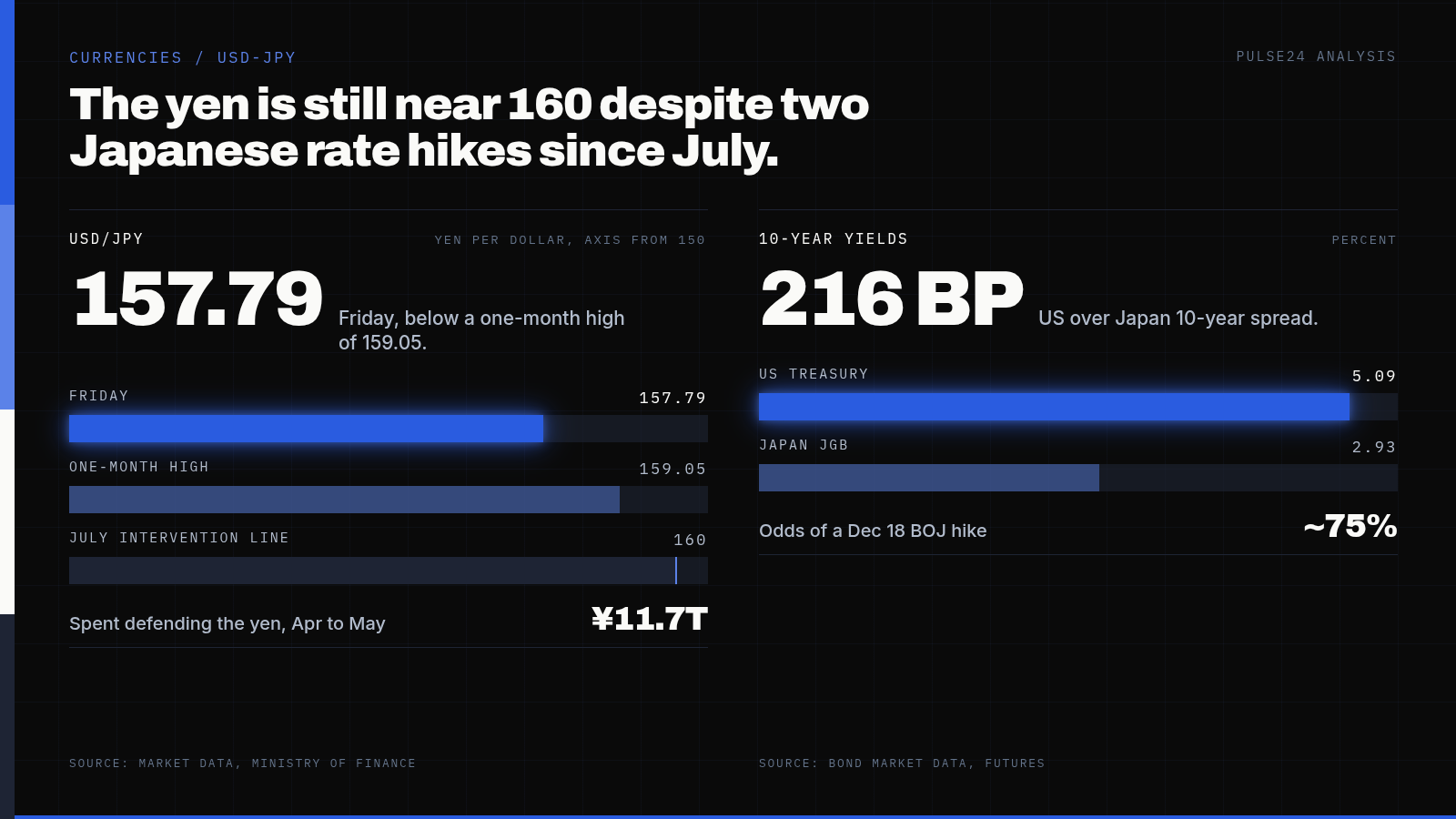
Japan's finance minister picked Thursday to remind currency traders she still has a playbook. Satsuki Katayama said she is "prepared to take action in the currency market again if needed," language that echoes what Tokyo said before it bought roughly 11.7 trillion yen between late April and late May, and before it coordinated a joint intervention with the US Treasury once the dollar broke above 160 yen in late July.
What Changed
The Bank of Japan has raised its policy rate twice in three months, to 1.25%, the fastest pace of tightening since 1990. Governor Kazuo Ueda said Friday, speaking at IMF meetings in Bangkok, that the BOJ "cannot allow underlying inflation to rise further above its 2% target." He added that rate hikes will continue, and that the board is set to debate whether to retire its longstanding language describing inflation as merely "approaching" that target, a phrase that has described Japanese policy for years.
Board member Junko Koeda struck a similar tone this week, saying the BOJ should not become "overly cautious" about raising rates given what she called considerable upside risks to inflation. She argued financial conditions remain accommodative even after the hikes already delivered, with little sign that borrowing costs are hurting households or businesses.
None of it has been enough to lift the yen much. USD/JPY traded near 157.79 on Friday, down from a one-month high of 159.05 but still well below the roughly 155.87 level seen before September's hike. The currency weakened further after Wednesday's hot US inflation report rattled global markets and sent Japan's Nikkei down 4.9% in a single session.
Why It Matters
The core problem for Tokyo is the rate gap, not the rate path. The BOJ's policy rate at 1.25% still sits 250 to 275 basis points below the Fed's. The 10-year gap tells the same story: US Treasuries near 5.09% against Japanese government bonds near 2.93%, a 216-basis-point spread that keeps the incentive to borrow cheaply in yen and invest in dollar assets firmly intact. Pulse24 has covered the yen-funded carry trade that still hasn't unwound, and Friday's levels suggest that trade is still very much alive.
A currency that keeps weakening even as its own central bank hikes is a currency whose central bank looks like it's losing the argument, and foreign exchange markets tend to test governments that look like they're losing. Japan has already shown it's willing to spend real money to make the opposite point: September's hike to a 31-year high didn't stop the slide either, and Katayama's Thursday comments suggest the finance ministry is preparing to act again rather than simply talk.
The timing adds another layer. The Fed meets October 27 to 28, with markets pricing roughly an 85% chance it holds steady, while the BOJ meets just two days later, on October 29 and 30. Central banks from Frankfurt to Tokyo are increasingly tightening in parallel, a dynamic Pulse24 flagged when European economists reversed course on an ECB pause. When everyone hikes together, no single currency gets much lift from it, which helps explain why Japan's two hikes in three months have bought so little ground for the yen.
What to Watch Next
160 yen per dollar remains the number that matters most. That's the level that triggered Japan's joint intervention with the US Treasury in July, and traders widely treat it as the threshold where verbal warnings turn into actual dollar sales. USD/JPY sitting at 157.79 puts the currency within hailing distance of that line again.
Watch whether the BOJ actually changes its "approaching 2%" inflation language at the October 29-30 meeting. Markets currently price only a modest chance of a hike that week but a roughly 75% probability of one by the December 18 meeting. A language shift now would be read as laying groundwork for December, even without an immediate move.
Also watch the US side of the equation. Fed Chair Kevin Warsh has declined to signal his October plans, and the Fed's own meeting lands just before the BOJ's. A dovish surprise from Washington would do more to narrow that 216-basis-point gap, and take pressure off Tokyo, than another Japanese hike on its own.
The Pulse24 Take
There's a lesson here about the limits of unilateral rate hikes in a world where every major central bank is moving at once. Japan has delivered its fastest tightening cycle since 1990, and the yen is barely better off for it, because the thing that actually drives USD/JPY is the gap between Japanese and American rates, not the level of Japanese rates in isolation.
That's worth remembering before assuming another BOJ hike in December will finally turn the yen around. It might narrow the gap a little. It won't close it. The bigger swing factor is still what the Fed does next, and Warsh's refusal to telegraph October leaves that an open question. Until the two paths actually converge, intervention threats like Katayama's are likely to keep doing the job that rate hikes alone haven't.
How we read the data
Curious how we get from raw data to a take like this? Our Trader's Toolkit walks through the tools we lean on.
Explore the Toolkit