Pulse24 Original
Japan's Core Inflation Hit a Nine-Month High. The Bank of Japan Still Isn't Rushing to Hike.
October 25, 2026
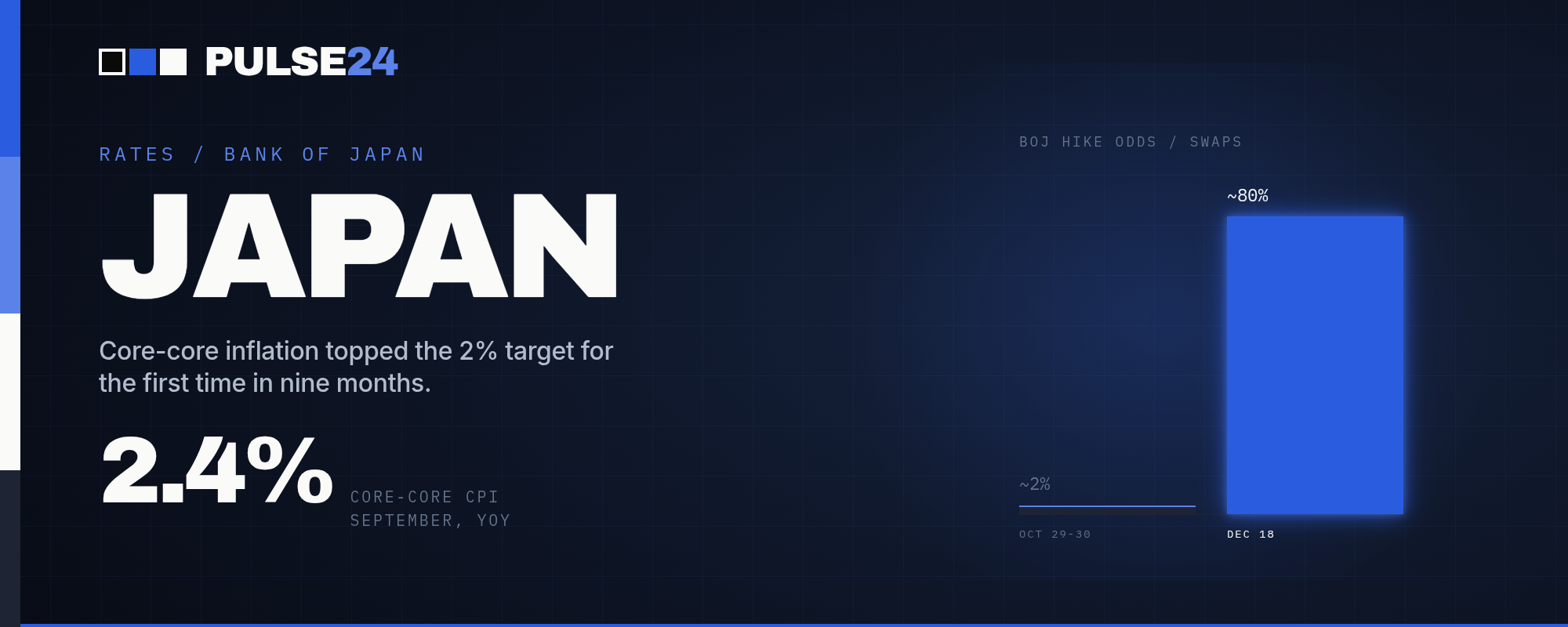
Japan's September core inflation data beat every forecast on the Street, pushing the yen to a one-month high and reviving bets on a December Bank of Japan hike. Traders still see almost no chance of a move at this week's meeting, and that gap between now and December is where the real risk sits.
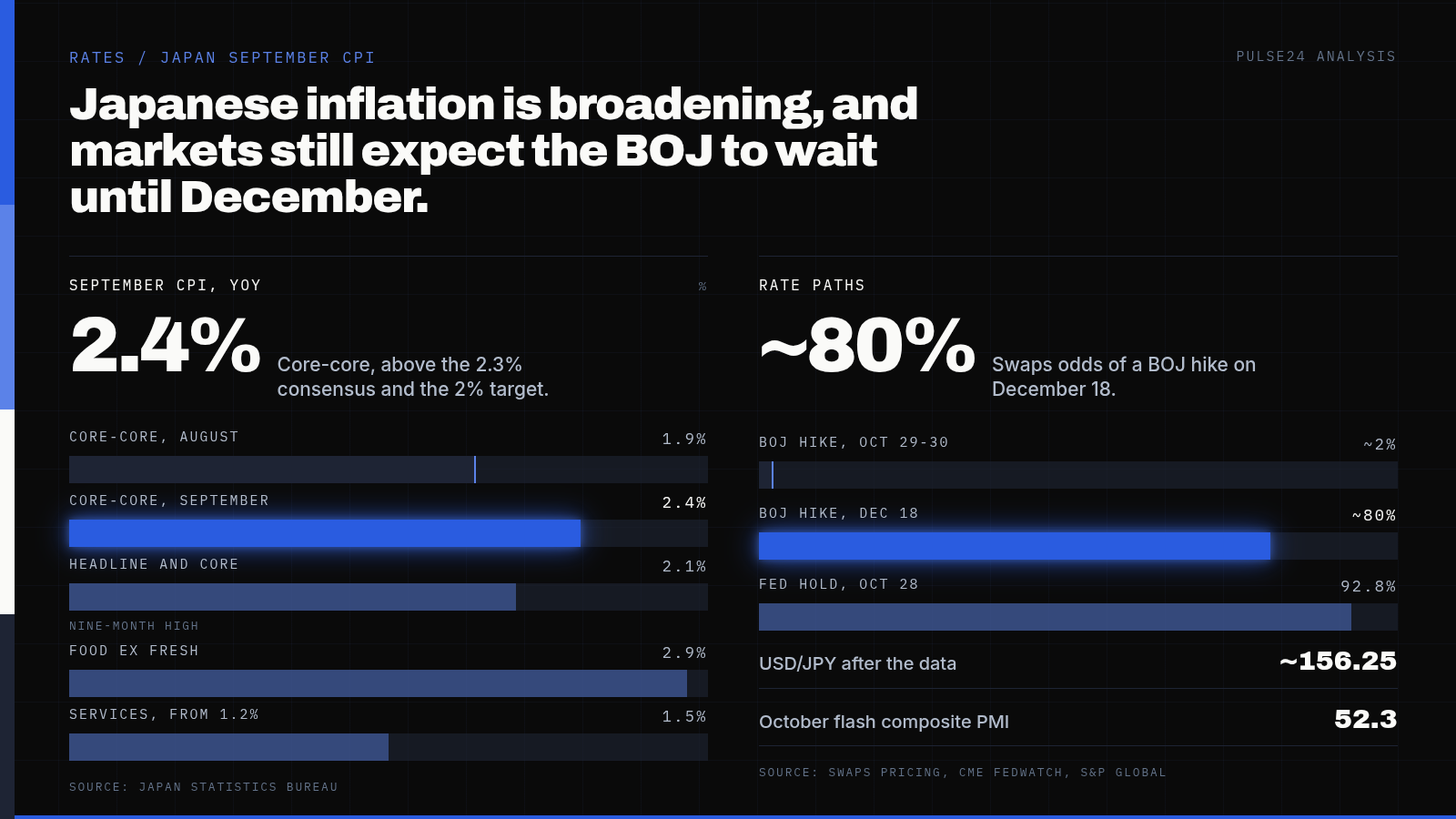
Japan's core inflation rate, stripped of fresh food and energy, climbed to 2.4% year-over-year in September, according to data released Friday. That's above the 2.3% economists had forecast and the first time this closely watched gauge has topped the Bank of Japan's 2% target in nine months. The yen did what it tends to do when Japanese inflation surprises to the upside: it rallied, with USD/JPY sliding to near 156.25 in early Asian trading.
What Changed
Headline inflation and the narrower core measure that excludes only fresh food both came in at 2.1% year-over-year, also a nine-month high, matching consensus and up from 1.7% in August. The broader core-core figure, the one the BOJ leans on most heavily because it filters out the swings in energy prices that have distorted Japanese inflation readings for much of this decade, rose from 1.9% in August to 2.4% in September, above the 2.3% consensus estimate. Food prices excluding fresh items rose 2.9% on the month, and services prices accelerated to 1.5% from 1.2%, evidence that the pickup is broadening beyond the usual energy and import-cost culprits.
Currency strategists read the yen's reaction as more than a simple rate story. Elias Haddad at Brown Brothers Harriman described the yen as leading gains across the board, calling it "the ultimate refuge currency" in a note following the release. That framing matters because Japan's flash composite PMI for October held at 52.3, a reading that points to resilient private-sector growth even as manufacturing cools and services keep expanding. A currency does not usually rally on both inflation and growth data unless investors are also parking money in it for safety, and Japanese equities and bonds have looked more attractive to foreign money than they have in years.
None of this is pushing the Bank of Japan toward an immediate move. The central bank hiked rates by 25 basis points to 1.25% in September, and swaps markets currently assign only about a 2% probability to another hike at the October 29-30 meeting. The bigger question is December. Haddad's team still expects the BOJ to avoid accelerating its tightening, since headline and core inflation remain below the central bank's own 2.5% projection for 2026, while swaps pricing has moved to roughly 80% odds of a hike at the December 18 meeting. Standard Chartered takes the more cautious side of that debate, penciling in January 2027 as its base case and treating December as merely a live option rather than the likely outcome.
Why It Matters
The yen's strength is a problem for anyone on the other side of a carry trade. For years, investors have borrowed cheaply in yen, when Japanese rates sat near zero, and used that money to buy higher-yielding assets abroad, from US Treasuries to tech stocks to emerging-market debt. Japan's hiking cycle has been the fastest since 1990, and for most of this year that tightening still wasn't enough to stop the yen's slide. A yen that strengthens on both inflation surprises and safe-haven demand is a different animal: it raises the cost of maintaining those borrowed positions and makes unwinding them more urgent if volatility picks up elsewhere. Haddad specifically flagged that a deeper selloff in AI-related stocks could push USD/JPY below 155.00, which is the kind of two-way link between Tokyo funding costs and Nasdaq volatility that tends to go unnoticed until it suddenly doesn't.
There's also a direct parallel sitting one timezone away. Every one of the 100 economists Reuters recently polled now expects a Fed hike by December, and this week's FOMC meeting is widely expected to end in a hold, just as the BOJ's October meeting is expected to. Two of the world's most important central banks appear to be converging on the same playbook: hold through October, hike in December. A survey of economists put December BOJ hike odds near 70% as of three days before this inflation print, and the fresh data has only firmed that view rather than changed it.
When two major central banks tighten in the same window, the effect compounds rather than adds. Cheaper yen funding has been one of the quiet sources of liquidity that helped keep risk assets well bid even as the Fed stayed restrictive elsewhere. If the BOJ follows through in December while the Fed does the same, two major sources of global liquidity tighten simultaneously, and currency and rate volatility become more likely to spill into equity and credit markets rather than stay contained to foreign exchange desks.
What to Watch Next
The BOJ's Outlook Report for Economic Activity and Prices, published alongside this week's rate decision, will carry more signal than the decision itself, since a hold is already priced in. Look specifically for any upward revision to the 2.5% inflation projection for 2026, since that's the threshold Haddad's team is watching before shifting away from a January 2027 call. The Fed's own meeting lands just two days earlier, on October 27-28, and any surprise there would likely move USD/JPY as much as anything coming out of Tokyo.
USD/JPY's 155.00 to 160.00 range is the number to track between now and December 18. A break below 155.00, especially one driven by a selloff in AI-linked equities rather than by Japanese data, would be the clearest sign yet that carry-trade unwinding, not inflation alone, has become the dominant force in the pair.
The Pulse24 Take
A hot inflation print next to a surging currency looks like the start of something aggressive. Swaps pricing in only a 2% chance of an October hike looks like evidence that nothing is happening at all. Both readings miss what the data is actually showing. Japan's central bank has spent the better part of two years moving more slowly than its own inflation numbers justified, catching up only after revisions forced its hand, and there's no clear sign that pattern has broken. What has changed is the yen's role in the global trade. A currency that investors used to short almost automatically is now drawing safe-haven bids on inflation days and selloff days alike, and that shift matters more for how capital moves around the world than whatever the BOJ decides this week. December 18 is circled for a reason, but the real test may arrive earlier, the next time US tech stocks wobble and someone has to decide whether to keep holding a yen-funded position into that kind of volatility.
How we read the data
Curious how we get from raw data to a take like this? Our Trader's Toolkit walks through the tools we lean on.
Explore the Toolkit