Pulse24 Original
Gold Fell Below $4,000 to a One-Year Low. The Dollar and Bond Yields Were Falling at the Same Time, Which Isn't Supposed to Happen.
November 2, 2026
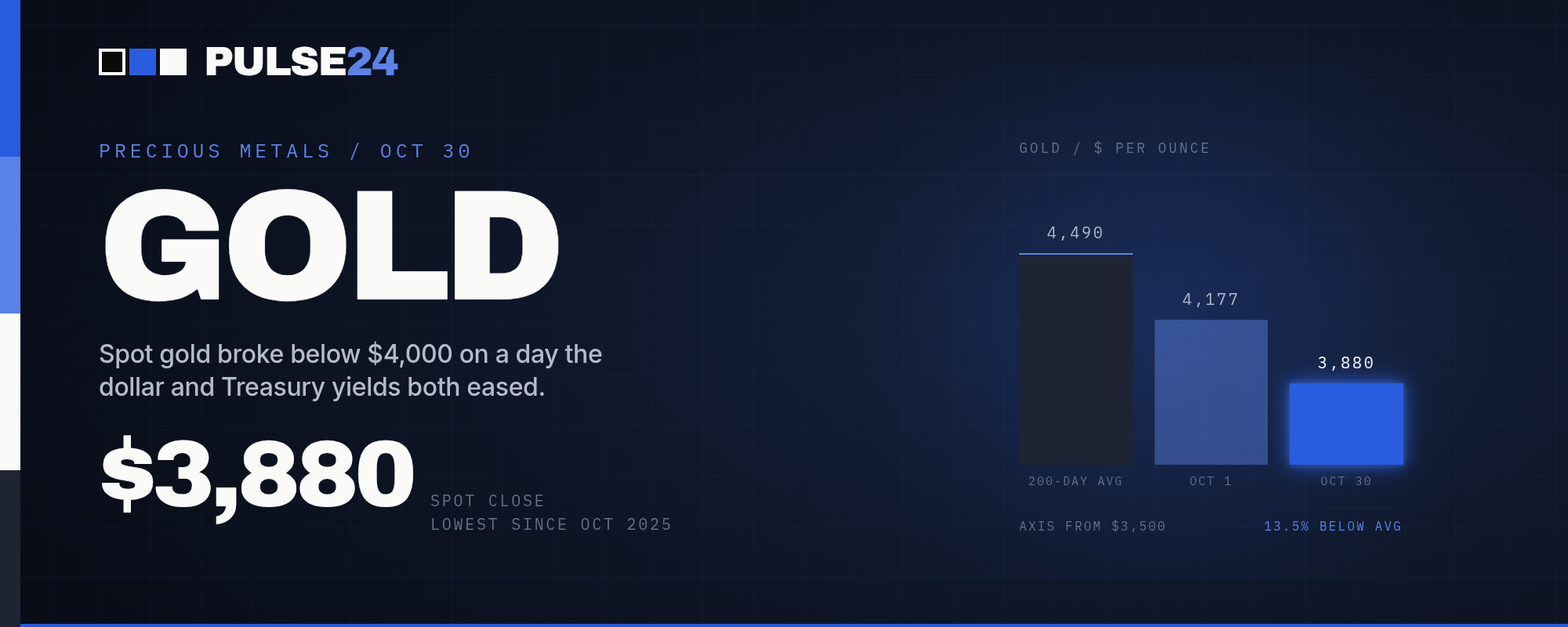
Gold broke below $4,000 to its lowest level in a year, falling 3.5% in a single session on Friday. The odd part: the dollar and Treasury yields were falling at the same time, which is supposed to push gold higher, not lower.
Spot gold sank 3.5% on Friday, closing at $3,880 an ounce and slipping below $4,000 for the first time since early October of last year. Nothing about that would be strange on its own. Gold corrects. What makes this drop worth a second look is what else happened at the same time: the dollar eased, Treasury yields fell, and gold still couldn't catch a bid. That combination almost never happens.
What Changed
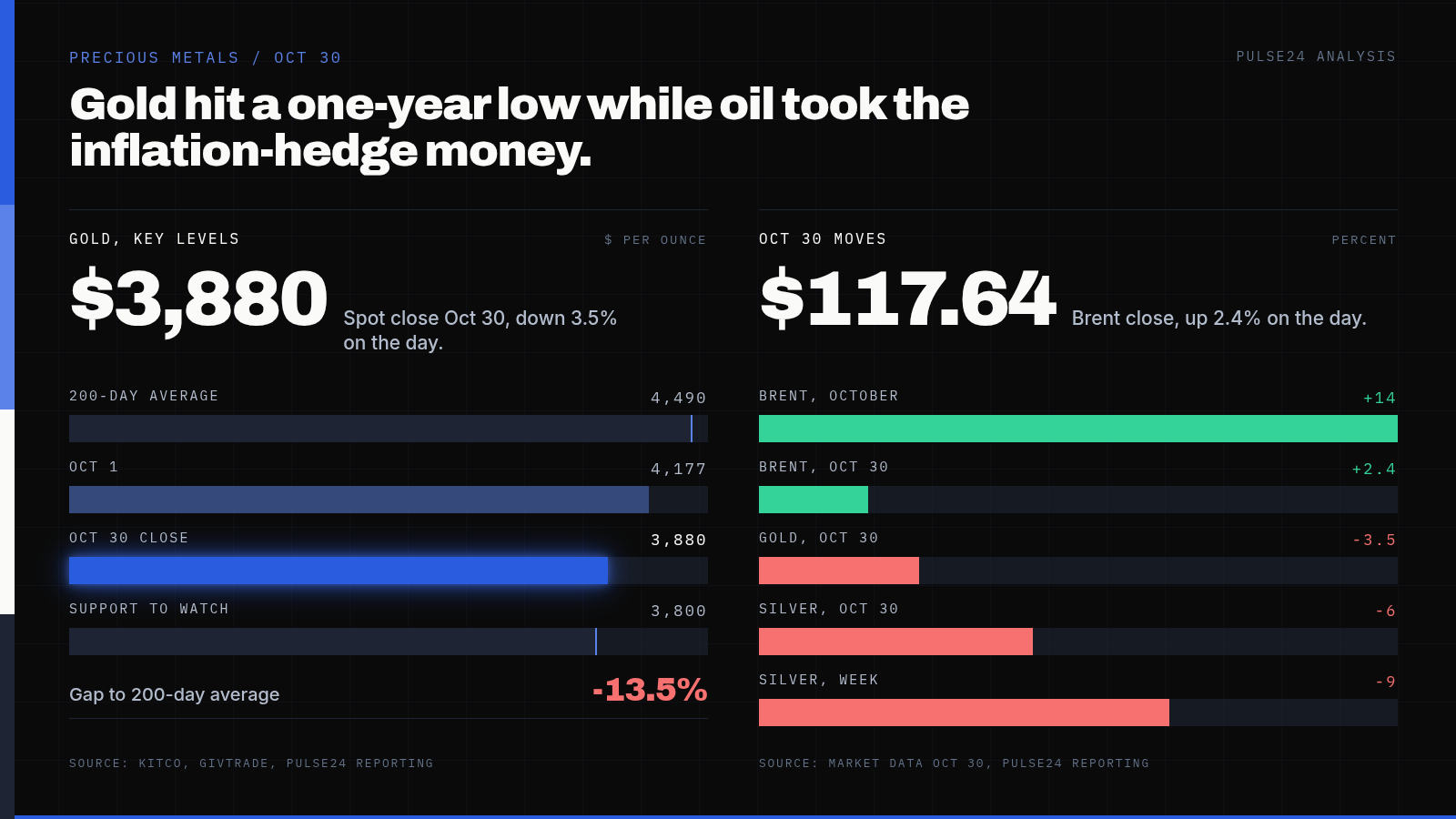
Friday's close put gold at its weakest since October 6, 2025, when the metal touched an intraday low of $3,884.61, according to Kitco. The drop left gold roughly 13.5% below its 200-day moving average, which sits near $4,490, and GivTrade's Waleed Said says a test of $3,800 support is plausible if the selling carries into next week.
Silver fell even harder. Spot silver dropped almost 6% on Friday to $48.95 an ounce, capping its worst weekly decline since early June with an almost 9% loss over five sessions. Both metals had already been drifting lower since the Fed's meeting on Wednesday, when the central bank held its benchmark rate at 3.75% to 4% in a 10-2 vote, with two governors pushing for an immediate hike instead.
That hold didn't calm anyone down. Wall Street has moved to pricing a December hike as close to a sure thing, the same shift that had already knocked more than $130 off gold's October high before Friday's drop added to it. The backdrop hasn't helped either: last week's GDP report showed the economy growing 3.4% while core inflation stayed stuck above 3%, exactly the kind of data that keeps a Fed hike on the table instead of taking it off.
Why It Matters
Gold and the dollar are supposed to move in opposite directions most of the time. A weaker dollar makes gold cheaper for buyers holding other currencies, and falling yields reduce the opportunity cost of holding a metal that pays no interest. Both of those things happened on Friday, and gold fell anyway. When the usual relationship breaks down like that, it's worth asking what's actually driving the price instead of what's supposed to be driving it.
Part of the answer is sitting in the oil market. Brent crude rose 2.4% Friday to $117.64 a barrel, climbing almost 14% for the month as Middle East supply concerns kept a bid under prices. Phil Streible of Blue Line Futures put it simply: traders are buying the inflation trade, and right now oil is that trade, not gold. Waleed Said at GivTrade made a related point, that gold isn't playing its usual safe-haven role at the moment, with oil and the dollar absorbing the flows that would normally land in bullion.
Simon-Peter Massabni of XS.com expects the pressure to continue until incoming data actually shifts rate expectations one way or the other. That's a narrower bar than it sounds. Gold doesn't need a crisis to turn around. It needs the market's Fed bets to change, and this week brings a full slate of data that could do exactly that.
What to Watch Next
The calendar is unusually packed. ISM manufacturing data lands Monday, JOLTS job openings and ADP payrolls follow Tuesday and Wednesday, the Bank of England meets Thursday with a 25-basis-point hike to 4.0% expected, and Friday brings the non-farm payrolls report the Fed itself is waiting on before deciding how many more hikes are coming this cycle. Any one of those releases could move rate expectations enough to flip gold's direction.
Not everyone reads the selloff as a reason to stay away. Morton Wealth's Jeff Sarti pointed to sentiment readings that are flashing deeply bearish, which he treats as a contrarian signal rather than a warning. Zaye Capital Markets' Naeem Aslam goes further, calling a dip like this a long-term buying opportunity. Said's $3,800 level is the number to watch if the selling keeps going instead.
The Pulse24 Take
It's tempting to read a one-day, one-week move as proof that gold's whole safe-haven story is broken. That's probably too much weight to put on five trading sessions. Rate expectations have whipped around all year, and gold has whipped around with them every time. What's unusual about this particular move is the company it fell in. Gold dropped at the same time two of its normal tailwinds, a softer dollar and lower yields, were blowing in the opposite direction.
The more useful way to think about it: right now, oil is doing gold's job. Investors who want protection against inflation are buying the thing that's visibly getting more expensive rather than the thing that's supposed to protect them from it getting more expensive. That won't last forever, and it doesn't erase the slower-moving forces, central bank buying chief among them, that have supported gold for years. But until this week's jobs report and the data around it actually move the Fed's expected path, betting on a quick reversal here is a bet on timing, not on the thesis.
How we read the data
Curious how we get from raw data to a take like this? Our Trader's Toolkit walks through the tools we lean on.
Explore the Toolkit