Pulse24 Original
US GDP Grew 3.4% Last Quarter, Beating Forecasts. Core Inflation Still Won't Dip Below 3%.
October 29, 2026
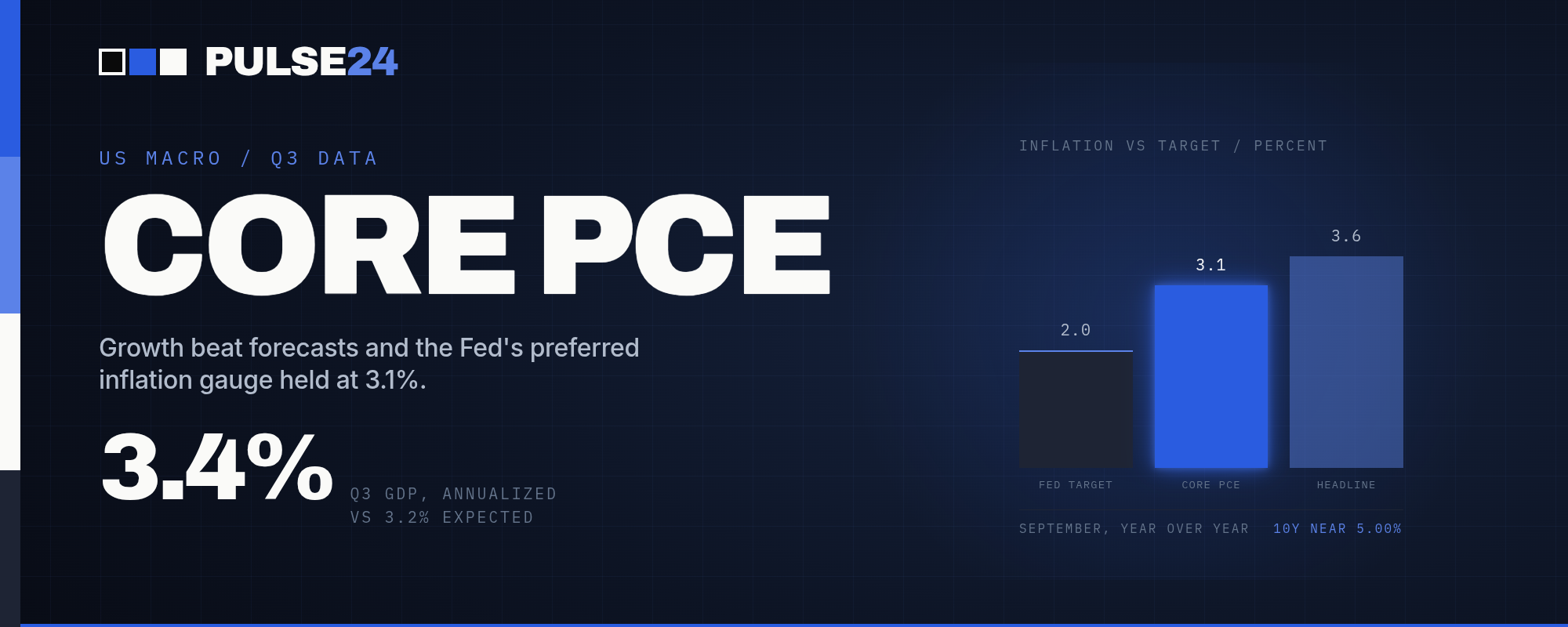
The economy grew faster than expected in the third quarter, and the Fed's preferred inflation gauge held at 3.1% anyway. That combination makes the December rate decision harder to call, not easier.
The number the Fed watches most came in at 3.1% Thursday morning. Core PCE inflation for September matched what economists expected, which in this economy counts as a small win. It is also more than a full point above the Fed's 2% target, and it landed less than a day after the central bank chose to hold interest rates rather than cut them.
What Changed
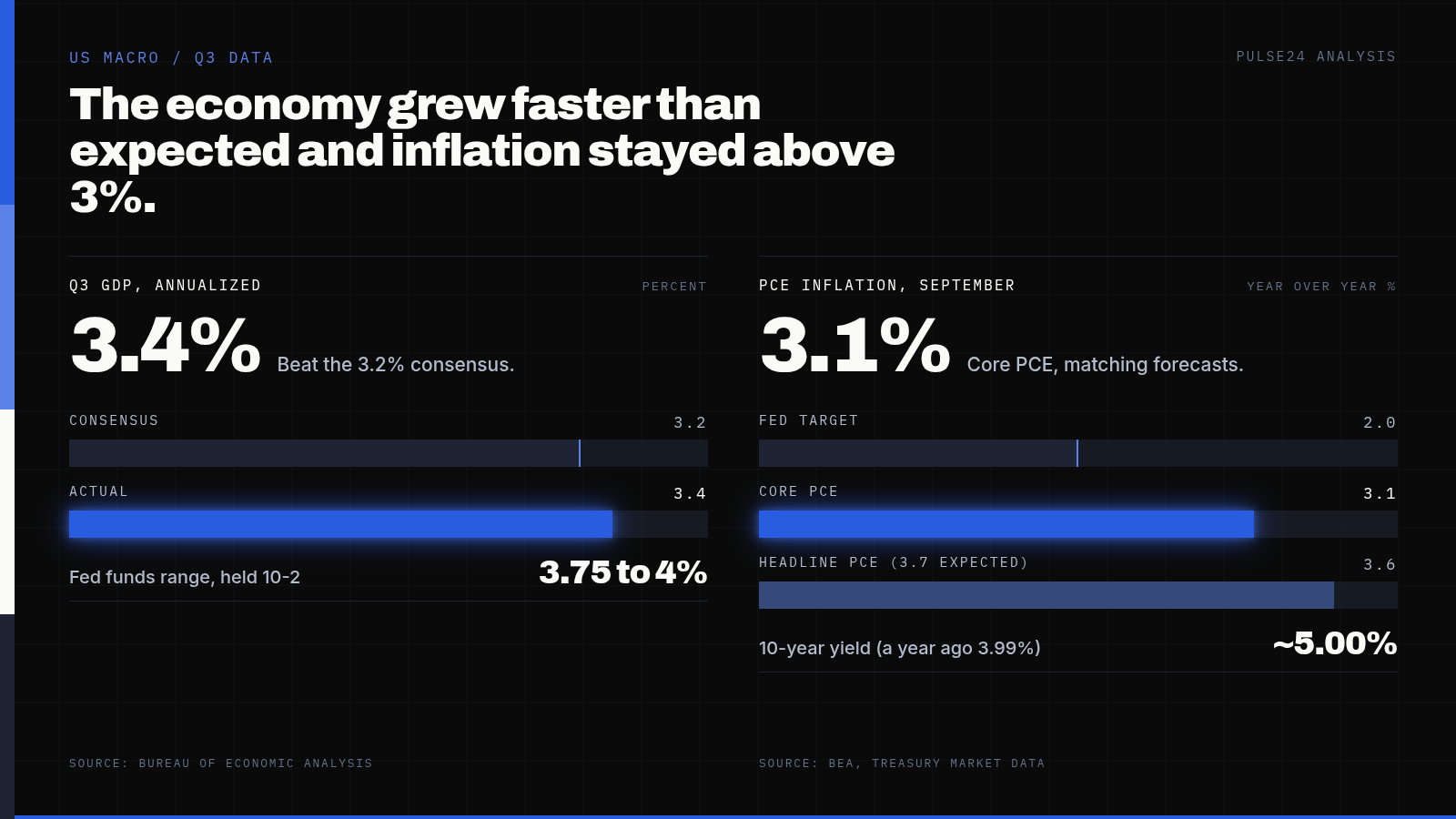
Two reports arrived within minutes of each other on Thursday. The Commerce Department's first look at third-quarter GDP showed the economy grew at a 3.4% annualized pace, beating the 3.2% that economists had penciled in. The same batch of data included the Fed's preferred inflation gauge: core PCE, which strips out food and energy, rose 3.1% year over year in September and 0.3% on the month, both right in line with forecasts. Headline PCE came in at 3.6% annually, a tenth of a point softer than the 3.7% consensus.
Context matters here. The growth number beat expectations at the same time the inflation number refused to drop. That combination is the one the Fed has spent most of this year trying to avoid. The Fed held its benchmark rate at 3.75% to 4% on Wednesday by a 10-2 vote, with two governors on record wanting to raise rates immediately rather than wait. Thursday's data gave neither side a clean win. Growth that strong is not the kind of economy that typically needs rate cuts. Inflation that sticky is not the kind that typically gets them.
Why It Matters
Bond markets had already drawn their own conclusion before Thursday's numbers landed. The 10-year Treasury yield traded near 5.00% this week, up from 3.99% a year earlier, a jump of more than a full point in twelve months. That move reflects a market that has stopped pricing in near-term rate cuts and started pricing in the opposite. Most of Wall Street is now leaning toward a rate hike in December rather than a cut, and Thursday's data did little to change that calculus. A core PCE print that matched expectations is not the same as a core PCE print that fell.
There is a reason the Fed watches PCE over the more commonly cited CPI. PCE adjusts for how consumers substitute between goods when prices shift, so it tends to run a bit cooler and smoother than CPI over time. When PCE stays elevated anyway, as it has through most of 2026, it tells policymakers that the inflation problem is not a measurement quirk. It is showing up no matter how the basket gets weighted.
What to Watch Next
The next scheduled Fed decision falls on December 8 and 9, and between now and then, two more inflation reports and a full jobs report will shape the debate. A repeat of Thursday's pattern, growth holding up while core PCE stays pinned above 3%, would make the case for a December hike louder. The opposite would happen if either series posted a clear downside surprise instead. Watch services inflation within the PCE report specifically. That is the stickier component the Fed has flagged as the one that needs to cool before officials feel comfortable easing off.
The Pulse24 Take
Strong growth and stubborn inflation sound like a contradiction until you remember they often arrive together. An economy spending freely is an economy that keeps upward pressure on prices, and Thursday's data captured exactly that tension in two numbers released minutes apart. Neither report was a disaster, and neither amounted to a clean resolution. For a Fed trying to decide whether September's hike was the end of this cycle or just a pause, that is the hardest kind of data to get. It does not settle the argument. It just extends it a little further into December.
How we read the data
Curious how we get from raw data to a take like this? Our Trader's Toolkit walks through the tools we lean on.
Explore the Toolkit