Pulse24 Original
AMD's Data Center Revenue Nearly Doubled to $8.5 Billion. The Company's Own Guidance Says That Was the Slow Quarter.
November 4, 2026
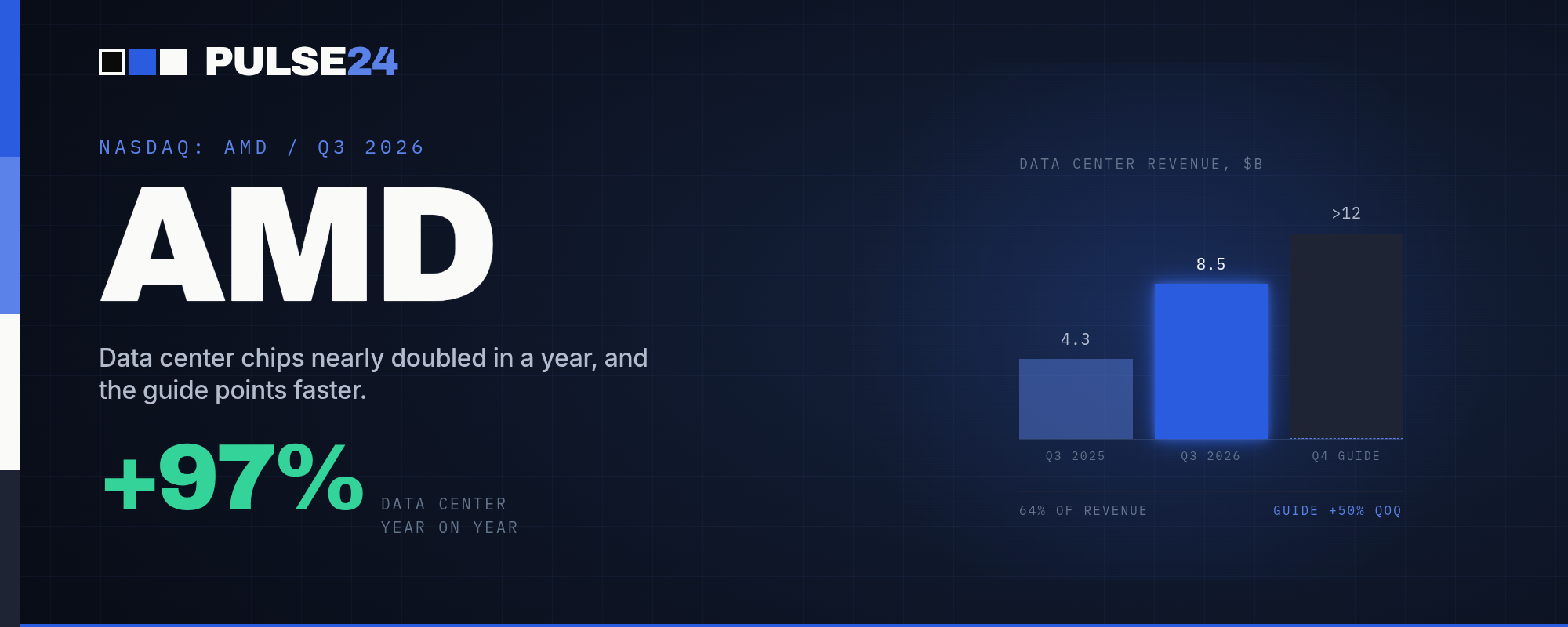
AMD's data center chips brought in $8.5 billion last quarter, up 97% from a year ago, and the company is guiding to an even faster sequential jump next quarter. The AI chip market now has a credible second supplier at scale, not just Nvidia.
AMD's data center chip business brought in $8.5 billion last quarter. A year earlier, the same business brought in $4.3 billion. Revenue in that one segment nearly doubled in twelve months, and nothing else at the company grew anywhere close to that pace.
The report landed Tuesday afternoon, one trading day after the semiconductor sector logged its worst session in months on Oracle's debt filing and Marvell's acquisition spree. The numbers AMD put up told a different story about AI chip demand than Monday's selloff implied.
What Changed
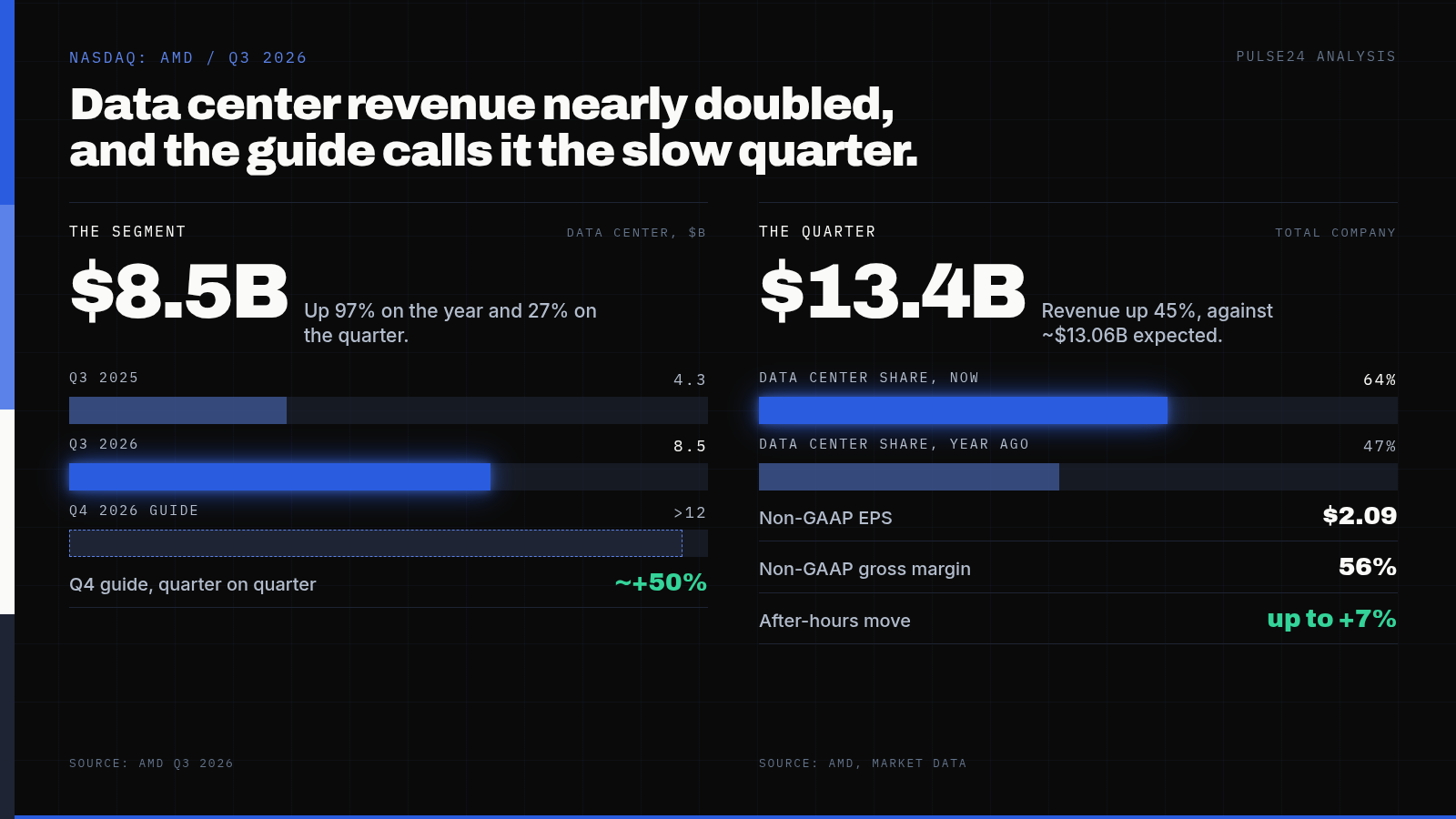
Total revenue for the third quarter came in at $13.4 billion, up 45% from a year earlier and above the roughly $13.06 billion analysts had modeled. Data center revenue did the heavy lifting: $8.546 billion, up 97% year-over-year and up 27% from the second quarter. That segment now accounts for 64% of AMD's total revenue, versus 47% a year ago. Client and gaming, the PC and console chip business, stayed a far smaller and slower-growing slice of the pie by comparison.
Profitability moved in the same direction. Non-GAAP gross margin expanded to 56%, up two percentage points from the 54% AMD posted in the same quarter last year. GAAP gross margin rose the same two points, to 54% from 52%. Non-GAAP earnings per share reached $2.09, up 74% year-over-year, while GAAP EPS hit $1.46, up 95%, a figure that includes a $1.1 billion non-cash charge tied to warrants AMD issued as part of its chip supply agreement with OpenAI.
The guidance is where the quarter turns from strong to unusual. AMD told investors to expect fourth-quarter revenue of about $17 billion, plus or minus 3%, implying roughly 66% year-over-year growth. Inside that number, data center revenue is guided up about 50% sequentially, which would put the segment above $12 billion on its own. Data center revenue grew 27% sequentially from the second quarter to the third. A 50% sequential jump would mean the business is accelerating, not simply continuing a trend, right as it crosses the $8 billion mark.
CEO Lisa Su extended that framing out to next year, telling analysts the company now expects total revenue growth above 80% in 2027, with server chip revenue roughly doubling and data center products making up more than 80% of AMD's business by then. Those are targets, not results, and AMD's own track record on multi-year AI forecasts is still being written. They match the direction every other number in this report pointed, though.
Why It Matters
Nvidia still dominates the market for AI training and inference chips, commanding premium pricing on hardware that remains supply-constrained. AMD's quarter shows that hyperscalers and cloud providers are willing to split orders across more than one supplier once a credible alternative exists at scale. AMD's MI300 series, built to compete with Nvidia's H100 and H200 chips, appears to be winning design slots at major cloud and enterprise customers rather than simply picking up overflow demand Nvidia couldn't fill. That matters for margins across the entire AI hardware chain, not only for AMD's stock price.
It also lands at an awkward moment for the market's broader AI narrative. Strip the handful of AI-linked names out of the S&P 500 and the index is up 5% since earnings season began; leave them in and it's down 3%, a gap that has strategists split on whether the AI trade is a genuine earnings story or a concentration risk waiting to unwind. AMD's print argues for the earnings side of that debate. This was real revenue, at expanding margins, not a vendor-financing arrangement dressed up as a sale.
The chip-level health also cuts against a separate worry building around the companies that rent out AI computing capacity rather than make the chips themselves. Up to 30% of America's AI data centers are now owned by private equity, and the debt behind them has started to show stress, while neocloud operators have swung sharply on financing worries without missing an earnings number. AMD sits a layer above that fight. Whoever wins the scramble for data center capacity still needs chips, and this quarter suggests AMD is picking up a bigger share of that spending regardless of which cloud operator ends up footing the bill.
There's a memory angle too. Data center GPU shipments at this volume lean hard on high-bandwidth memory, and South Korea's chip exports jumped 259% in October on exactly that kind of demand, even as Samsung and SK Hynix shares whipsawed through the month. AMD's guidance implies that demand isn't slowing down heading into 2027.
What to Watch Next
The next real test is whether AMD actually delivers that 50% sequential jump in data center revenue when it reports fourth-quarter results in early 2027. Guidance ranges get missed, and a company guiding to an acceleration off an already-record quarter has more room to disappoint than one guiding to a steady climb. Nvidia's next earnings report is also worth watching, for a read on whether AMD's gains are coming from a genuinely larger AI chip market or from share AMD is taking directly from its larger rival. The two stories carry very different implications for margins across the sector.
Also worth tracking: which hyperscalers are actually driving AMD's order book. The company has pointed to multi-year commitments from large cloud providers but hasn't broken out customer concentration the way some of its AI infrastructure customers have had to under investor pressure. If one or two customers account for an outsized share of that data center growth, the durability question shifts from AI demand broadly to the health of a small number of massive capex budgets.
The Pulse24 Take
One earnings beat doesn't resolve whether AI infrastructure spending is a durable multi-year buildout or a bubble inflating on circular financing arrangements between a handful of companies. What it does show is that there's more than one way to make money from that buildout, and AMD just posted some of the clearest evidence yet that it's one of them. Revenue nearly doubling at expanding margins is a different kind of story than the debt-funded data center buildouts and still-unsigned contracts showing up elsewhere in the AI trade. The skeptical read is still worth holding onto: guidance for a 50% sequential jump off a record quarter is a big ask, and AMD's own history includes quarters where the following number landed short of the story management told. The optimistic read is that a second credible supplier at AMD's scale makes the AI capex story less fragile, not more, because it spreads the bet across more balance sheets than Nvidia's alone. Where this settles probably depends less on AMD's next slide deck than on whether the hyperscalers actually spend the capex budgets they've already promised.
How we read the data
Curious how we get from raw data to a take like this? Our Trader's Toolkit walks through the tools we lean on.
Explore the Toolkit