Pulse24 Original
The Semiconductor ETF Fell 3.8% Monday. Oracle's $20 Billion Debt Filing and Marvell's $115 Billion Deal Both Added to the Selloff.
November 3, 2026
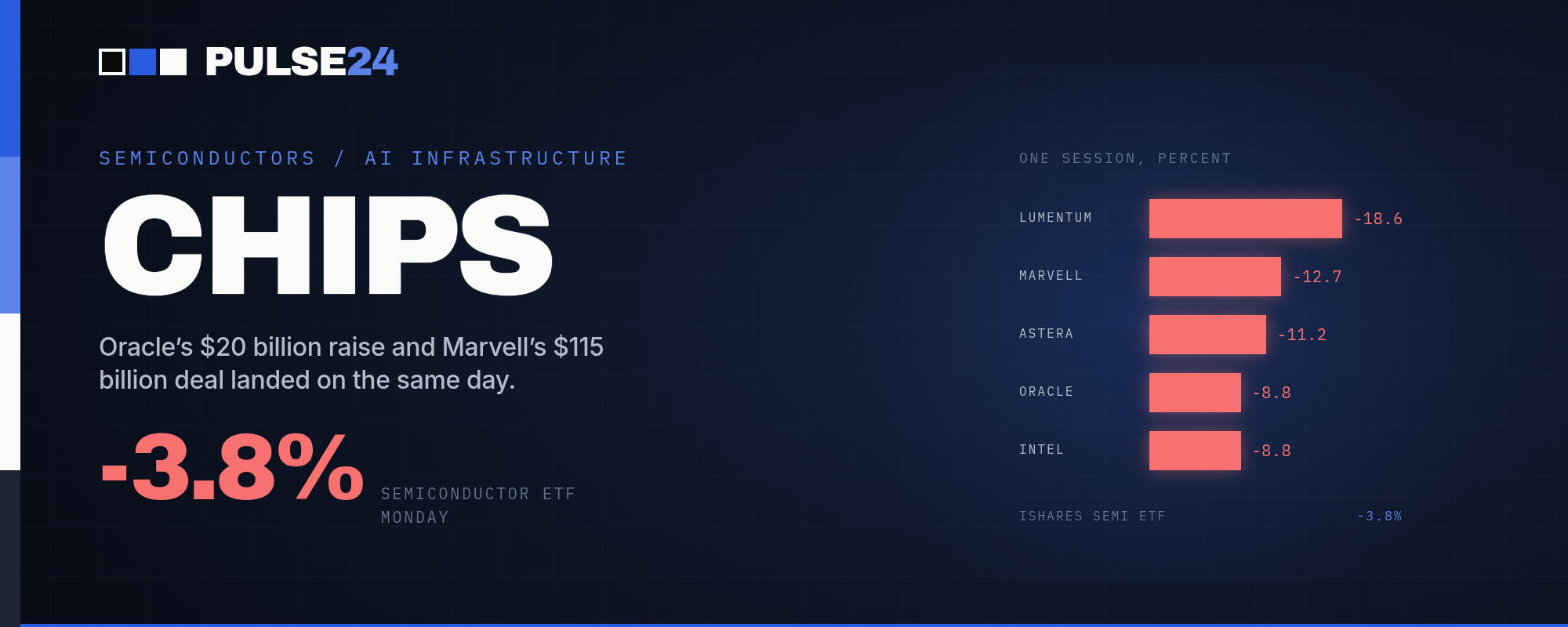
Oracle filed to raise $20 billion in new stock and bonds for its AI buildout the same day Marvell agreed to buy optical-chip maker Lumentum for $115 billion in an all-stock deal. The semiconductor sector's benchmark ETF fell 3.8%, with Oracle, Marvell, Intel, AMD and CoreWeave all down at least 5%.
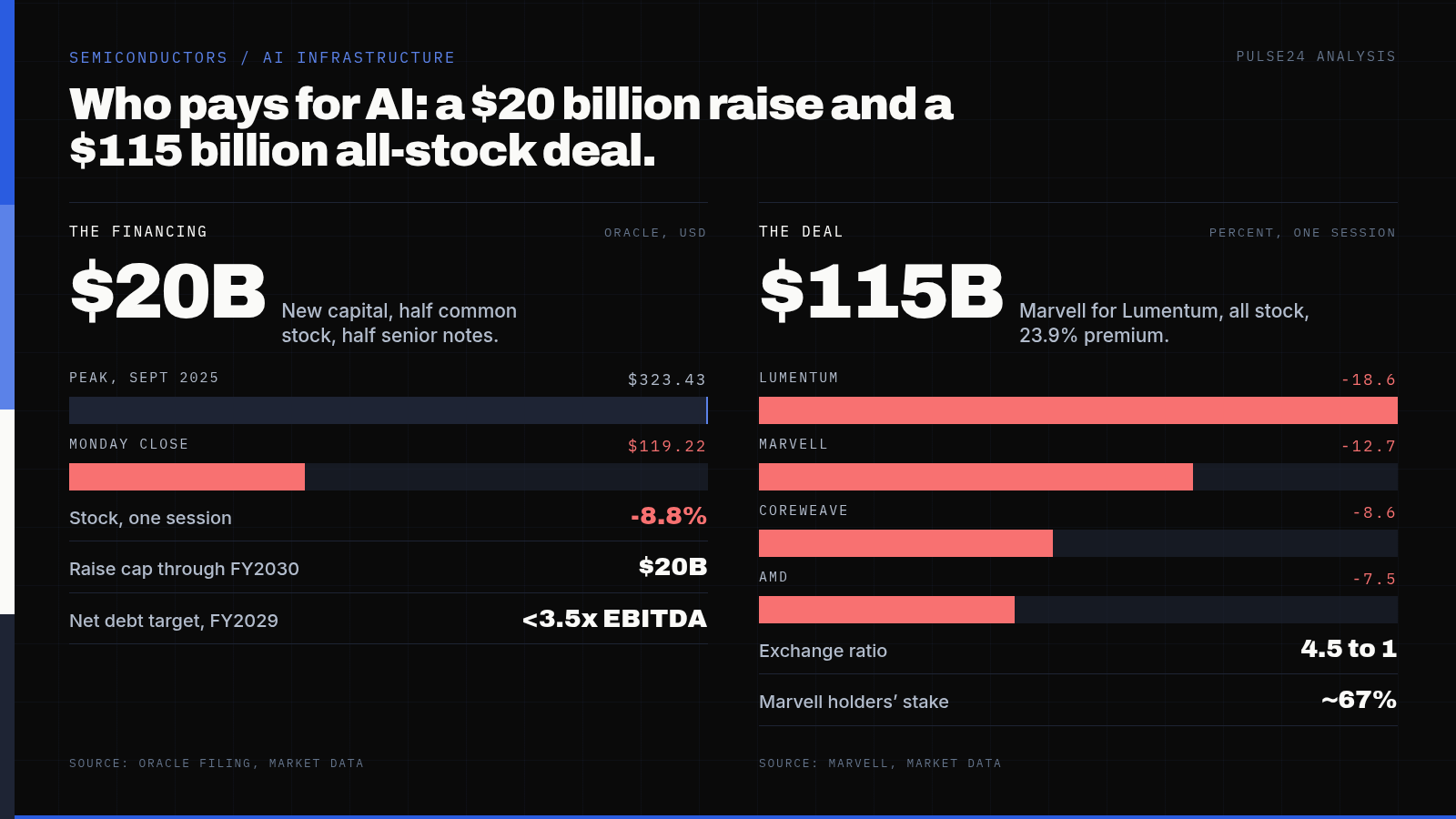
Oracle's stock closed Monday at $119.22, more than 60% below the $323.43 high it hit in September 2025. The company spent that same trading day filing paperwork to raise another $20 billion, split evenly between new common stock and senior notes, to keep funding the AI data centers at the center of its growth story.
A few hours earlier, Marvell Technology put a different number on the table. The chipmaker agreed to buy optical-components maker Lumentum for $115 billion in an all-stock deal, the largest acquisition in Marvell's history and more than ten times the size of its 2021 purchase of Inphi. Both stocks fell anyway. Marvell dropped about 12.7% to $171.41, and Lumentum, the company being bought at a premium, still fell roughly 18.6% to $684.40.
What Changed
The two announcements aren't connected on paper, but they landed on the same trading day and pointed at the same underlying question: who pays for the AI buildout, and on what terms. Oracle's filing covers $10 billion in common stock and $10 billion in senior notes, with proceeds earmarked for general corporate purposes, including capital expenditures and debt repayment. It follows an October 28 investor day where Oracle capped its additional capital raises through fiscal 2030 at $20 billion and set a target for net debt to fall below 3.5 times adjusted EBITDA by fiscal 2029.
Marvell's deal works differently. It's a fixed exchange ratio, not a cash purchase: Lumentum shareholders get 4.5 Marvell shares for every Lumentum share they hold, a headline value of about $1,132 a share and a 23.9% premium to where Lumentum traded before the talks were first reported. Because the exchange ratio is fixed rather than the dollar value, Marvell's own decline after the announcement mechanically shrank the real value of that offer, a dynamic that's kept merger-arbitrage desks active on both sides of the trade through a deal that isn't expected to close until the first half of 2028.
The logic behind the price, as Marvell has laid it out, comes down to supply. Lumentum's optical components, the parts that move data between AI chips at the speeds modern data centers now need, are reportedly sold out well into the future, and the indium phosphide laser fabs that produce them take years to build from scratch. Marvell is also pointing to more than $1 billion in expected annual run-rate cost savings, and Lumentum CEO Michael Hurlston will join Marvell's board along with two other Lumentum directors once the deal closes. Lumentum actually beat earnings estimates the same day, reporting revenue of $1.26 billion, more than double the $533.8 million it posted a year earlier. The market priced in the acquisition terms over the earnings beat regardless.
Why It Matters
Both stories reduce to the same concern that's been building across AI infrastructure all year: financing is getting more expensive and more creative at the same time demand keeps climbing. Pulse24 has tracked this shift since private equity quietly took on roughly 30% of America's data-center capacity, much of it funded with debt that's grown pricier as the year has worn on. Oracle choosing a stock-and-bond mix instead of debt alone fits that pattern. So does a company the size of Marvell deciding the surest way to lock down scarce optical supply is to hand over a huge block of its own stock rather than pay cash.
The rest of Monday's chip selloff tells a similar story from a different angle. Intel fell 8.8%, AMD fell 7.5%, CoreWeave fell 8.6%, Astera Labs fell 11.2% and Micron fell 5.8%, dragging the iShares Semiconductor ETF down 3.8% on a day with no single piece of bad news about AI demand itself. Intel's drop extends a rough stretch; the stock had already suffered a record 29% single-day collapse last month on worries tied to Fed policy. CoreWeave's cost of capital has already been a warning sign too this year: the company had to borrow at 15% interest while Meta funded similar spending by selling $95 billion in stock. Monday's moves look like investors repricing the entire sector's financing risk at once, not one company getting punished for its own numbers.
None of this proves AI spending has stopped growing. Lumentum's revenue more than doubled and still beat estimates. Oracle reaffirmed its fiscal 2027 revenue guidance of at least $90 billion. What's shifted is how skeptically the market now reads every new financing announcement, treating a capital raise or an all-stock acquisition as a signal about balance-sheet strain rather than routine corporate housekeeping.
What to Watch Next
Three things will say more than Monday's price action alone. First, how Oracle's bonds actually price when they go out the door: a wider spread over Treasuries than the market expects would confirm lenders are demanding more for AI-infrastructure risk than they were a few months ago. Second, whether merger-arbitrage funds keep shorting Marvell against long Lumentum positions through the deal's roughly 18-month runway to a first-half-2028 close, a trade that could keep pressuring both stocks regardless of how the underlying businesses perform. Third, whether other optical and networking names, Ciena and Coherent among them, face similar consolidation pressure now that Marvell has shown the market will tolerate a scarcity-driven acquisition even at a rich premium.
Oracle's next earnings report, scheduled for December 14, will be the clearer test of the bigger picture. Scotiabank and Wells Fargo both trimmed their price targets on Oracle the week before this filing while keeping bullish ratings, which suggests Wall Street still believes in the growth story even as it questions how that growth gets funded. That split is likely to keep driving swings like Monday's for months: markets rewarding AI's revenue curve while punishing its balance sheet in the same session.
The Pulse24 Take
Nothing that happened Monday really questions whether AI compute demand is real. Lumentum's production is reportedly sold out years into the future. Oracle reaffirmed revenue guidance it says it's already on track to hit. Both facts point to a sector still growing into genuinely enormous demand. The stocks fell anyway because of how that growth gets paid for, and that's a separate question from whether the growth itself is in doubt.
That distinction is worth holding onto, because most AI coverage collapses two very different risks into one story. The first is that the technology never pays off, that all this compute gets built and nobody ends up willing to pay enough to use it. The second, narrower risk is that even a technology with real demand behind it gets financed badly along the way, with too much debt stacked at the wrong moment or too much dilution handed out at the wrong price. Monday's selloff was almost entirely about the second risk.
The companies raising this money don't appear worried about it. Oracle capped its own future raises and set a leverage target. Marvell structured an all-stock deal specifically to avoid straining its balance sheet with cash. The market's reaction suggests investors want to watch those promises actually get kept, quarter by quarter, before they stop flinching every time a new filing lands.
How we read the data
Curious how we get from raw data to a take like this? Our Trader's Toolkit walks through the tools we lean on.
Explore the Toolkit