Pulse24 Original
South Korea's Chip Exports Jumped 259% in October. Samsung and SK Hynix Spent the Month Whipsawing Anyway.
November 2, 2026
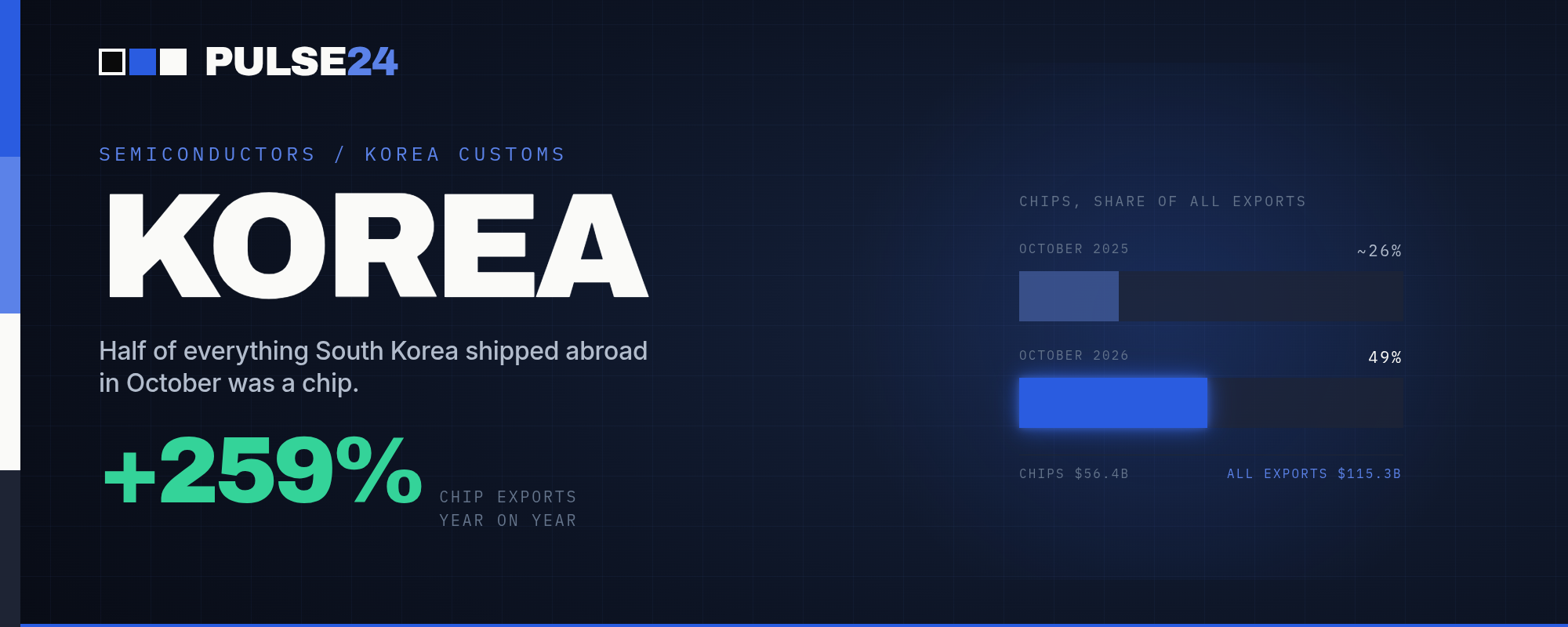
South Korea's October exports hit a record $115.3 billion, with semiconductors alone up 259% from a year ago and now half of everything the country sells abroad. The stocks behind that number fell sharply twice this month before bouncing back Monday, and the swings say as much about how markets are pricing the AI boom as the export data does.
South Korea sold $115.3 billion worth of goods to the rest of the world in October, a record for any single month and 93.7% more than a year earlier. Semiconductors made up $56.4 billion of that figure on their own, a 259.4% jump from last October. Half of everything the country shipped out last month was a chip.
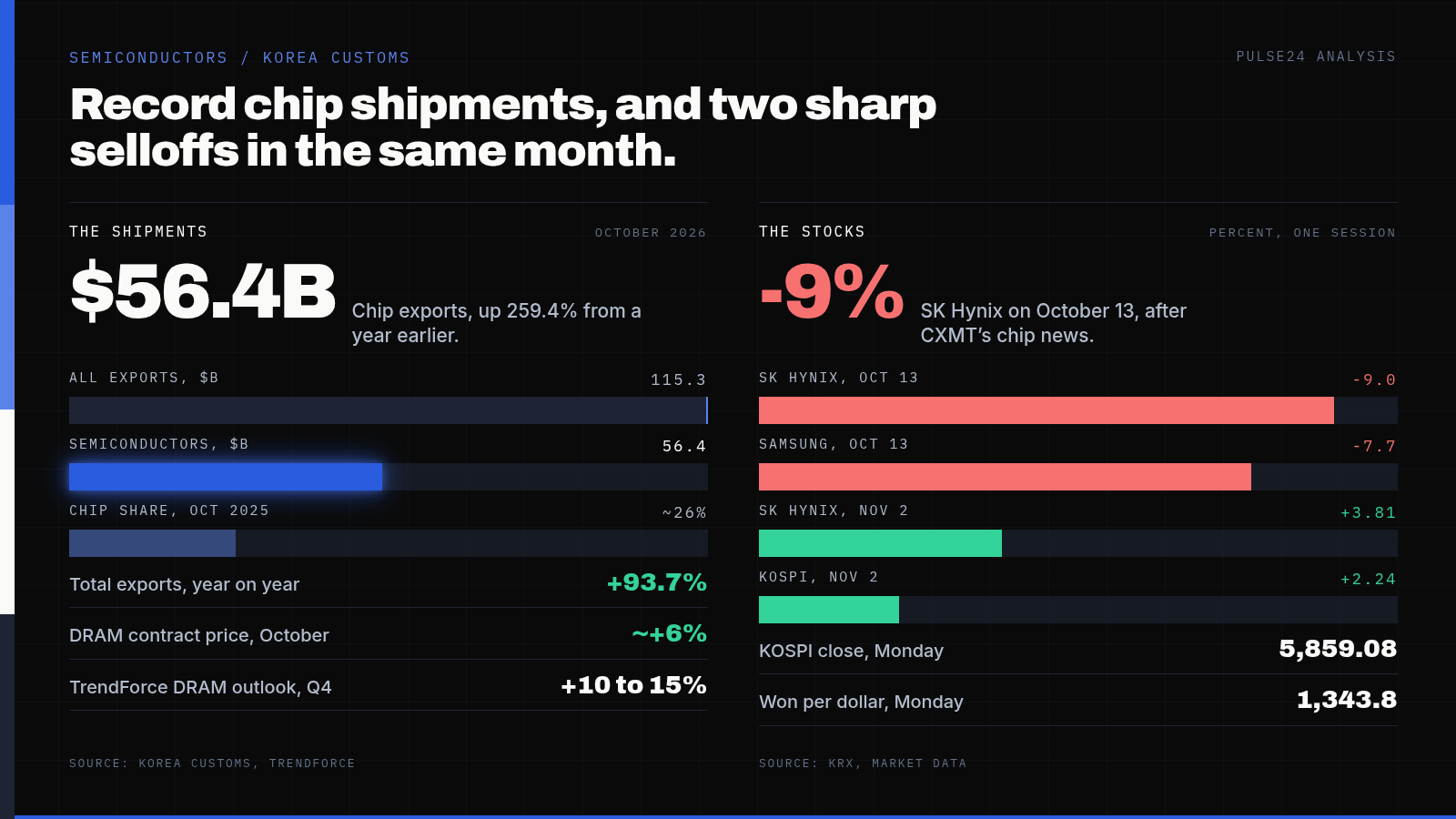
That's the real-economy half of the story. The market half looks nothing like it. Samsung and SK Hynix, the two companies responsible for most of that export surge, spent much of the past month sliding before Monday's bounce, building on the slide Pulse24 covered during their earnings week. Shares of both companies fell again on October 13, with SK Hynix down about 9% and Samsung down 7.7% in a single Seoul session, after Chinese memory maker CXMT said it had made progress on a competing chip design. Samsung and SK Hynix Shed $753 Billion in a Month. This Week's Earnings Decide Who Was Right.
Why It Matters
Korea's export data is about as close to a real-time read on global AI infrastructure demand as any economic release gets. Samsung, SK Hynix, and Micron together control roughly 88% of global DRAM supply by revenue, and Korea's customs data effectively tracks how much of that memory is actually shipping, not how much Wall Street thinks a chipmaker's quarter will look like three months from now. The gap between those two signals, strong shipment data and shaky stock prices, is the story.
Memory prices back up the shipment numbers. A general-purpose DRAM chip's contract price rose nearly 6% in October alone, and TrendForce expects broader DRAM contract prices to climb another 10% to 15% in the fourth quarter on top of that. That lines up with the DRAM shortage Pulse24 covered last week, when NAND flash prices broke a 21-month stretch of gains. DRAM Prices Hit an All-Time High in October. NAND's 21-Month Rally Finally Broke.
So why did the stocks fall anyway, twice? The October 13 drop traces to a specific competitive threat. CXMT's announcement put a dent in the assumption that Samsung, SK Hynix, and Micron have years of breathing room before Chinese memory makers catch up. The October 30 drop was broader and less specific to Korea. It landed the same day Intel fell 29% and the Nasdaq had its worst session since June, part of a wider reassessment of whether AI infrastructure spending is translating into profit on the timeline investors had priced in. Nasdaq Fell 2.9% Friday, Its Worst Session Since June. The 10-Year Yield Fell Too, Even With a December Hike Still Priced In.
Monday's bounce suggests at least some of that selling was overdone. The KOSPI closed up 2.24% at 5,859.08, Samsung rose 1.78% to 229,000 won, and SK Hynix rose 3.81% to 1,472,000 won, with traders pointing to the export data itself as validation that chip demand remains real. The Korean won, meanwhile, closed at 1,343.8 per dollar, slightly weaker on the session, a sign capital hasn't fully returned even as local equities recover.
What to Watch Next
Three things will decide whether October's export strength or October's stock volatility turns out to be the more honest signal. First, whether CXMT's progress is a real near-term threat to the DRAM oligopoly or a longer-term story that got priced in a month or two too early; Chinese memory makers have talked about closing the gap before without doing it on schedule. Second, whether the ministry's projection of a $1 trillion annual export milestone, which would require November to extend October's pace, actually holds once Q4 AI capex plans from the hyperscalers buying this memory become clearer. Third, whether contract memory prices keep climbing the way TrendForce expects or start to roll over, since that pricing is the cleanest tell on whether the shortage is structural or cyclical.
The Pulse24 Take
The temptation with a headline like "chip exports up 259%" is to treat it as unambiguously bullish and move on. The stock market's own behavior this month argues against that read. Record shipment data and a sharp round-trip in Samsung and SK Hynix shares can both be true at once, because they're answering different questions. The export number says demand for memory chips is real right now. The stock price says investors are still arguing about whether that demand, and the capital spending behind it, will still look rational two or three years out. Both arguments have evidence behind them, which is exactly why the volatility hasn't settled down. Readers watching the AI trade for signs of a peak should weigh financing terms and competitive threats like CXMT's more heavily than any single month of export data, strong as this one looks.
How we read the data
Curious how we get from raw data to a take like this? Our Trader's Toolkit walks through the tools we lean on.
Explore the Toolkit