Pulse24 Original
DRAM Prices Hit an All-Time High in October. NAND's 21-Month Rally Finally Broke.
October 31, 2026
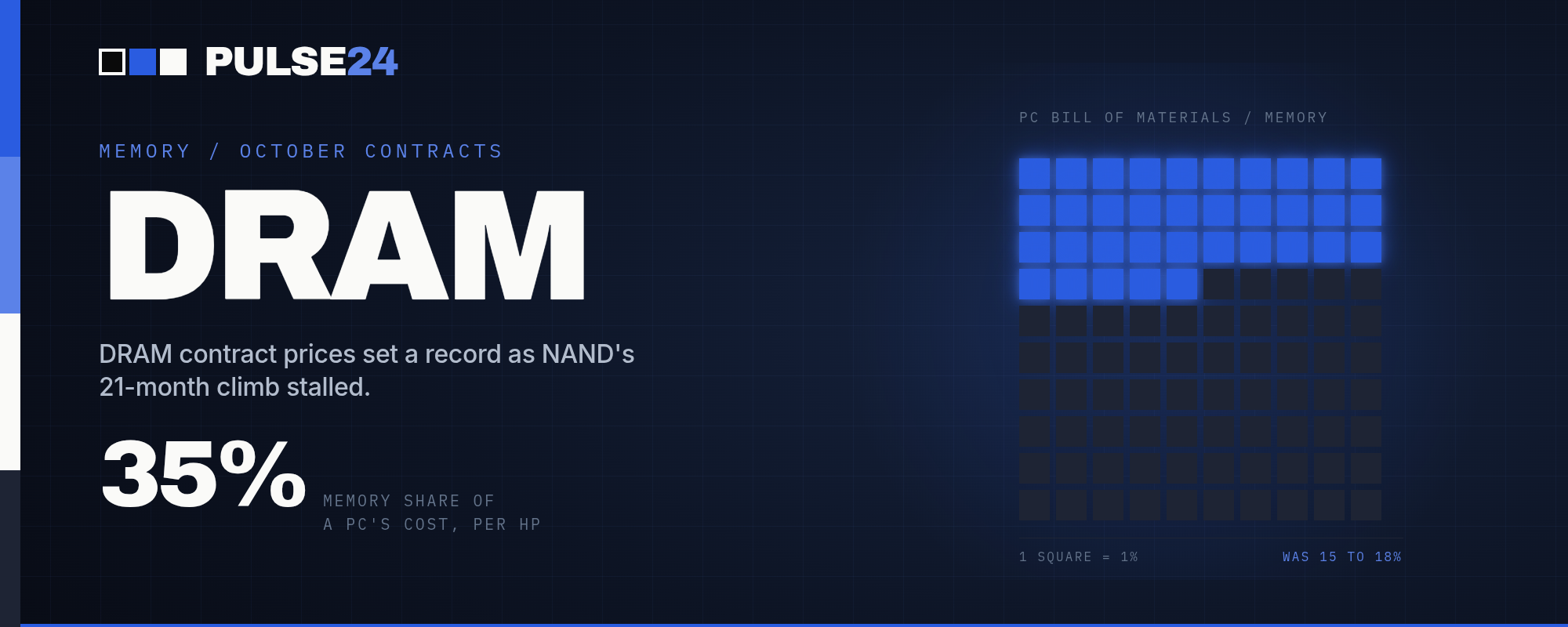
DRAM contract prices set a fresh record in October while NAND prices stalled for the first time in 21 months, with the fallout already showing up in PC pricing, Apple's margins, and the earnings of Samsung and Micron. The split traces back to one cause: AI servers are absorbing the memory capacity consumer electronics used to get first.
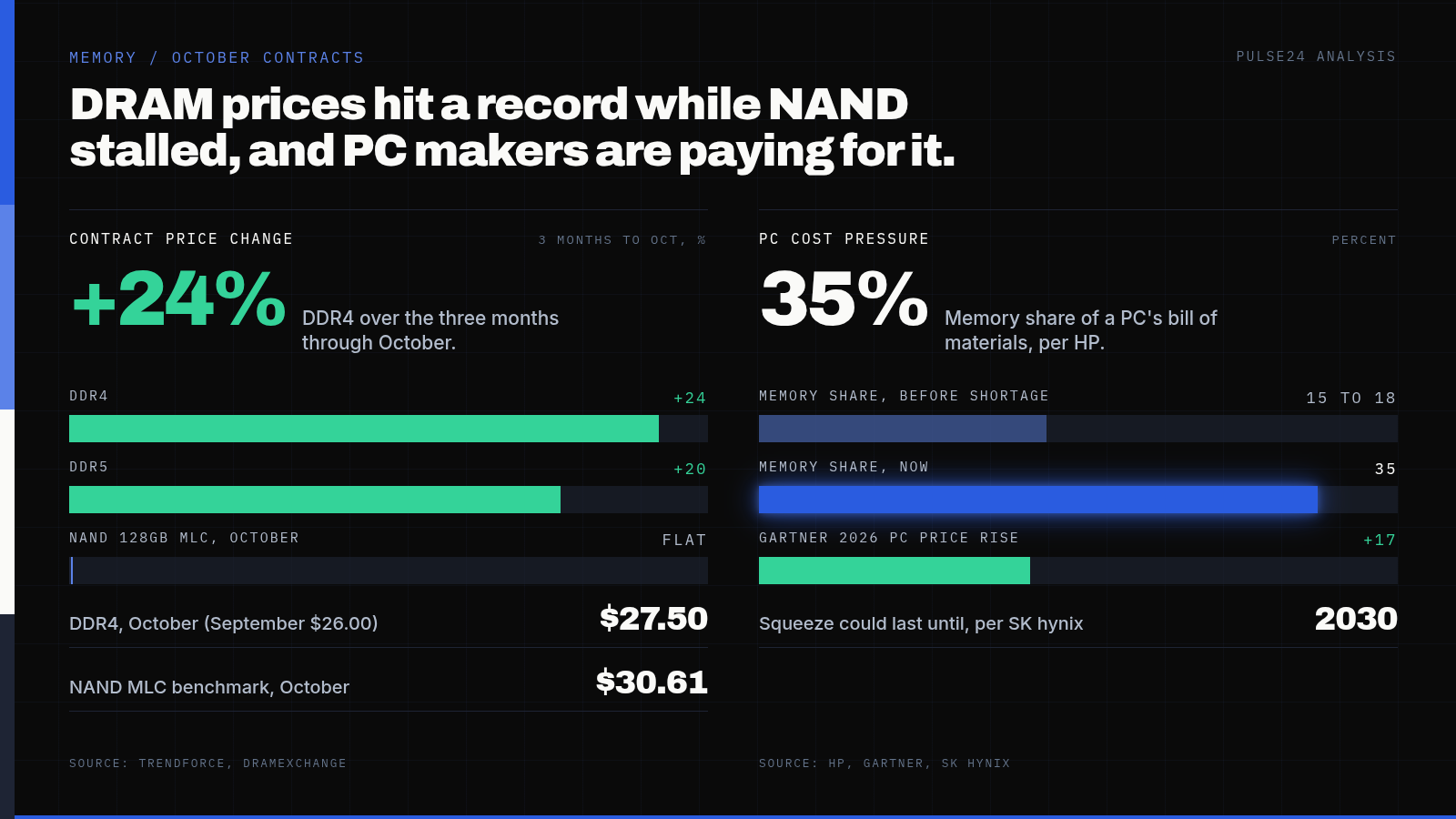
A gigabyte of DDR4 memory cost $27.50 in October, up from $26 in September. That is an all-time high for DRAM contract pricing, according to data TrendForce and DRAMeXchange reported on October 30. NAND flash, the other half of the memory market, did something it hasn't done in 21 months: it stopped climbing. The 128Gb MLC NAND benchmark held flat at $30.61 last month.
What Changed
DRAM and NAND have moved together for most of the past two years, both squeezed by the same AI buildout. October broke that pattern. Contract prices for DDR4 rose 4% month over month and 24% over the past three months, outpacing DDR5's 20% gain over the same stretch, per Barclays. DDR5 spot prices jumped 8% in October alone. NAND, by contrast, went nowhere. TrendForce attributes the split to one word: allocation. Suppliers are steering their best capacity toward AI servers, where margins run far higher than on consumer parts, and DRAM capacity is harder to redirect quickly than NAND capacity. Earlier this year the divergence wasn't even close. TrendForce data cited by SoftwareSeni put conventional DRAM contract increases at 90% to 95% quarter over quarter back in the first quarter of 2026. The latest quarter looks tame by comparison, but the direction hasn't changed.
Why NAND stalled is its own story. Buyers who stocked up earlier in the year are sitting on inventory. PC makers are trimming configurations to manage cost, and retailers say they've run out of room to pass along further increases. TrendForce's own framing captures the split well: AI demand is offsetting weak consumer demand, not adding to it. Whether that's a genuine pause or just one month of inventory digestion at module makers is still an open question.
Why It Matters
This is where an obscure component spec becomes a consumer price story. HP says memory now makes up 35% of a PC's bill of materials, up from 15% to 18% before the shortage took hold. Gartner is forecasting PC prices will rise 17% in 2026 versus 2025, with combined DRAM and SSD costs up 130% by year end. Lenovo, Dell, HP, Acer, and Asus have all signaled price increases in the 15% to 20% range. Apple raised prices back in June, and its shares fell more than 6% that day, a reminder that memory costs are no longer a rounding error on a product margin line.
The earnings calendar backs this up. Micron's outsized share of S&P 500 earnings growth this year traces directly to this dynamic: when a company's product suddenly commands AI-server pricing instead of commodity PC pricing, its margins move in a hurry. Micron, Samsung, and SK hynix have reportedly sold out their 2026 HBM capacity to AI customers already, which is part of why Samsung's quarterly profit jumped 783% even as global PC shipments fell 21%. The same mechanism that's inflating a laptop's bill of materials is inflating a chipmaker's income statement.
It isn't only a Korean and American story. China's chip exports told a similar tale by value rather than volume: export volumes barely moved while the dollar value of what shipped jumped, because the memory embedded in those exports got more expensive, not because more of it moved. Nvidia's own finance chief, Colette Kress, has said memory price increases already exceed what the company had budgeted for, and that they could climb further next year. When the company buying the most AI silicon on earth is surprised by memory costs, it's a reasonable bet that smaller buyers further down the chain are too.
What To Watch Next
Citi's most recent memory model, published in September, projects the DRAM supply deficit widening to 9.7% in 2028 from 8.7% in 2027, with the broader imbalance persisting through 2031 and the HBM shortfall reaching 36% by 2028. NAND's gap is projected to narrow slightly, to 5.5% in 2028 from 6.1% in 2027, as Chinese entrants CXMT and YMTC add capacity. Citi has separately forecast that quarter-over-quarter price increases will decelerate and peak around the second quarter of 2027, with DRAM and NAND prices actually dipping in the second half of that year, even as the underlying physical shortage runs on for years afterward. The memory makers themselves sound less optimistic than that pricing model implies. Micron's CEO, Sanjay Mehrotra, told investors on the company's latest earnings call that 2027 and 2028 will both be tighter than 2026, and that Micron has no line of sight yet to when supply and demand return to balance. Samsung has told customers to expect tightness through 2028. SK hynix, the most cautious of the three, has said the squeeze could last until 2030. Reports that Samsung and SK hynix may cut PC-grade DRAM output by 20% to 40% in 2027, to free up capacity for AI customers, remain unconfirmed but would extend the consumer-side pain if they happen. Micron's $9.3 billion fab in Hiroshima, which broke ground in July, isn't expected to be complete until late 2028, which tells you how long the industry itself expects this to run. Watch Samsung and SK hynix's next earnings for commentary on 2027 capacity allocation, and watch whether NAND's October pause holds into November or turns out to be a one-month blip.
The Pulse24 Take
Every AI capex story eventually shows up somewhere else in the economy, and this is where it's showing up now: in the bill of materials for a laptop that has nothing to do with artificial intelligence. The 2017-2018 DRAM spike and the 2021 chip shortage were both demand shocks that eventually faded on their own. This one looks different because the demand pulling memory away from consumers isn't cyclical. Data centers training and running AI models aren't going to suddenly need less RDIMM capacity next quarter, and chipmakers have made the economically obvious choice to sell their best supply to whoever pays the most for it. De-speccing, the industry's term for designing around the shortage by using less memory per device, buys time without changing the underlying math. For investors, the read-through is that memory makers now sit closer to the AI trade than the PC cycle, which is exactly why Samsung's profit and the Nasdaq's AI basket have started moving on the same headlines. For anyone buying a laptop or a phone this holiday season, the read-through is simpler: the discount you were expecting probably isn't coming, at least not before 2027.
How we read the data
Curious how we get from raw data to a take like this? Our Trader's Toolkit walks through the tools we lean on.
Explore the Toolkit