Pulse24 Original
Global PC Shipments Fell 21% Last Quarter. Samsung's Profit Jumped 783% in the Same Three Months.
October 25, 2026
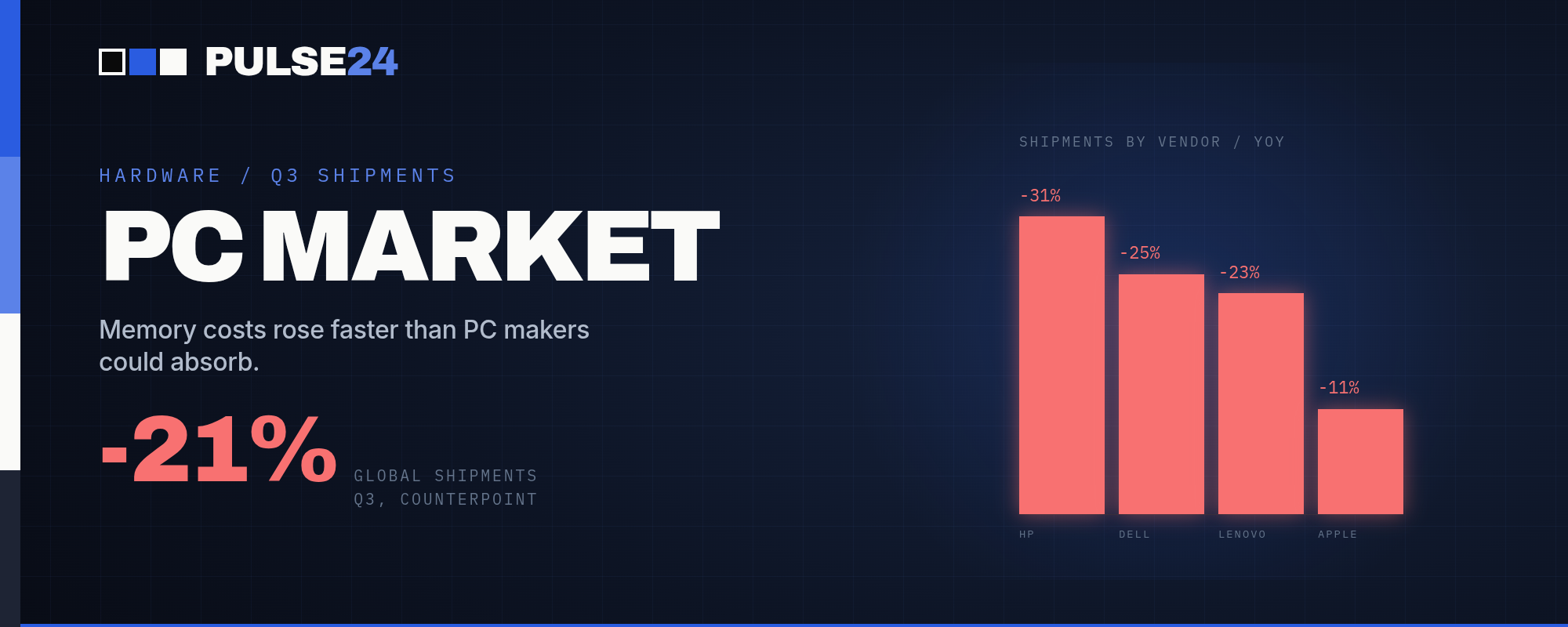
Global PC shipments fell 21% last quarter as memory costs squeezed every major manufacturer, the same three months Samsung's consolidated profit jumped 783% on the strength of its chip business. The gap between those two numbers says less about computers and more about where the world's memory supply is actually going.
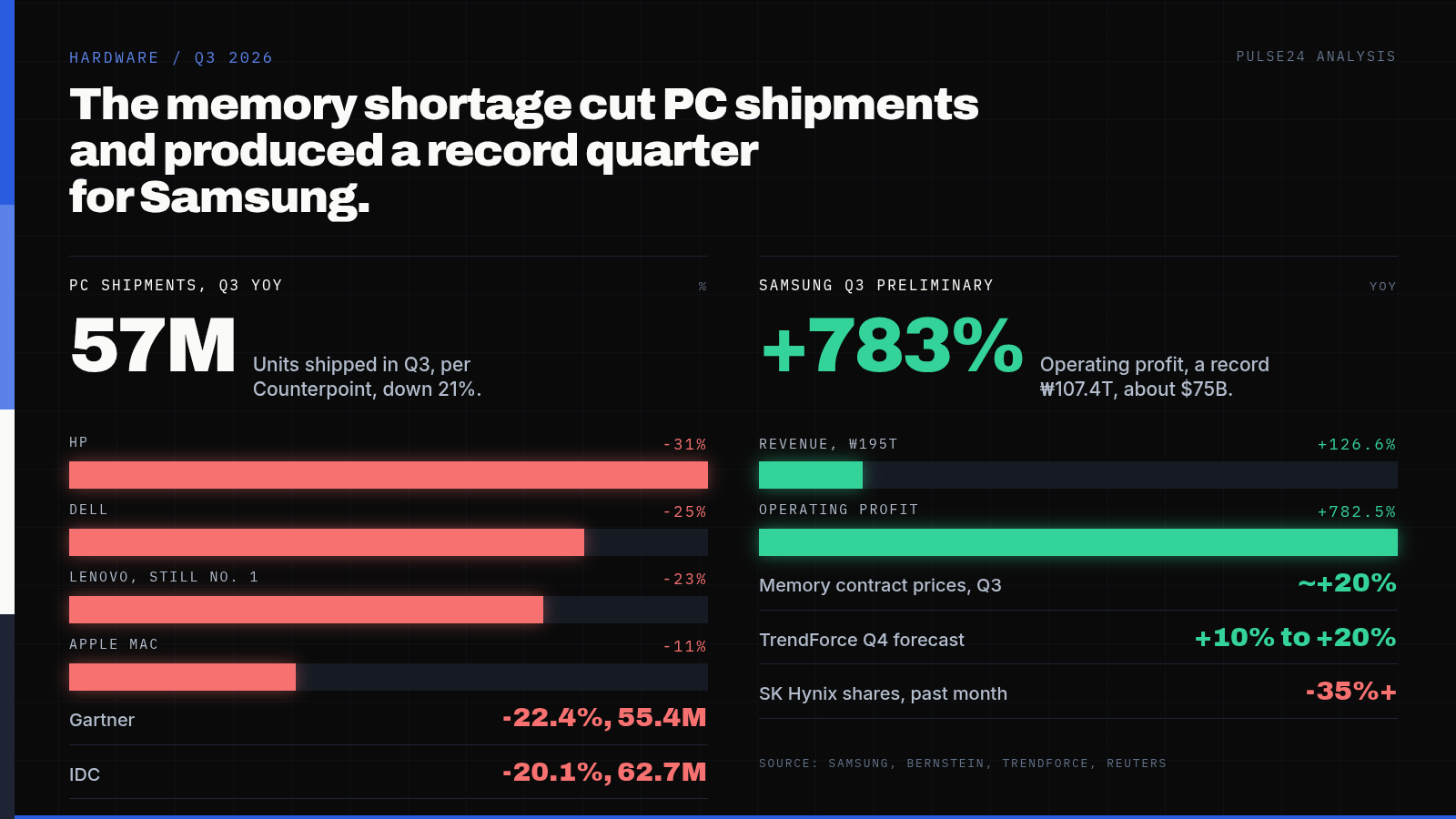
Fifty-seven million personal computers shipped worldwide in the third quarter. That's the preliminary count from Counterpoint Research, released October 22, and it works out to a 21% drop from the same quarter last year, the steepest decline the firm has logged since the pandemic-era buying boom unwound. Gartner put the decline at 22.4%, to 55.4 million units. IDC measured 20.1%, to 62.7 million. The three trackers rarely agree on exact figures, but they agree on the reason: memory chips got too expensive, too quickly, for PC makers to absorb quietly.
Weeks earlier, Samsung told a very different story. The company's preliminary third-quarter results, released October 8, showed consolidated operating profit surging 782.5% from a year ago to a record 107.4 trillion won, roughly $75 billion, on revenue that jumped 126.6% to 195 trillion won. Chips did most of the work. Nvidia's ramp of its Vera Rubin AI accelerators pulled Samsung's newest HBM4 memory into meaningful production for the first time, and the company's HBM bit shipments rose nearly 50% from the prior quarter, according to Reuters. Ordinary DRAM prices climbed sharply too, even though the volume Samsung actually shipped barely moved.
Read together, the two numbers describe one shortage from opposite ends. AI data centers are pulling memory chips toward themselves at a pace the industry wasn't built for, and everything else waiting on the same silicon, laptops, phones, the graphics cards that don't go into a hyperscaler's rack, is getting squeezed.
What's Driving The Shortage
TrendForce and Bernstein have been tracking the same pattern from the pricing side. Bernstein's analysts found that memory chip contract prices across both DRAM and NAND rose nearly 20% in the third quarter alone, and they expect another round of increases in the fourth quarter, with the shortage extending into 2027. TrendForce's own forecast for the current quarter calls for DRAM contract prices to climb another 10% to 15% and NAND to climb 15% to 20%. These aren't one-time jumps. They mark roughly the fourth or fifth consecutive quarter of increases, depending on the product category.
PC makers are absorbing the squeeze first, because they can't match a hyperscaler's order size or its willingness to sign multi-year supply contracts at any price. Counterpoint's own vendor breakdown shows HP's shipments fell 31% in the quarter, the steepest drop among the major vendors, to 10.3 million units. Dell's shipments dropped 25% to 7.6 million, even as its backlog of AI server orders climbed to $95 billion, a reminder that Dell's server business and its PC business are now competing with each other for the same memory. Lenovo held onto the top spot despite a 23% decline, shipping 15 million units. Apple was the exception: Mac shipments fell just 11%, and its market share actually rose, from 8.7% to 9.8%, helped by the cheaper MacBook Neo. The memory standard behind Samsung's HBM4 ramp is the same one Pulse24 broke down earlier this year, and it sits at the center of this particular shortage.
Why It Matters
Record profits and falling stocks aren't supposed to coexist, yet that's roughly where memory chip companies sit right now. Micron, SK Hynix, Samsung and SanDisk have all traded down by roughly a third from where they peaked last July, even as each has reported some of the best margins in the industry's history. Micron's most recent quarter came in with an 86.8% gross margin and an 80.7% operating margin, numbers closer to a software company than a chip maker, and the stock still trades at a forward price-to-earnings ratio near 5.
The gap comes down to how long investors think the shortage lasts. Part of the selloff traces back to July, when China's CXMT, a domestic memory chipmaker, surged in its stock market debut and raised fears that Chinese supply could eventually undercut Samsung, SK Hynix and Micron on price. Those fears resurfaced this month. SK Hynix shares have fallen more than 35% on the Kospi over the past month alone, and on October 23 it scrapped its plan to list its Solidigm flash storage unit on the Nasdaq. The company said it needed to reassess whether a separate listing still made sense given recent capital market conditions, and some shareholders had argued it would widen the discount the market already applies to a conglomerate's subsidiaries. South Korean regulators had also signaled that split-listing rules would apply to the Nasdaq plan just as they would to a domestic one.
Nvidia's Jensen Huang has made the opposite case. Speaking at the company's GTC conference in Berlin, he said he doesn't expect a memory glut before sometime after 2029, arguing that AI workloads will keep finding new uses for whatever memory is available. It's one more AI-infrastructure name getting the benefit of the doubt from its own chief executive while the market hesitates. CoreWeave fell 24% and Nebius fell 19% earlier this week on no earnings miss at all, and the memory trade is showing a version of the same pattern: strong current results, but a stock price that's betting the good quarter doesn't repeat forever.
What To Watch Next
Samsung's full third-quarter release lands October 29, with the first division-level breakdown of how much of that 107.4 trillion won actually came from chips versus smartphones and displays. SK Hynix and Micron both report their own next quarters within weeks of each other, and each call will test whether the view memory executives have offered, that demand will keep exceeding supply through 2027 and into 2028 with no clear timeline for the market to rebalance, is holding up against a stock market that's pricing in the opposite.
Counterpoint expects PC shipments to fall another 27% year over year in the fourth quarter before flattening out in 2027, so the next read on consumer hardware won't look any better before it looks worse. The more useful signal is whether TrendForce's fourth-quarter price forecast, 10% to 15% higher DRAM and 15% to 20% higher NAND, actually holds. If prices climb roughly in line with that estimate, the shortage story stays intact. If the increases come in smaller than forecast, or if CXMT's ramp starts showing up in actual shipment volumes rather than just stock-market fear, that's the first real evidence the market's skepticism about memory stocks arrived early, not wrong.
The Pulse24 Take
The PC industry and Samsung's chip division just lived through the same quarter in opposite ways, and that's the clearest evidence yet of how completely AI has rearranged where memory chips go. A shortage this severe was always going to show up somewhere as pain, and for now that pain is landing on anyone who isn't building AI infrastructure directly: higher laptop prices, slower PC sales, probably your next phone too. What's strange is that the companies profiting most from the shortage, the memory makers themselves, are the ones Wall Street trusts least to keep profiting from it. That disconnect won't resolve with one earnings call. It resolves whenever investors decide whether 2027 looks more like another record year or the start of the oversupply Jensen Huang insists is still years away.
How we read the data
Curious how we get from raw data to a take like this? Our Trader's Toolkit walks through the tools we lean on.
Explore the Toolkit