Pulse24 Original
What Is HBM? The Memory Chip Reshaping the AI Hardware Shortage, Explained
October 16, 2026
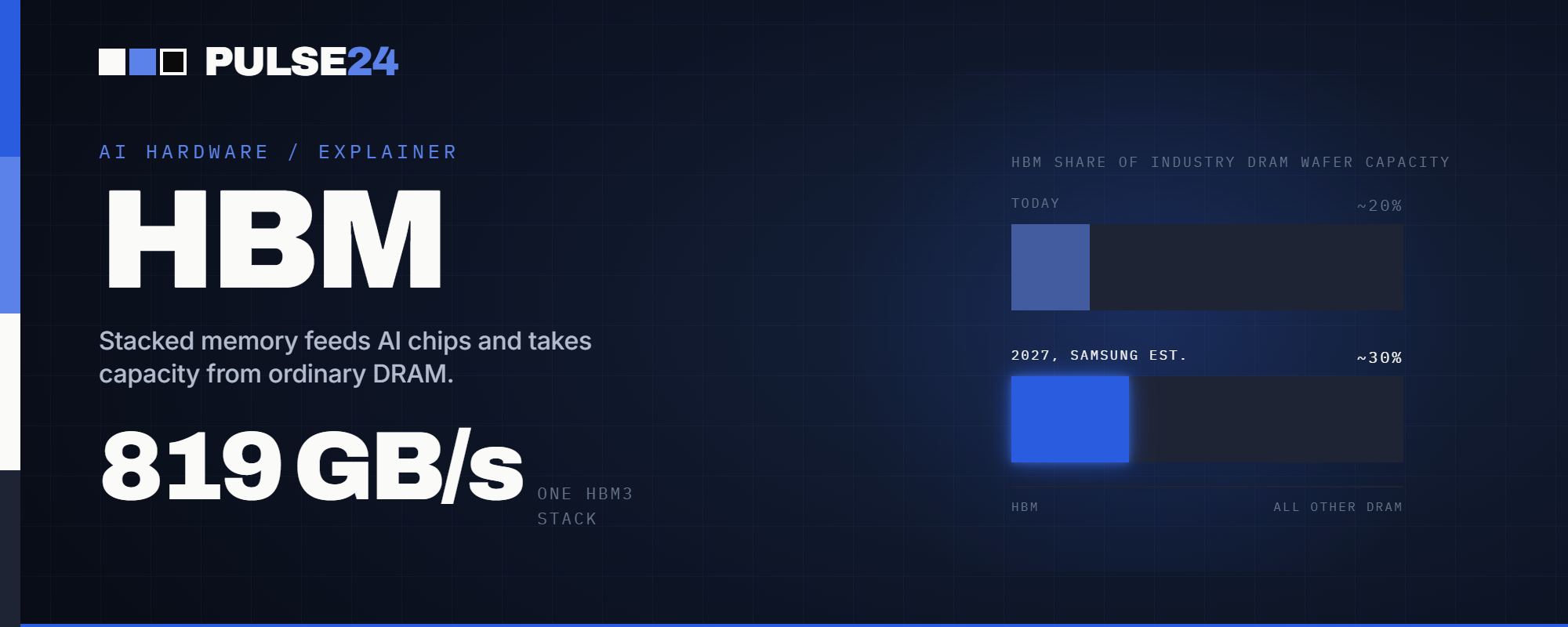
High bandwidth memory, or HBM, is the stacked chip technology behind many leading AI accelerators, and the AI industry's growing appetite for it is a major reason phone and laptop memory prices are under pressure in 2026. Memory makers have strong incentives to redirect production toward HBM's better margins, leaving less capacity for the ordinary DRAM that phones, laptops, and cars still need.
Many leading AI accelerators, from Nvidia's Blackwell GPUs to Intel's Gaudi chips, depend on a type of memory most people had never heard of until their phone got more expensive. High bandwidth memory, or HBM, is a central reason AI hardware got so capable so quickly, and the AI industry's growing appetite for memory is also contributing to higher prices and tighter supply for ordinary devices through 2026.
HBM is still DRAM underneath, arranged differently than the memory most devices use. Instead of placing memory chips flat on a circuit board next to the processor, HBM stacks multiple DRAM dies vertically, one on top of another, and connects them using through-silicon vias: tiny conductors etched straight through the silicon to link each layer. The whole stack then sits on a silicon interposer that bridges it directly to the processor, rather than routing data across a circuit board.
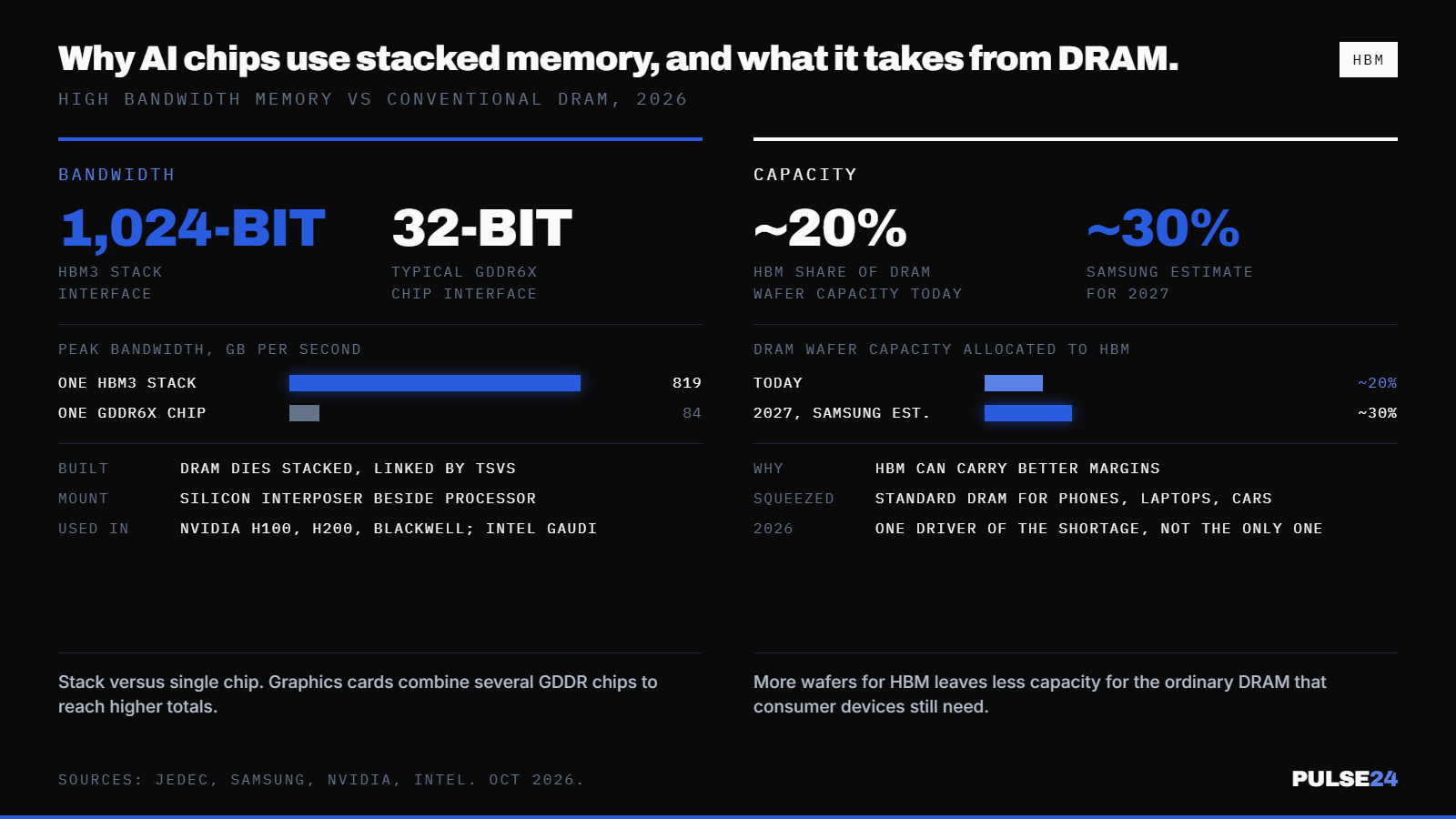
That construction gives a single HBM stack an enormous data path. A typical HBM3 stack combines a 1,024-bit interface with data rates that can deliver roughly 819 gigabytes per second. A single GDDR6X chip, the kind found in high-end gaming graphics cards, has a much narrower interface, often around 32 bits, and delivers closer to 84 gigabytes per second on its own. Graphics cards combine several GDDR chips in parallel to reach far higher totals, so that comparison is stack versus chip, not stack versus whole card. HBM's distinct advantage is packing a very wide memory interface into a short, direct connection right next to the processor, which helps reduce the energy required to move each bit of data, an important factor when accelerators are moving enormous volumes of information continuously.
Why AI Chips Need It
Training and running large AI models means moving enormous amounts of data in and out of memory constantly, and that movement, not raw computing power, is often what limits how fast a chip can work. A processor with plenty of computing cores but a narrow memory connection ends up waiting on data instead of crunching it. HBM's wide interface and proximity to the processor address exactly that bottleneck, which is why it's central to many leading data-center AI accelerators, including Nvidia's H100, H200, and Blackwell families and Intel's Gaudi chips, though not every AI accelerator relies on it; some use conventional DDR or GDDR memory instead.
Where the 2026 Shortage Comes From
HBM isn't just technically well suited to AI workloads. It can also deliver better margins than conventional DRAM, which gives manufacturers a strong incentive to allocate more production capacity to it. Samsung has said HBM could account for nearly 30% of industry DRAM wafer capacity by 2027, up from about 20% today, since HBM and standard DRAM compete for the same wafer capacity. That shift can constrain conventional DRAM supply even as demand for memory in servers, phones, and PCs keeps growing. Building new memory fabrication capacity takes years and enormous capital, so the supply response can't happen overnight, and HBM allocation is one major contributor to that squeeze, not the only one; demand from conventional servers, production constraints, and inventory decisions all play a part too.
The squeeze is already visible outside the data center. Industry researchers including IDC and Counterpoint have pointed to AI-driven memory demand as a factor pushing smartphone and PC memory costs higher heading into 2026, and Apple reportedly cut iPhone 18 Pro orders this cycle amid reporting that cited both rising memory costs and softer demand. Not every account lines up the same way; some point mainly to sales rather than component costs, a reminder that a single order cut rarely has one clean explanation.
The Pulse24 Take
HBM is a textbook example of a component most consumers will never see directly, yet it's one of the forces shaping which devices get expensive and which companies compete well in the AI hardware race. The shortage isn't the kind of bottleneck a single new factory fixes overnight, since adding meaningful capacity takes years, and the incentives point memory makers toward building more of that new capacity for HBM rather than for the ordinary memory sitting in next year's laptop. Expect phone and PC memory prices to stay under pressure for a while longer, even as the AI chips driving part of that pressure keep shipping in record numbers.
How we read the data
Curious how we get from raw data to a take like this? Our Trader's Toolkit walks through the tools we lean on.
Explore the Toolkit