Pulse24 Original
36% of the S&P 500's Q3 Earnings Growth Is Coming From Two Companies. Its Top 15 Stocks Are More Concentrated Than They Were at the 2000 Peak.
October 27, 2026
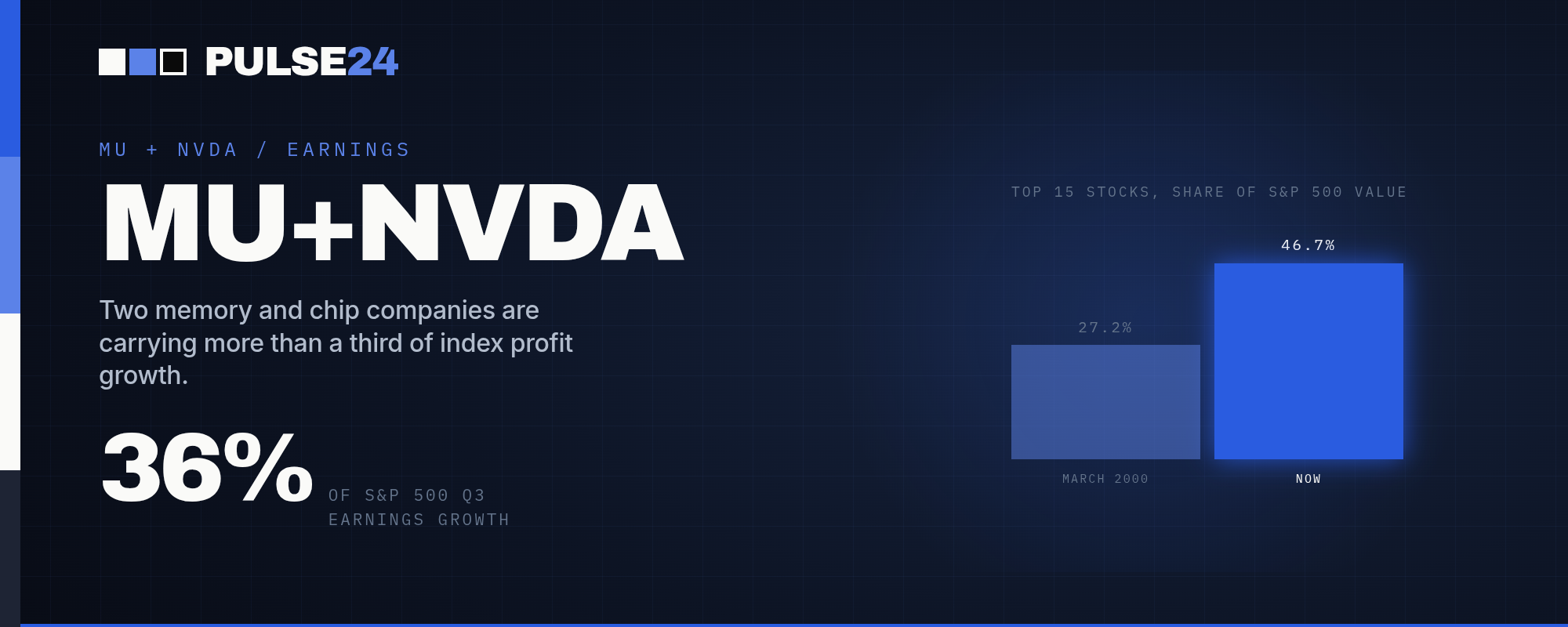
Micron and Nvidia are driving more than a third of the S&P 500's earnings growth this quarter, and the index's 15 largest stocks now hold a bigger share of its value than they did at the 2000 dot-com peak. That concentration cuts both ways for how fragile the rally really is.
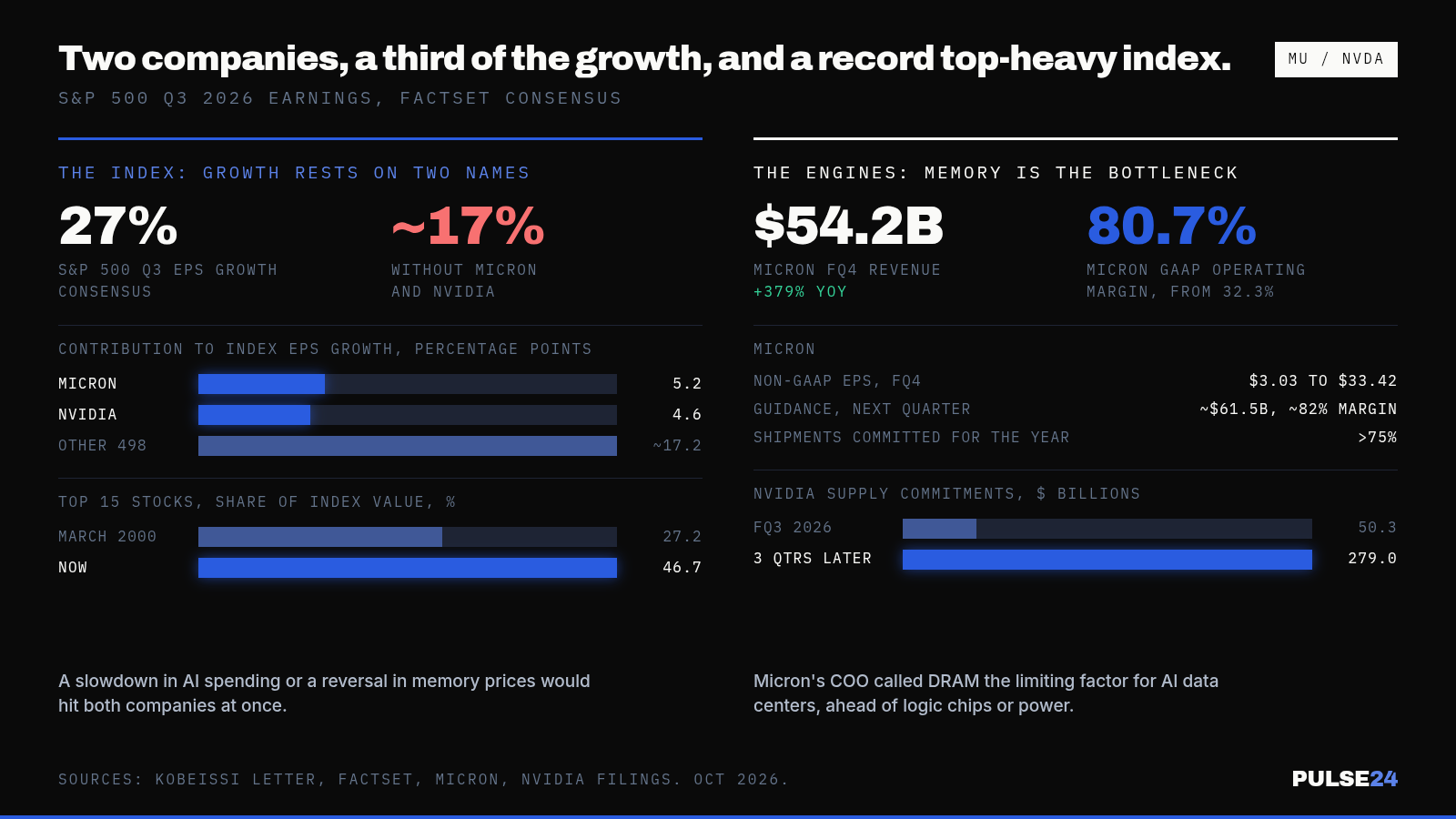
Thirty-six percent. That's the share of the S&P 500's entire year-over-year earnings growth this quarter that two companies, Micron and Nvidia, are projected to generate between them, according to data compiled by the Kobeissi Letter from FactSet consensus estimates. Analysts expect the index's overall earnings to grow about 27% from a year earlier. Micron alone is estimated to contribute 5.2 percentage points of that figure, Nvidia another 4.6. Pull both companies out of the math, and S&P 500 earnings growth this quarter falls from 27% to roughly 17%.
The Concentration Problem
This isn't happening in isolation. The 15 largest companies in the S&P 500 now hold 46.7% of the index's total market value, according to the same dataset. At the peak of the dot-com bubble in March 2000, that figure was 27.2%. Today's concentration is nearly double the prior extreme, a level that was already considered alarming back then.
The comparison has a real limit, and it's worth stating plainly. The leaders of 2000 were, in many cases, companies burning cash on a promise. Micron and Nvidia are generating actual profit, and growing it fast. But the underlying point still holds: a stumble at one or two of these companies would now hit both the index's valuation and its earnings growth at the same time, not just its share price.
Why Memory Is the Bottleneck
Micron's fiscal fourth quarter, which ended September 3 and was reported September 30, showed revenue of $54.2 billion, up 379% from a year earlier. Non-GAAP earnings per share came in at $33.42, versus $3.03 in the same quarter last year. The company's GAAP operating margin reached 80.7%, up from 32.3% a year earlier and 80.4% the quarter before. For the current quarter, Micron is guiding to an operating margin near 82% on roughly $61.5 billion in revenue. More than 75% of its shipments for the year are already spoken for.
Manish Bhatia, Micron's president and chief operating officer, put the constraint in blunt terms: DRAM, he said, is now the limiting factor for AI data centers, ahead of logic chips or power. That lines up with what Samsung and SK Hynix are seeing in their own earnings this week: the same memory squeeze is showing up across all three major DRAM makers at once, not just Micron.
Nvidia's numbers tell a similar story from the buyer's side. In its fiscal second quarter, which ended July 26, non-GAAP net income rose 118% year over year to $54.0 billion on revenue up 106%. Analysts expect next quarter's revenue to land near $108.98 billion, almost double the $57.0 billion Nvidia reported a year earlier. Results are expected in mid-November, though the exact date hasn't been confirmed.
What's notable is the cost side. Nvidia's non-GAAP gross margin has already climbed to 75% from 72.5% a year earlier, yet the company expects margins to dip back to between 71% and 72% next quarter, and it points to rising memory prices as the reason. Nvidia is both a major beneficiary of the AI buildout and, increasingly, exposed to the same memory shortage that's lifting Micron. Its supply commitments jumped from $50.3 billion in fiscal 2026's third quarter to $279.0 billion just three quarters later, a jump analysts attribute largely to memory purchases tied to its upcoming Vera Rubin platform, built around the same HBM memory supply chain Samsung and TSMC are racing to scale.
What to Watch Next
Two dates matter most from here. Nvidia's next earnings report, expected in mid-November, will show whether that $279 billion in supply commitments is translating into shipped revenue or just a bigger backlog. Micron's current quarter closes at the end of November, with results likely landing in mid-December. Consensus calls for $61.67 billion in revenue and $38.23 in non-GAAP earnings per share, which would be roughly eight times the non-GAAP earnings per share Micron posted in the same quarter a year earlier.
The risk, according to analysts tracking both stocks, runs in a few directions at once. Memory prices could turn, the way they have in past cycles. AI capital spending from the big cloud platforms could slow. A pullback in data center budgets at any of Nvidia's largest customers would show up in its numbers quickly, since so much of its near-term revenue already sits in a small number of massive contracts. Supply commitments, more than quarterly beats, are the number worth tracking, since they're the clearest signal of whether demand is still outrunning what the industry can build.
The Pulse24 Take
The dot-com comparison gets thrown around often these days, and most of the time it doesn't hold up well. This time it's at least worth taking seriously, not because history is repeating, but because the math is unusually exposed. When more than a third of an index's earnings growth and nearly half its market value sit with a small handful of companies, that index stops behaving like a diversified basket and starts behaving like a concentrated bet on two supply chains: AI compute and DRAM memory.
That's not automatically a bad trade. Micron and Nvidia are generating real, current profit, something most dot-com-era leaders never managed. But real profit doesn't erase concentration risk. It only changes its shape. The question for the rest of this earnings season isn't whether Micron and Nvidia can keep growing. It's whether anyone else in the index starts growing fast enough to matter, because right now the S&P 500's fortunes are riding on two chip stocks more than at any point since the market last learned that lesson the hard way.
How we read the data
Curious how we get from raw data to a take like this? Our Trader's Toolkit walks through the tools we lean on.
Explore the Toolkit