Pulse24 Original
Samsung Will Build Part of Nvidia's Next Memory Chip at TSMC. The Reported Reason Is a 40-Point Yield Gap.
October 19, 2026
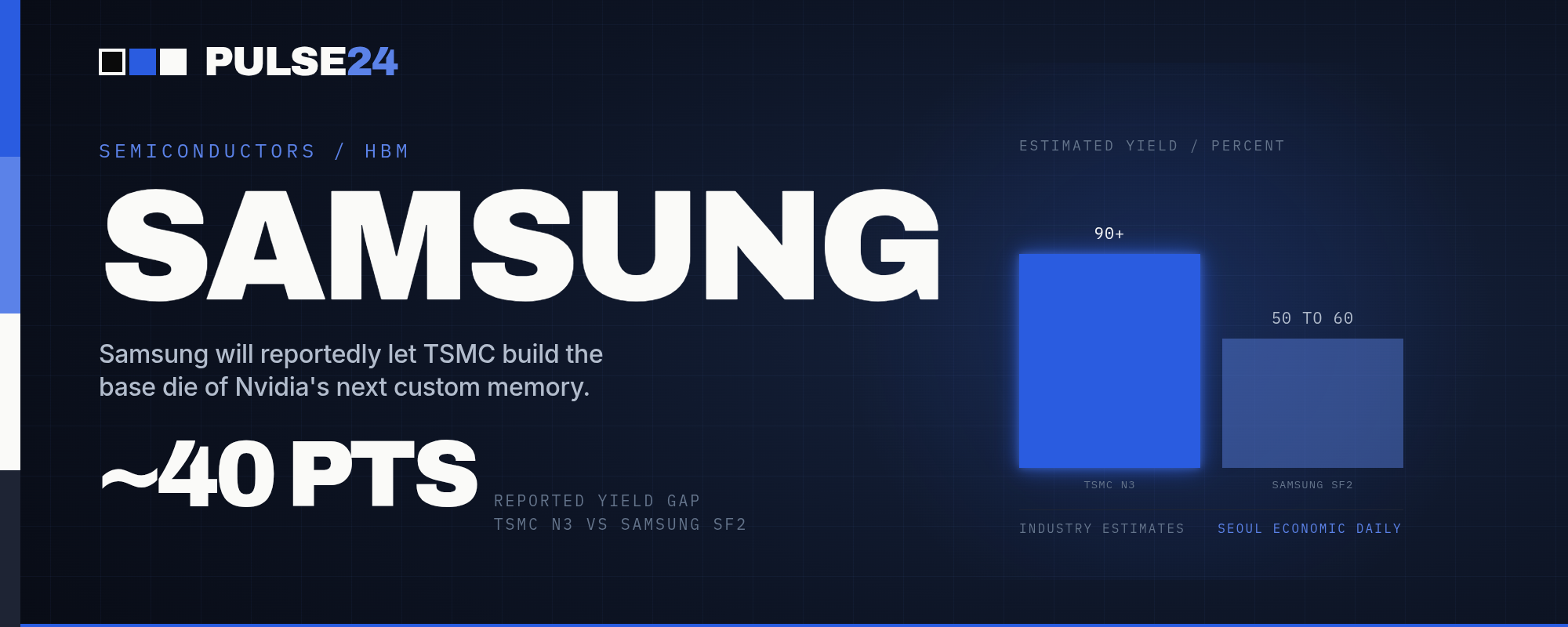
Samsung's foundry has reportedly agreed to let TSMC, its biggest rival, produce the base die for Nvidia's next custom HBM chips, after yield estimates showed TSMC's 3nm process beating Samsung's own by roughly 40 percentage points. It's a rare admission from a company that has always built its own memory from top to bottom.
Samsung's chip foundry, the division that has spent two decades building every layer of its own memory in-house, has reportedly agreed to let TSMC build part of Nvidia's next generation of custom HBM.
The report comes from Seoul Economic Daily on October 19 and says Nvidia asked Samsung, SK Hynix, and Micron to produce the base die for its new NVHBM memory on TSMC's 3-nanometer process. Samsung's Device Solutions division approved the request after an internal review, the report says. SK Hynix has little to adjust here, since it has built HBM4 base dies with TSMC under a partnership dating to 2024. Micron reportedly received the same instruction, though it's unclear so far how the company plans to respond.
What a Base Die Actually Does An HBM chip is a stack of DRAM dies sitting on top of one more layer, the base die, which handles communication between that memory stack and the processor it feeds. [What Is HBM? The Memory Chip Reshaping the AI Hardware Shortage, Explained](/article/what-is-hbm-high-bandwidth-memory-ai-chip-shortage-explained) covers how that stack became the bottleneck behind this year's AI chip shortage. NVHBM, which Nvidia announced on August 26, goes a step further: it moves part of the memory controller itself into the base die, which Nvidia says can lift bandwidth per stack by up to 30% over standard JEDEC HBM4E, cut power draw by 15%, and free up die area on the accelerator for compute instead of memory interfacing.
Amazon's Annapurna Labs is the first named partner, planning NVHBM support for its Trainium4 accelerator through Nvidia's NVLink Fusion. Nvidia's Feynman GPU platform, expected in 2028, is slated as the first full-scale deployment of the design.
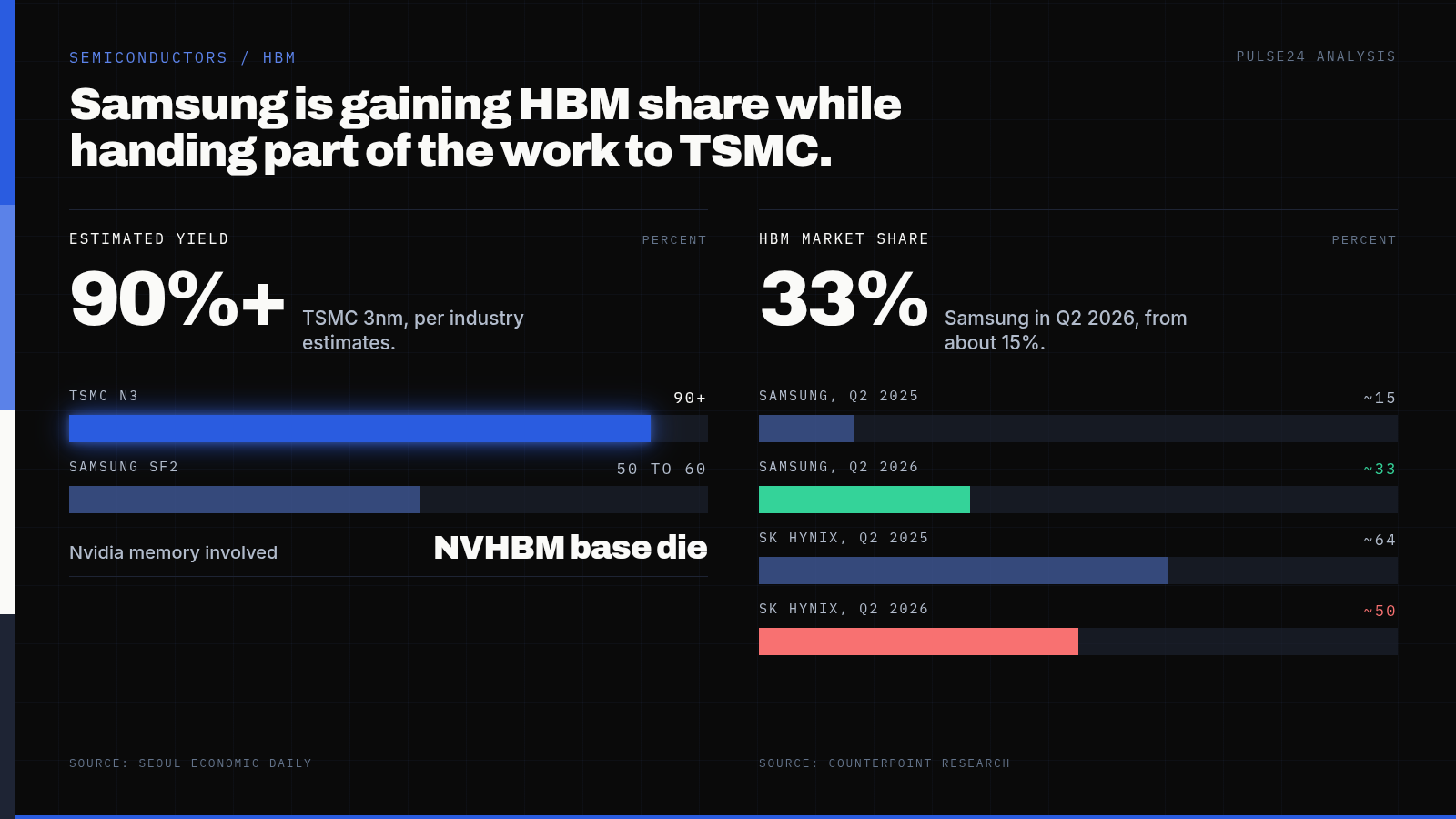
The Yield Math Behind the Decision Consistency is one reason Nvidia wants a single process for the base die: a chip that behaves the same no matter which supplier's memory sits on top of it needs far less separate validation work. Yield is the bigger one. TechInsights estimates put Samsung's SF2 gate-all-around process at roughly 50% to 60% yield, while Nvidia's own supplier brief, per the Seoul Economic Daily report, puts TSMC's N3 FinFET process above 90%. A base die that fails doesn't just waste itself. It wastes the expensive DRAM stacked on top of it, so a 40-point yield gap compounds fast across a product line built on scarce, costly memory.
Samsung isn't handing over everything. It keeps 4-nanometer base dies for its own standard HBM4 and HBM4E products, and turnkey production for other custom customers, including AMD, stays entirely in-house. Samsung is also reportedly validating NVHBM base dies on its own 2-nanometer process in parallel, a hedge in case TSMC's capacity can't keep up with demand from three memory makers at once.
A Rare Admission for Samsung Samsung has built its memory business on doing everything itself, from the DRAM to the packaging to the logic that ties it together. That's part of why [Samsung Posted a Record $80 Billion Profit Quarter Five Days Ago. Tuesday, Its Stock Fell 7.4% in a Single Session.](/article/samsung-sk-hynix-selloff-cxmt-chip-threat) landed as such a jarring swing for investors: the company's memory dominance has looked unshakeable and fragile in the same week more than once this year.
Zoom out, though, and Samsung's position in HBM overall has actually improved. Counterpoint Research puts Samsung's share of the HBM market at about 33% in Q2 2026, up from roughly 15% a year earlier, while SK Hynix, the long-time leader whose memory shortage windfall was detailed in Apple Cut iPhone 18 Pro Orders by Up to 20%. The Same Memory Shortage Built SK Hynix's $1 Trillion Valuation., slipped from about 64% to 50% over the same stretch. Handing TSMC the base die for one customer's custom part is a narrower concession than it might first appear, not a sign Samsung is losing the broader race.
What to Watch Next TSMC's 3-nanometer node made up about a third of its wafer revenue last quarter, and the company is already building another 3nm fab in Tainan. NVHBM base dies will now compete for the same wafer capacity as AI accelerators and flagship smartphone chips, three sources of demand converging on one process node. Analyst estimates for the HBM market vary, but JPMorgan puts it at roughly $160 billion in 2027 and $282 billion in 2028, so whoever controls that wafer capacity controls a meaningful chokepoint in AI hardware economics.
The sourcing decisions involved here are reportedly set to lock in sometime in 2027, a window that will show whether Samsung Foundry wins back this business or whether TSMC's role in Samsung's own memory products becomes a permanent fixture. Worth flagging: this account rests on a single Korean media report citing industry sources, and neither Nvidia nor Samsung has confirmed it publicly, so some details could still shift.
The Pulse24 Take The headline version of this story sounds like Samsung losing ground to TSMC. The more accurate version is a company choosing to lose a small, specific fight (whose factory stamps out one layer of one customer's chip) rather than risk a bigger one (whether its memory ships on time with acceptable yields). Nvidia forcing standardization onto its suppliers is the real thread here, and it's one that will keep showing up as AI memory gets more customized and more capacity-constrained. Watch where TSMC's 3-nanometer wafers get allocated over the next few quarters. That allocation is turning into one of the quieter chokepoints in the entire AI buildout.
How we read the data
Curious how we get from raw data to a take like this? Our Trader's Toolkit walks through the tools we lean on.
Explore the Toolkit